
Is 2026 a Good Time to Buy Pre-Construction in Ontario?
Updated 31 August 2026
If you’ve been thinking about buying a pre-construction home in Ontario, 2026 presents a very different market from the bidding-war years.
Buyers today are seeing something that was much harder to find during the peak of the market: more choice, competitive builder pricing, substantial incentives, extended deposit structures, available inventory homes and potentially significant new HST relief.
At the same time, Ontario’s housing market remains uncertain. Sales are below historical norms, new construction is slowing, and not every project or incentive represents good value.
So, is 2026 actually a good time to buy pre-construction in Ontario?
For the right buyer, property and price, 2026 may offer some of the strongest negotiating conditions and government incentives we’ve seen in years. But today’s market rewards buyers who compare pre-construction with resale, investigate the builder and project carefully, understand all closing costs, and have a solid financing plan.
Here’s what buyers need to know.
What Is Happening in Ontario’s Housing Market in 2026?
Ontario is still working through a significant housing-market adjustment.
CMHC’s Summer 2026 Housing Market Outlook expects housing activity to remain relatively weak in the near term. It forecasts continued pressure on prices and construction in 2026, followed by gradual improvement in 2027 and 2028.
The situation is particularly noticeable in the Greater Toronto Area.
CMHC expects Toronto resale transactions to improve from the 25-year low reached previously, but sales are still forecast to remain below historical averages. At the same time, Ontario housing starts are projected to fall near two-decade lows in 2026, driven largely by extremely weak condominium pre-construction sales.
That creates an unusual environment:
Today’s buyer may have considerable choice and negotiating leverage, while today’s construction slowdown could eventually mean fewer new homes entering the ownership market several years from now.
That does not guarantee future price appreciation. It does, however, make today’s supply-and-demand picture more complicated than simply saying, “The market is down.”
1. Buyers Have More Negotiating Power Than They Did During the Peak
One of the biggest differences in 2026 is who holds the leverage.
During stronger pre-construction markets, popular releases could sell quickly. Buyers sometimes had limited time to choose lots or floor plans and little ability to negotiate incentives.
Today’s market is different.
With fewer purchasers competing for many new-home opportunities, builders may need to work harder to secure qualified buyers.
Depending on the project and builder, buyers may encounter incentives such as:
Reduced or promotional pricing
Extended deposit structures
Décor or upgrade credits
Appliance packages
Mortgage-rate incentives
Capped development charges
Free or reduced assignment fees
Finished basement packages
Closing-cost credits
Lot-premium incentives
Flexible or extended closing dates
Not every builder offers these incentives, and their actual value varies considerably.
A “$50,000 incentive package,” for example, isn’t necessarily the same as receiving a $50,000 reduction in purchase price.
The important question isn’t how large the incentive sounds. It’s what the home will actually cost you compared with the alternatives.
2. Ontario’s New HST Relief Makes 2026 Particularly Interesting
One of the biggest changes for new-home buyers in 2026 has nothing to do with builder discounts.
It comes from government HST relief.
Ontario introduced a temporary Enhanced New Housing Rebate (ENHR) that can allow eligible purchasers to recover up to $80,000 of the 8% provincial portion of HST on qualifying new homes.
For a typical home purchased from a builder, the Ontario ENHR generally applies where the Agreement of Purchase and Sale is entered into between April 1, 2026 and March 31, 2027, provided the other eligibility conditions are satisfied.
Ontario has also introduced the Ontario New Home Affordability Payment (ONHAP), which can provide additional relief equivalent to as much as the 5% federal portion of HST for qualifying purchasers.
For an eligible new home valued at up to $1 million, combined relief can therefore potentially reach:
Up to $130,000
Ontario’s enhanced provincial rebate provides up to $80,000, while the additional relief associated with the 5% portion can provide up to $50,000, subject to eligibility.
Importantly, Ontario’s temporary enhanced program isn’t limited exclusively to first-time buyers.
First-time buyers may also have access to the federal First-Time Home Buyers’ GST/HST Rebate, which can recover up to $50,000 of the federal portion on an eligible new home.
For the federal first-time-buyer program:
Eligible new homes valued at $1 million or less can receive up to 100% of the federal GST portion, to a maximum of $50,000.
The rebate is gradually reduced between $1 million and $1.5 million.
It is eliminated at $1.5 million or more.
The federal program generally applies to qualifying builder agreements entered into on or after March 20, 2025 and before 2031.
Why this matters
For someone already considering a brand-new home, these programs can materially change the numbers.
But “up to $130,000” should never be treated as an automatic discount.
Eligibility depends on the transaction, purchase price, occupancy intentions, dates and other conditions. Your lawyer and, where appropriate, tax professional should confirm your eligibility before you rely on any rebate.
3. Interest Rates Are Lower Than They Were at the Recent Peak
Financing conditions are another reason some buyers are reconsidering the market.
As of the Bank of Canada’s latest decision on July 15, 2026, the overnight policy rate stands at:
2.25%
For comparison, the policy rate reached 5% in 2023 and remained there into 2024.
Lower rates don’t automatically make housing affordable, and the Bank of Canada’s policy rate is not the same thing as the mortgage rate a buyer receives.
But financing conditions are less restrictive than they were at the peak of the tightening cycle.
CMHC also notes that less burdensome mortgage rates have increased borrowing capacity and could encourage some previously sidelined GTA buyers back into the market.
The next Bank of Canada interest-rate announcement is scheduled for September 2, 2026.
4. Resale Prices Have Also Come Down – So You Need to Compare
This is one of the most important considerations in today’s market.
Pre-construction isn’t competing in isolation.
It’s competing with resale.
According to the Toronto Regional Real Estate Board, the GTA’s average resale selling price in July 2026 was approximately:
$1,003,956
That was 4.5% lower than July 2025.
The MLS® Home Price Index Composite benchmark was also down 4.6% year-over-year.
At the same time, market conditions began tightening during the summer. July sales increased month-over-month on a seasonally adjusted basis while new listings declined, suggesting some of the negotiating advantage enjoyed by buyers could narrow if that trend continues.
This means buyers shouldn’t assume:
New = better deal
or
Resale = better deal.
Instead, compare the actual numbers.
For example, suppose you are comparing:
Resale home: $900,000
versus
New construction home: $950,000
At first glance, resale appears $50,000 cheaper.
But what if the new home includes:
Significant HST relief for which you qualify
Brand-new appliances
New mechanical systems
Tarion warranty coverage
No immediate renovation requirement
Builder upgrades
A favourable deposit structure
A later closing that gives you additional time to save
The comparison becomes more complicated.
The reverse can also happen. A heavily discounted resale property may be significantly better value than a nearby pre-construction home.
In 2026, buyers should compare both markets before making a decision.
5. Inventory Homes Can Be Particularly Interesting
When people hear “pre-construction,” they often imagine buying a floor plan and waiting three or four years.
That’s no longer the only option.
Some builders have:
Completed homes
Quick-closing homes
Homes already under construction
Cancelled inventory
Previously reserved lots returned to inventory
These are commonly referred to as inventory homes or quick-closing homes.
They can offer an interesting middle ground between resale and traditional pre-construction.
You may get:
The benefits of a brand-new home + a much shorter closing timeline.
And because a builder may want to move completed or near-completed inventory, there can sometimes be stronger incentives.
The trade-off is that you may have less choice over finishes, structural options, lot selection or floor-plan modifications.
6. Lower or Extended Deposits Can Make Buying More Manageable
Traditional pre-construction purchases can require substantial deposits, often paid in stages.
However, deposit structures vary considerably by builder and project.
In today’s competitive market, some builders are using extended or reduced deposit structures to attract buyers.
Instead of requiring a large percentage within the first few months, a builder may spread payments over a longer period.
That can be valuable for buyers who have strong income but need additional time to accumulate their full down payment.
But there is an important distinction:
Your builder deposit is not necessarily the same as your mortgage down payment.
You still need to qualify for financing and have sufficient funds available at closing.
Never choose a property simply because the initial deposit is low.
7. New Homes Come With Tarion Warranty Protection
Another factor when comparing new construction with an older resale property is warranty coverage.
Eligible newly built Ontario homes come with statutory warranty protection.
For Agreements of Purchase and Sale signed on or after July 1, 2023, Tarion states that maximum statutory warranty coverage is:
Up to $400,000 for freehold homes
Up to $300,000 for condominium units
Warranty coverage extends through different periods and can address specified construction defects and major structural issues.
There is also pre-possession protection.
For freehold homes purchased for more than $600,000, Tarion’s current deposit protection can cover 10% of the purchase price up to $100,000.
Condominium deposits receive protection through the trust requirements of Ontario’s Condominium Act, with additional Tarion deposit protection of up to $20,000 in specified circumstances.
Tarion also introduced a registration requirement in 2026 for purchasers of freehold homes. Buyers should register their purchase with Tarion within 45 days of signing the Agreement of Purchase and Sale. Tarion has announced a transition period affecting how the new deposit-coverage rules will apply.
8. Buying Before Construction Can Give You More Time
A longer closing isn’t right for everyone.
But for some buyers, it can be an advantage.
Imagine buying a home scheduled to close in 2028.
Rather than needing your entire down payment immediately, you may have additional time to:
Save money
Increase income
Reduce other debt
Improve credit
Prepare your existing home for sale
Plan for closing costs
This can be particularly useful for younger buyers and families planning their next move.
However, there is an important risk:
You still need to qualify for your mortgage when the home closes.
Nobody knows exactly where mortgage rates, lending rules, employment conditions or property values will be several years from now.
That’s why buyers should avoid purchasing at the absolute maximum of what they believe they can afford today.
What Are the Risks of Buying Pre-Construction in 2026?
The opportunities are real.
So are the risks.
A balanced buying decision should consider both.
Construction Delays
Your anticipated closing date may change.
Buyers need to understand the difference between tentative occupancy or closing dates, firm dates and outside dates in their Agreement of Purchase and Sale and Tarion addendum.
Project Cancellation Risk
The weakness in pre-construction sales is significant.
CMHC reports that many condominium projects have been delayed or cancelled because financing thresholds are becoming harder to achieve.
That makes builder reputation, project status and sales progress especially important in today’s market.
Mortgage Qualification Risk
A mortgage pre-approval today doesn’t guarantee financing several years from now.
Your income, debt, credit, mortgage rates, lender requirements and property appraisal can all change.
Appraisal Risk
If the property is worth less than your contract price when it closes, your lender may base financing on the lower appraised value.
You could potentially need additional cash to close.
Closing Costs
The purchase price isn’t your total cost.
Depending on the property and agreement, buyers may face expenses such as:
Land transfer tax
Legal fees
Development-charge adjustments
Utility connection charges
Tarion-related charges
Builder adjustments
Occupancy fees for some condominiums
HST amounts where applicable
Your lawyer should review the Agreement of Purchase and Sale before you proceed.
Lack of Liquidity
Pre-construction deposits can tie up a substantial amount of capital for years.
Don’t commit funds that you expect to need for emergencies or other major financial obligations.
So, Is 2026 a Buyer’s Market for Pre-Construction?
In many parts of Ontario, buyers have considerably more leverage than they did during the market peak.
But “buyer’s market” doesn’t mean “buy anything.”
It means buyers can afford to be selective.
This is arguably the most important difference.
Instead of asking:
“Can I get an allocation?”
buyers can increasingly ask:
“Is this actually the best opportunity available for my money?”
That shift matters.
Who Could Benefit Most From Buying in 2026?
Pre-construction may deserve serious consideration if you:
Are planning to hold the home long term
Short-term speculation is considerably riskier in an uncertain market.
Don’t need to move immediately
A longer closing can give you time to save and prepare financially.
Have stable income and a financial cushion
You should be able to handle unexpected closing costs or financing changes.
Find a project priced competitively against resale
This is critical.
Can benefit from current HST programs
For eligible buyers, the 2026 rebate changes can materially affect affordability.
Value a new home and warranty coverage
Some buyers simply prefer new construction, modern layouts, energy efficiency and fewer immediate renovation requirements.
Can secure meaningful builder incentives
In today’s market, the incentive package can sometimes materially improve the economics of the purchase.
Who Should Be More Cautious?
Pre-construction may not be the right choice if:
You need certainty about your move-in date
Your employment or income is unstable
You’re stretching your finances to qualify
You’re relying on rapid appreciation to make the investment work
You may need your deposit money back before closing
You’re assuming you’ll automatically be able to assign the property
You’re buying primarily because of a flashy incentive
A comparable resale home offers significantly better value
Sometimes the right decision is pre-construction.
Sometimes it’s resale.
And sometimes the right decision is to wait.
How to Evaluate a Pre-Construction Opportunity in 2026
Before buying, look beyond the advertised starting price.
Compare:
1. Actual purchase price
Include lot premiums and upgrades you’re likely to need.
2. Builder incentives
Determine their real dollar value.
3. HST eligibility
Find out which rebates may actually apply to you.
4. Deposit structure
Understand exactly when every payment is due.
5. Closing costs
Have the APS reviewed by a real-estate lawyer.
6. Comparable resale homes
See what the same budget buys today.
7. Builder reputation
Research the builder’s track record and licensing.
8. Project status
Understand whether you’re buying into an established construction project or an early-stage launch.
9. Location and future development
Consider transportation, schools, employment, amenities and planned infrastructure.
10. Your exit strategy
What happens if your circumstances change before closing?
Should You Buy Now or Wait?
There is no universal answer.
Waiting could mean:
Prices decline further
Better opportunities emerge
Your financial position improves
But waiting could also mean:
Today’s incentives disappear
The temporary Ontario HST enhancement expires for new agreements
Inventory is absorbed
Prices stabilize
Competition increases
The home or lot you wanted is no longer available
Ontario’s Enhanced New Housing Rebate has a particularly important timing component: for a typical builder purchase, the qualifying Agreement of Purchase and Sale generally must be entered into between April 1, 2026 and March 31, 2027.
Meanwhile, CMHC expects Ontario housing-market conditions to improve gradually in 2027 and 2028 after a weak 2026.
No one can reliably identify the exact bottom of a housing cycle.
For most genuine home buyers, the more useful question is:
“Can I buy the right home, at the right price, on terms I can comfortably afford?”
If the answer is yes, waiting solely to perfectly time the market may not be necessary.
The Bottom Line: Is 2026 a Good Time to Buy Pre-Construction?
For qualified, financially prepared buyers who are willing to research and compare opportunities carefully, 2026 can be a compelling time to consider a pre-construction or inventory home in Ontario.
The combination of:
More buyer choice
Builder incentives
Negotiating opportunities
Extended deposit structures
Quick-closing inventory
Lower borrowing costs compared with the recent peak
New federal and Ontario HST relief
Less competition than during the market peak
creates opportunities that didn’t exist in the same way several years ago.
But the strategy for 2026 should not be:
“Buy pre-construction because prices will go up.”
It should be:
“Buy when the property, price, incentives, location, financing and long-term plan make sense together.”
That’s a much stronger foundation for making one of the largest financial decisions of your life.
Looking for the Right New-Home Opportunity in Ontario?
Today’s market isn’t about chasing every project launch.
It’s about comparing the right opportunities.
At New Home Source, we help buyers explore pre-construction, new-construction and inventory-home opportunities across Ontario and compare current builder pricing, incentives, deposit structures, available lots, closing timelines and other important purchase considerations.
Whether you’re looking for a townhome, semi-detached or detached home, our goal is to help you understand the numbers and identify opportunities that fit your needs and budget.
Thinking about buying a new home in 2026? Contact New Home Source to explore current opportunities and builder incentives available across Ontario.
Frequently Asked Questions
Is pre-construction cheaper than resale in Ontario in 2026?
Sometimes, but not always. Builder incentives, HST relief and promotional pricing can make certain new homes competitive with resale properties. However, resale inventory is also relatively high in parts of Ontario. Buyers should compare actual properties and total costs rather than assuming one category is automatically cheaper.
Can I negotiate with a builder in 2026?
It depends on the builder and project. Some builders maintain fixed prices but offer incentives, upgrades, deposit flexibility or other benefits. Inventory and quick-closing homes may sometimes offer additional opportunities. Your Realtor can investigate what is currently available.
Can I receive up to $130,000 in HST relief?
Potentially. Ontario’s temporary enhanced measures can provide qualifying buyers with combined relief of up to $130,000 on eligible new homes, subject to the applicable conditions. The amount is not automatic, and buyers should obtain legal or tax advice regarding their individual eligibility.
Do I need 20% down for pre-construction?
Not necessarily. Builder deposit requirements and mortgage down-payment requirements are separate issues. Deposit structures vary by project, and your eventual mortgage requirements depend on the purchase price, mortgage type and lending rules applicable when you close.
Is it risky to buy a pre-construction home right now?
Pre-construction always carries risks, including construction delays, financing changes, appraisal risk, project cancellation and unexpected closing costs. Current market weakness makes project and builder due diligence particularly important.
Is an inventory home safer than buying at a new project launch?
An inventory home may offer greater certainty because construction is further advanced or complete, but every transaction is different. Inventory homes may offer shorter closings and less construction uncertainty, while an early-stage purchase may provide more selection and additional time to save.
Will Ontario home prices increase in 2027?
No one can guarantee future prices. CMHC currently expects Ontario market conditions to improve gradually in 2027 and 2028, but economic conditions, interest rates, employment, population growth and housing supply can change those forecasts.
Disclaimer: This article is for general informational purposes only and does not constitute legal, tax, mortgage, investment or financial advice. Real-estate market conditions, builder incentives, mortgage rates and government programs can change. HST rebate eligibility depends on the specific purchaser and transaction. Buyers should obtain independent legal advice regarding an Agreement of Purchase and Sale and appropriate professional advice regarding financing and tax matters before making a purchase decision.
You Might Also Like
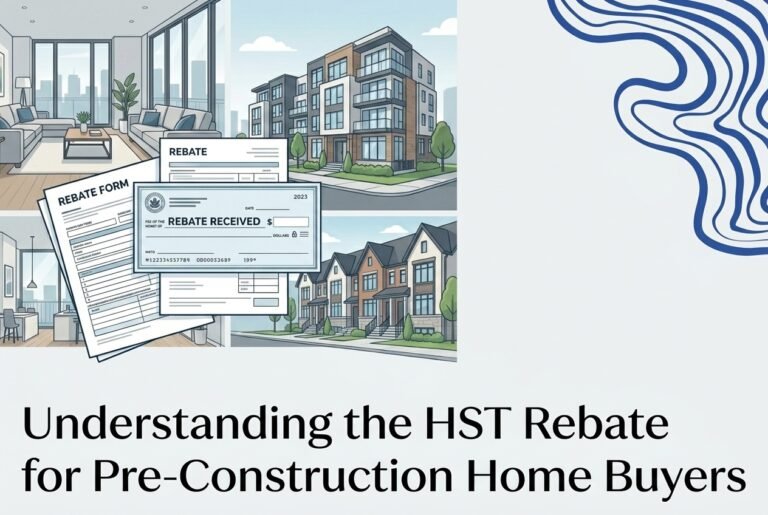
Understanding the HST Rebate for Pre-Construction Home Buyers in Ontario: 2026 Guide Updated August 20, 2026 Buying a pre-construction home...

Smart Real Estate Investments: Choosing the Right Home Type for Maximum Returns Real estate investment offers an exciting opportunity to...

Top Pre-Construction Markets in Ontario: A Smart Investment Guide Investing in pre-construction projects offers significant benefits for homebuyers and investors,...