
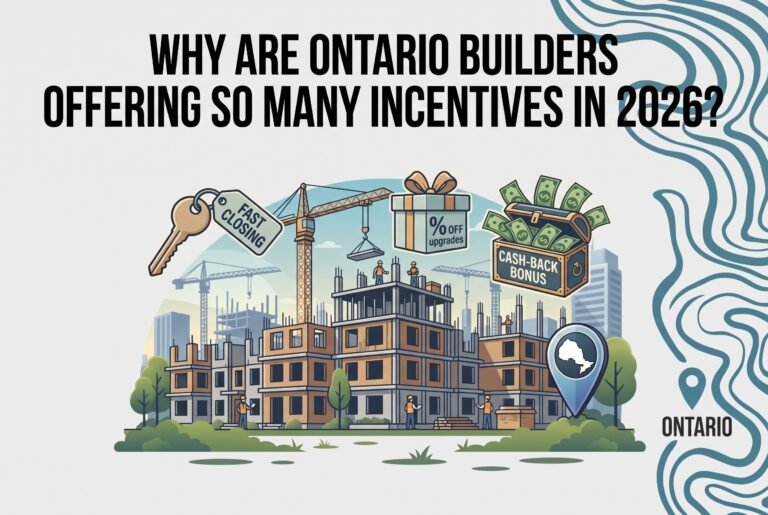
Why Are Ontario Builders Offering So Many Incentives in 2026?
Updated October 30, 2026
If you’ve been shopping for a new home in Ontario lately, you’ve probably noticed something unusual.
Builders are advertising offers such as:
$50,000 or $100,000 in incentives
Reduced prices
Extended deposits
Mortgage-rate promotions
Free upgrades
Finished basements
Appliances included
Capped development charges
Free assignments
Lot-premium discounts
Closing credits
A few years ago, many popular new-home releases sold with far fewer incentives.
So what changed?
Why are Ontario builders offering so much in 2026?
The short answer is:
The market has shifted in favour of buyers.
Pre-construction sales have slowed substantially, financing new developments has become more challenging, construction costs remain high, and builders in some communities are carrying completed or unsold inventory.
Rather than simply cutting prices across an entire community, builders can use incentives to encourage qualified buyers to purchase.
For buyers, this can create opportunities.
But understanding why the incentives exist is just as important as understanding what they’re worth.
Ontario’s New-Home Market Has Changed
During the strongest years of Ontario’s pre-construction market, demand could exceed available supply.
Buyers sometimes competed for:
Units
Lots
Allocations
Floor plans
Premium locations
Builders had little reason to offer large incentives when buyers were already lining up to purchase.
Today’s environment is different.
Ontario’s housing market has slowed, particularly in certain pre-construction segments.
Condominium pre-sales have been especially weak, while builders are also dealing with high construction and financing costs.
The result?
Builders need qualified buyers more than they did during the peak market.
And that changes the negotiating environment.
1. Pre-Construction Sales Have Slowed
This is probably the biggest reason incentives have increased.
Developers don’t build large communities purely on speculation.
Pre-construction sales help builders demonstrate demand and support project financing.
When sales slow, builders may need to encourage more purchasers to commit.
Rather than simply waiting for buyers, they may offer:
Better deposits
Better incentives
Better pricing
Better closing terms
The objective is straightforward:
Make the purchase more attractive.
2. Builders Need Sales to Move Projects Forward
Pre-construction sales can be an important part of securing and maintaining development financing.
A large project may require substantial capital for:
Land
Construction
Labour
Materials
Municipal requirements
Infrastructure
Marketing
Financing
Lenders and project partners want evidence that buyers actually want the homes being built.
That means sales matter long before purchasers receive their keys.
If a project needs additional sales momentum, attractive incentives can help generate it.
3. Builders May Prefer Incentives Over Large Public Price Cuts
This is one of the most important things buyers should understand.
Suppose a builder has already sold 100 homes at:
$900,000
and still has 20 homes available.
The builder could reduce the new price to:
$800,000.
But doing that may create problems.
Earlier buyers may immediately ask:
“Why did I pay $900,000?”
A much lower recorded sale price could also potentially affect:
Comparable values
Future releases
Appraisals
Existing purchasers
Project positioning
Financing
Instead, the builder may keep the official price near:
$900,000
but offer:
$25,000 décor credit
Finished basement
Appliances
Mortgage incentive
Development-charge cap
Extended deposits
The effective deal gets better without necessarily reducing the headline price dramatically.
This is one reason today’s builder incentives can look unusually generous.
4. Unsold Inventory Costs Builders Money
Imagine a builder has already constructed a home.
The builder has paid for:
Land
Labour
Lumber
Concrete
Electrical
Plumbing
Roofing
Financing
Municipal costs
Marketing
But the home remains unsold.
That property represents capital tied up in inventory.
Depending on the situation, the builder may also continue carrying financing and other costs while the property remains unsold.
That can create motivation to sell.
This is why inventory and quick-closing homes can sometimes offer particularly attractive opportunities.
5. Completed Inventory Can Create Stronger Negotiating Opportunities
Consider two properties from the same builder.
Home A
Closing in 2029.
Construction hasn’t started.
Home B
Completed and sitting empty.
Which home might the builder be more motivated to sell?
Potentially:
Home B.
The builder has already invested the construction capital.
A qualified buyer capable of closing quickly may therefore be valuable.
Possible incentives could include:
Price reduction
Appliances
Finished basement
Free upgrades
Lot-premium reduction
Closing credit
Flexible closing date
This doesn’t mean every inventory home is negotiable.
But buyers should always ask what is available.
6. Construction Is Still Expensive
If builders need buyers, why don’t they simply reduce home prices dramatically?
Because building a home remains expensive.
Builders still face costs involving:
Land
Labour
Materials
Financing
Development charges
Municipal fees
Infrastructure
Insurance
Marketing
Taxes
Construction costs have not simply returned to where they were before the pandemic.
This limits how aggressively some builders can reduce base prices.
As a result, an incentive package may sometimes make more financial sense for the builder than a large permanent price cut.
7. Builders Are Competing With the Resale Market
Builders aren’t only competing with other builders.
They are competing with:
Resale homes.
Suppose a buyer has:
$800,000.
They may be comparing:
Option A
Brand-new townhome from a builder
Option B
Five-year-old resale townhome
Option C
Ten-year-old semi-detached home
If resale prices decline, builders need to make their homes more competitive.
They can do that through:
Lower pricing
Better deposits
HST advantages
Mortgage incentives
Upgrades
Warranty
Finished basements
Today’s buyer has alternatives.
Builders know that.
8. Buyers Have More Negotiating Power
When supply exceeds immediate buyer demand, purchasers gain leverage.
That doesn’t necessarily mean every builder will negotiate the purchase price.
But buyers may have greater ability to ask about:
Better deposits
Lot premiums
Closing dates
Upgrade credits
Appliances
Assignment fees
Development charges
Mortgage incentives
During a highly competitive launch, a buyer may simply ask:
“Can I get the home?”
In today’s market, the better question may be:
“What is the best package available on this home?”
That’s a significant shift.
9. Extended Deposits Help Builders Overcome an Affordability Problem
Many buyers have enough income to eventually purchase a home.
Their immediate challenge is:
Cash.
Suppose a builder requires 10% on an:
$800,000 home.
Total deposit:
$80,000.
Compare:
Deposit Program A
$80,000 required within 90 days.
versus:
Deposit Program B
$80,000 spread over 18 months.
The total amount is identical.
But Program B may be much easier for the buyer.
This allows builders to improve affordability without reducing the home’s sale price.
10. Lower Deposits Can Attract More Buyers
Some projects may offer total deposits such as:
5%
8%
10%
rather than higher traditional structures.
This can preserve substantial buyer liquidity.
For an:
$800,000 home
a 20% deposit would be:
$160,000.
A 10% deposit would be:
$80,000.
That’s an $80,000 difference in cash tied up during the construction period.
However, buyers need to remember:
Builder deposit requirements and mortgage down-payment requirements are different.
A low builder deposit doesn’t automatically mean the buyer will need only that amount to complete the purchase.
11. Mortgage Incentives Can Help Builders Without Cutting Prices
Mortgage promotions are another strategy.
A builder may advertise:
Promotional mortgage rate
Rate buydown
Mortgage payment support
Closing credit toward financing
Why?
Because buyers often make decisions based on:
Monthly payment.
Suppose a buyer likes an $850,000 home but feels the monthly mortgage is too high.
A temporary builder-funded mortgage incentive could make the payment more manageable.
That can help complete the sale without reducing the official purchase price by the same amount.
12. Government HST Relief Makes New Homes More Competitive
The 2026 HST changes are another factor.
Qualifying buyers of new homes may now receive substantial federal and Ontario HST relief.
For eligible transactions, potential savings can be significant.
This isn’t technically a builder incentive.
It is:
Government relief.
That distinction matters.
A builder may advertise:
“Save up to $130,000.”
But buyers need to determine how much of the advertised savings actually comes from:
Builder-funded incentives
versus
Government-funded rebates.
Don’t give the builder credit for a government program when comparing two projects.
Calculate them separately.
13. Builders Use Upgrade Credits Because Their Cost Isn’t Necessarily the Retail Value
Suppose a builder offers:
$30,000 décor credit.
To the buyer, that means:
$30,000 of builder upgrade purchasing power.
But the builder’s actual internal cost of providing those upgrades may be less than $30,000.
That can make décor credits an effective marketing tool.
The buyer receives something valuable.
The builder preserves the headline sale price.
That’s why upgrade packages are so common.
14. Finished Basements Can Be a Powerful Incentive
A finished basement is especially attractive to families buying:
Townhomes
Semi-detached homes
Detached homes
It can add:
Recreation space
Bedroom
Bathroom
Home office
Multi-generational space
Builders may use a finished-basement package because buyers immediately understand its usefulness.
But ask exactly what’s included.
A:
“Finished Basement”
does not automatically mean:
“Legal Rental Apartment.”
Those are very different things.
15. Capped Development Charges Reduce Buyer Uncertainty
This can be one of the most financially valuable incentives.
A builder APS may allow certain development-related costs to be passed to the purchaser.
Because pre-construction can take several years, those amounts may change before closing.
A cap creates greater certainty.
For example:
Uncapped agreement
Future adjustment:
Unknown.
Capped agreement
Maximum purchaser exposure:
$10,000.
The buyer now has a clearer idea of the maximum cost.
That’s valuable even though no money is being handed to the buyer today.
16. Free Assignment Can Help Overcome Buyer Fear
One of the concerns buyers have about pre-construction is:
“What happens if my life changes before closing?”
Maybe they:
Move
Change jobs
Get married
Separate
Have children
Experience financial changes
Assignment rights can offer flexibility.
A builder may therefore offer:
Free Assignment.
But that usually doesn’t mean:
Do whatever you want with the contract.
Builder consent, restrictions, documentation and tax considerations can still apply.
The incentive is valuable.
Just understand what it actually provides.
17. Builders May Discount Certain Lots Before Others
Not every property in a project has equal demand.
A buyer may strongly prefer:
Ravine lot
Corner lot
Deep lot
Walkout lot
But the builder may have slower-selling:
Interior lots
Certain elevations
Particular floor plans
Homes near traffic
Lots with specific orientations
Instead of reducing the entire community’s prices, builders may create incentives for specific inventory.
This can generate some of the strongest deals.
But only if the lot still works for you.
Don’t buy an undesirable location simply because the discount is large.
18. Builders May Offer Incentives Near Fiscal or Sales Milestones
Like many businesses, builders have:
Sales targets
Release targets
Construction milestones
Inventory objectives
At certain points, securing additional firm sales may be particularly useful.
This can sometimes create short-term promotional opportunities.
However, buyers should never assume:
“This weekend only!”
automatically means the offer can never return.
Promotions can legitimately expire.
But don’t allow urgency to replace due diligence.
19. Some Incentives Are Better Than Others
Imagine two builders.
Builder A
Offers:
$50,000 décor credit.
Builder B
Offers:
$25,000 direct price reduction.
Which is better?
It depends.
If you planned to spend $50,000 at the décor centre anyway, Builder A may be attractive.
If you need very few upgrades, Builder B’s smaller price reduction may provide greater financial value.
This is why incentive packages need to be converted into:
Real value to you.
20. The Biggest Incentive Isn’t Necessarily the Best Deal
Suppose:
Project A
Price:
$900,000
Advertised incentives:
$100,000
Project B
Price:
$825,000
Advertised incentives:
$25,000
Most buyers immediately notice Project A’s:
“$100,000 SAVINGS!”
But if the $100,000 consists largely of:
Décor credits
Appliances
Assignment rights
Marketing-valued upgrades
Project B could still cost less overall.
Always calculate the effective cost.
How to Calculate the Real Deal
Use this simple approach.
Start with:
Builder Purchase Price
Subtract:
Actual Price Discount
Then subtract:
Builder Incentives You Would Personally Pay For
Then separately account for:
Government Rebates You Qualify For
Then add:
Builder Closing Adjustments
and:
Additional Upgrades You Still Need
That gives you something much closer to:
Effective Acquisition Cost.
Compare that number with:
Another builder
Inventory homes
Resale homes
That’s how you identify real value.
Example: Builder A vs Builder B
Imagine you’re looking at two townhomes.
Builder A
Purchase price:
$800,000
Includes:
$20,000 décor
Appliances
10% deposit over 12 months
Development charges:
Uncapped.
Builder B
Purchase price:
$820,000
Builder discount:
$20,000
Effective starting price:
$800,000
Includes:
Finished basement
Capped development charges
Appliances
10% deposit over 18 months
At first glance:
Builder A looked cheaper.
After examining the actual package:
Builder B may provide significantly greater value.
This is why the advertised starting price is only the beginning of the comparison.
Are Builders Desperate?
This is a question buyers sometimes ask when they see large incentives.
The answer shouldn’t be generalized.
Some projects may need sales.
Some builders may be clearing inventory.
Some promotions may simply be part of normal marketing.
Some builders may have strong balance sheets and simply prefer to improve sales velocity.
A large incentive doesn’t automatically mean:
“The builder is in trouble.”
But today’s slower new-home market does mean buyers should conduct more project and builder due diligence.
Research:
Builder licensing
Completed communities
Construction status
Project history
Sales progress where available
Look at the complete picture.
Could Today’s Construction Slowdown Matter Later?
Potentially.
Builders are responding to weak pre-construction sales by reducing or delaying new construction.
That means fewer ownership-oriented homes may enter the market several years from now than previously expected.
Does that guarantee prices will rise?
No.
Housing values depend on many factors:
Interest rates
Employment
Immigration
Population growth
Economy
Housing supply
Buyer confidence
Financing
But today’s weak construction pipeline is worth understanding.
The homes that aren’t launched or built today won’t magically become completed inventory tomorrow.
Should Buyers Rush Because Construction Is Slowing?
No.
Supply arguments should never be used to pressure someone into an unsuitable purchase.
Instead, ask:
Is this particular property competitively priced today?
Then evaluate:
Builder
Location
Floor plan
Deposit
Incentives
Closing costs
HST
Resale competition
Financing
The future is uncertain.
Today’s numbers are something you can actually evaluate.
Are Incentives Likely to Last Forever?
Probably not in exactly the same form.
Builder incentives respond to market conditions.
If demand strengthens significantly, builders could potentially:
Reduce incentives
Increase prices
Tighten deposit structures
Remove discounted inventory
Become less flexible
If the market weakens further:
Incentives could increase
Prices could decline
More inventory opportunities could emerge
No one can reliably predict exactly when that balance will change.
Does This Mean 2026 Is the Best Time to Buy?
Not automatically.
The existence of incentives doesn’t make every purchase attractive.
Buying may make sense if:
The home fits your needs
The price compares favourably
The builder is reputable
Financing is comfortable
Closing costs are understood
The location works
You can hold the property long term
An incentive should improve a good purchase.
It shouldn’t create a reason to make a bad purchase.
What Should Buyers Negotiate?
Depending on the builder, project and inventory, you can ask about:
Purchase price
Is there flexibility?
Deposit
Can it be extended?
Lot premium
Can it be reduced?
Upgrades
Can additional décor value be included?
Appliances
Are they included?
Basement
Is a finished basement available?
Development charges
Can they be capped?
Closing credit
Is one available?
Assignment
Can the fee be waived?
Closing date
Is there flexibility?
Not every builder will negotiate every item.
But in 2026:
It is worth asking.
Who Has the Most Negotiating Power?
Generally, a buyer’s position may be stronger when:
The home is completed
The home is near completion
Inventory has been available for some time
The buyer has financing ready
The buyer can close quickly
Multiple similar homes remain available
By contrast, a newly released premium lot or highly desirable model may offer little or no negotiation.
Each situation is different.
Why Inventory Homes Deserve Special Attention
One of the most interesting parts of today’s new-home market is:
Completed and quick-closing inventory.
These homes can combine:
Brand-new construction
Faster possession
Tarion warranty
Greater certainty
Potential incentives
Ability to inspect the actual home
For financially prepared buyers, inventory should be compared directly against both resale and traditional pre-construction.
Sometimes the strongest new-home opportunity isn’t the newest launch.
It may already be built.
Frequently Asked Questions
Why are Ontario builders offering so many incentives in 2026?
Pre-construction demand has slowed, builders are carrying more inventory in some segments, project financing remains important and construction costs are still elevated. Incentives can help builders attract qualified buyers without making broad reductions to headline prices.
Are builder prices negotiable?
Sometimes. Some builders maintain fixed pricing but may offer upgrades, deposits, lot-premium discounts, closing credits or other incentives instead.
Why don’t builders simply lower prices?
Large recorded price reductions can affect existing buyers, comparable sales, future releases, appraisal values and project economics. Incentives allow builders to improve the buyer’s package while maintaining headline pricing.
Are $100,000 builder incentives really worth $100,000?
Not necessarily to every buyer. The package may include décor credits, appliances, basement finishes, deposit flexibility and other items. Calculate how much you personally value each component.
Are HST rebates builder incentives?
No. Government HST rebates should be calculated separately from builder-funded incentives.
Are inventory homes more negotiable?
They can be, particularly when the builder wants to sell completed or near-completed inventory. However, there is no guarantee that a specific builder will negotiate.
What is the best builder incentive?
Direct price reductions and closing-cost protection are among the easiest to value. Extended deposits, mortgage subsidies, finished basements and other benefits can also be extremely valuable depending on the buyer.
Should I buy because a builder incentive is expiring?
Never make a major purchase based solely on promotional urgency. Determine whether the property itself offers strong value and complete proper legal and financial due diligence.
The Bottom Line
Ontario builders are offering more incentives in 2026 because:
The balance of power has shifted.
Buyers have more choices.
Builders need sales.
Some developers are carrying inventory.
Financing new projects is challenging.
Construction remains expensive.
Resale homes are competing for the same buyers.
And that means builders sometimes need to offer more than just:
“Here is our price.”
For buyers, this can create meaningful opportunities.
But the winning strategy isn’t:
Find the biggest incentive.
It’s:
Find the best overall deal.
Compare:
Price + Deposit + Incentives + HST + Closing Costs + Location + Builder + Resale Alternatives
and determine what you’re actually getting for your money.
A $100,000 incentive attached to an overpriced home may not be a bargain.
A $20,000 incentive attached to a competitively priced home might be.
Buy the value—not the headline.
Want to Know Which Builders Are Offering the Strongest Deals Right Now?
Builder incentives can change quickly.
A promotion available this month may be different from what was available at launch—or what appears publicly online.
At New Home Source, we help buyers compare:
Current builder pricing
Builder incentives
Extended deposit programs
Inventory and quick-closing homes
Mortgage promotions
Finished-basement packages
Capped development charges
HST rebate opportunities
Pre-construction versus resale alternatives
Tell us your:
Budget + Preferred Location + Home Type + Closing Timeline
and we can help you compare current new-home opportunities based on their real value—not just the advertised incentive.
Contact New Home Source to explore current builder incentives and new-home opportunities across Ontario.
Disclaimer: This article is provided for general informational and real-estate marketing purposes only and does not constitute legal, tax, mortgage, financial or investment advice. Builder prices, incentives, inventory and deposit programs can change without notice. Government programs and housing-market conditions can also change. Buyers should independently verify all incentives and obtain appropriate legal, mortgage and tax advice before entering into an Agreement of Purchase and Sale.
You Might Also Like
Understanding the HST Rebate for Pre-Construction Home Buyers in Ontario: 2026 Guide Updated August 20, 2026 Buying a pre-construction home...

The Real Cost of a $700K, $800K or $1 Million New Home in Ontario Updated September 31, 2026 When buyers...

When venturing into the realm of pre-construction real estate, whether as a first-time homebuyer or a seasoned investor, the process...