
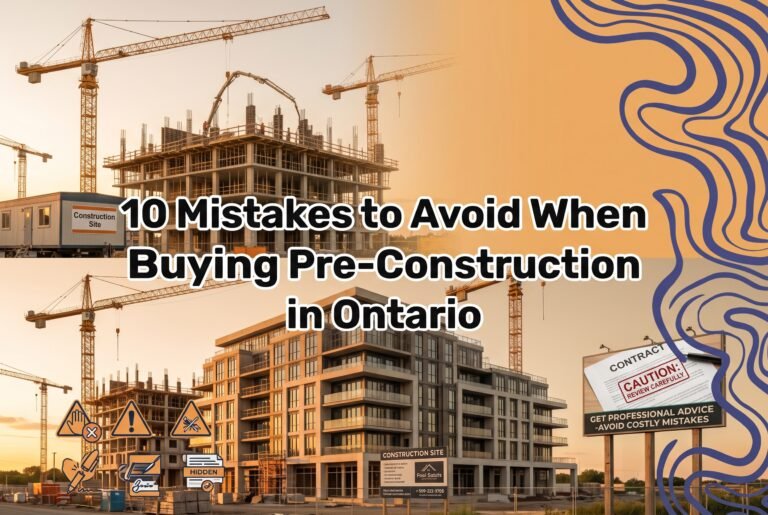
10 Mistakes to Avoid When Buying Pre-Construction in Ontario
Updated October 17, 2026
Buying a pre-construction home can be an exciting opportunity.
You may get a brand-new property, modern floor plans, builder incentives, flexible deposits, warranty protection and, for qualifying buyers in 2026, potentially significant HST relief.
But buying pre-construction is also very different from buying a resale home.
You’re often committing hundreds of thousands—or more than a million dollars—to a property that may not be completed for several years.
And some of the most expensive mistakes happen before construction even begins.
A buyer may focus on the floor plan and purchase price while overlooking:
Builder closing adjustments
Deposit requirements
Mortgage qualification
HST eligibility
Assignment restrictions
Construction delays
Appraisal risk
Builder reputation
Warranty requirements
The actual value of incentives
Here are 10 common pre-construction mistakes Ontario buyers should avoid in 2026.
Mistake #1: Buying Based Only on the Advertised Price
This is probably the most common mistake.
You see:
“Freehold Townhomes From $699,990”
and immediately start calculating whether you can afford $699,990.
But the advertised starting price may not represent the home you actually want.
Your final purchase could also include:
Lot premium
Premium elevation
Structural upgrades
Décor upgrades
Parking
Locker
Builder adjustments
Development charges
Utility charges
Other closing expenses
For example:
Advertised price:
$699,990
Lot premium:
$20,000
Structural upgrades:
$15,000
Décor upgrades:
$20,000
Your actual contract price could quickly approach:
$755,000
before closing costs.
Better approach
Before deciding whether a project fits your budget, determine:
Actual home price + likely upgrades + closing costs + financing requirement.
The starting price is useful for marketing.
Your final number is what matters financially.
Mistake #2: Not Having the Agreement Reviewed by a Real-Estate Lawyer
A builder Agreement of Purchase and Sale can be long and complicated.
It may contain provisions dealing with:
Development charges
Municipal levies
HST
Utility charges
Construction delays
Assignments
Closing adjustments
Builder termination rights
Property modifications
Financing
Default
Occupancy
Closing dates
This isn’t paperwork you should simply sign and file away.
Condo buyers
Purchasers of new or pre-construction condominiums in Ontario generally have a statutory 10-day cooling-off period after receiving the required documents, giving them an important opportunity to obtain legal advice.
Freehold buyers
Do not automatically assume that every freehold purchase has exactly the same cancellation rights as a condominium purchase.
Different contractual and Tarion provisions may apply.
Your lawyer should determine what applies to your particular agreement.
Better approach
Ask your lawyer specifically:
Which closing costs are capped?
Which are uncapped?
What can the builder adjust?
How is HST treated?
What happens if I don’t qualify for an assumed rebate?
Can I assign the property?
What happens if construction is delayed?
Are there termination conditions?
What financial exposure should I know about?
Don’t simply ask:
“Is this contract okay?”
Ask:
“What could cost me additional money?”
Mistake #3: Confusing the Builder Deposit With Your Mortgage Down Payment
These are not necessarily the same thing.
Suppose you’re buying an:
$800,000 home.
The builder requires:
5% deposit = $40,000.
That does not automatically mean $40,000 is all the equity you’ll need.
Under current insured-mortgage rules, the minimum down payment on an eligible $800,000 purchase would generally be:
5% of first $500,000:
$25,000
plus 10% of remaining $300,000:
$30,000
Total:
$55,000.
So even after paying the builder $40,000, you could still need additional down-payment funds at closing—plus closing costs.
The opposite can also happen.
If the builder requires 10%:
$80,000
you’ve already contributed more than that theoretical insured-mortgage minimum.
Better approach
Calculate separately:
Builder deposit
What does the builder require and when?
Mortgage down payment
How much will your lender require?
Closing costs
How much additional cash will you need?
Emergency reserve
What will remain after closing?
Never stop the calculation at the first deposit cheque.
Mistake #4: Assuming Every HST Rebate Applies to You
This mistake could involve a very large amount of money in 2026.
Ontario and the federal government have introduced significant new-home HST relief.
Eligible first-time buyers may qualify for up to $50,000 under the federal First-Time Home Buyers’ GST/HST Rebate on qualifying new homes up to $1 million, with the benefit gradually reduced between $1 million and $1.5 million.
Ontario’s temporary Enhanced New Housing Rebate can provide eligible purchasers with up to $80,000 of provincial HST relief, with qualifying builder agreements generally entered into between April 1, 2026 and March 31, 2027.
But:
“Up to $130,000” does not mean every buyer automatically receives $130,000.
Eligibility depends on factors such as:
Purchase date
Property value
Occupancy
Buyer status
Transaction structure
Applicable rebate program
Another common mistake is seeing an advertised builder price and then mentally subtracting the rebate again.
The builder’s advertised price may already assume an applicable rebate.
Better approach
Ask:
Is HST included in the advertised price?
Which rebate has already been assumed?
Which rebate do I personally qualify for?
Will the builder credit it at closing?
Do I have to apply afterward?
What happens if CRA determines I don’t qualify?
Your lawyer and, where appropriate, tax professional should confirm the treatment.
Mistake #5: Ignoring Closing Costs
You save enough money for the deposit.
You secure financing.
Then closing arrives.
Suddenly you’re faced with:
Land transfer tax
Legal fees
Title insurance
Development charges
Utility charges
Builder adjustments
Property-tax adjustments
Mortgage-related costs
Condo occupancy expenses where applicable
This can create a serious cash-flow problem.
Tarion’s buyer guidance specifically warns purchasers to budget beyond the purchase price and deposits for closing and moving-related costs.
Better approach
Keep a dedicated:
Closing-cost reserve.
And have your lawyer estimate your potential financial exposure under the APS.
Particularly ask about:
Capped development charges
versus
Uncapped charges.
A slightly more expensive property with capped closing adjustments can sometimes provide better financial certainty than a cheaper property with broad uncapped clauses.
Mistake #6: Buying Because of the Incentives Instead of the Property
You’ve probably seen offers like:
“$100,000 in incentives!”
That sounds impressive.
But what’s actually included?
Maybe:
$25,000 décor credit
Appliances
Finished basement
Assignment incentive
Deposit extension
Closing-cost cap
These may all be useful.
But their value to you may not equal the advertised promotional value.
Imagine:
Builder home:
$900,000
Advertised incentives:
$75,000
Comparable resale:
$800,000
Even after assigning the full $75,000 value to the incentives, the builder home effectively remains around:
$825,000
before considering other differences.
That doesn’t necessarily make it a bad purchase.
But the incentive headline shouldn’t make the decision for you.
Better approach
Calculate:
Builder price
minus
Genuine incentives you actually value
plus
Closing costs
and compare that result with:
Other builders
Inventory homes
Resale properties
Don’t buy the incentive.
Buy the home.
Mistake #7: Failing to Research the Builder
A beautiful model home doesn’t tell you everything about the company building your property.
Before committing, investigate:
Builder licensing
Years in business
Previous communities
Number of homes built
Regulatory history
Construction track record
Customer experiences
Ontario requires new-home builders and sellers to be licensed by the Home Construction Regulatory Authority.
The Ontario Builder Directory lets buyers review information including licensing status, years of activity, homes built and certain regulatory actions.
Better approach
Research both:
The property
and
The company responsible for delivering it.
A floor plan can be excellent.
But execution matters.
Mistake #8: Assuming the Closing Date Is Guaranteed
Imagine purchasing in 2026 with an anticipated closing in:
September 2028.
You plan everything around that date.
You:
Give notice to your landlord
Sell your existing home
Arrange movers
Register children for school
Then construction is delayed.
This is one of the realities buyers need to plan for.
Ontario’s Tarion framework includes delayed-closing and delayed-occupancy protections. For qualifying freehold homes, improper delays beyond applicable contractual dates can result in compensation of up to $7,500, subject to the warranty rules.
But compensation doesn’t necessarily eliminate the inconvenience of delayed possession.
Better approach
Understand:
Tentative closing date
Firm closing date
Outside closing date
Required notices
Your rights if dates change
And avoid making irreversible commitments too far ahead based solely on an initial tentative date.
Mistake #9: Assuming Your Mortgage Approval Today Guarantees Financing at Closing
This can be one of the most financially dangerous mistakes.
Suppose you sign today for a home closing in three years.
Your mortgage broker tells you that you qualify.
Excellent.
But three years later:
Your employment changes
Your income drops
You buy an expensive vehicle
You accumulate debt
Your credit score drops
Lending rules change
Interest rates change
Property values change
Your lender will assess the transaction again closer to closing.
Your original pre-approval isn’t necessarily a permanent guarantee.
Appraisal risk matters too
Suppose your contract price is:
$1,000,000.
At closing, your lender appraises the home at:
$900,000.
The lender may calculate financing based on the lower valuation.
You may need additional cash.
Better approach
During construction:
Maintain good credit
Avoid unnecessary debt
Keep saving
Maintain emergency funds
Review financing periodically
Reconfirm financing well before closing
Do not spend the construction period assuming the mortgage is permanently solved.
Mistake #10: Assuming You Can Always Assign or Sell Before Closing
Some buyers enter pre-construction thinking:
“If my circumstances change, I’ll just assign it.”
That can be dangerous.
An assignment allows a purchaser to transfer their interest in the purchase contract to another buyer before final closing, subject to the agreement.
But the builder may:
Prohibit assignment
Require approval
Charge a fee
Restrict advertising
Restrict timing
Impose administrative conditions
Even when the builder advertises:
“Free Assignment”
there may still be conditions and legal expenses.
And assignment transactions can have tax consequences.
Better approach
Before purchasing, ask your lawyer:
Is assignment permitted?
Does the builder need to consent?
Is there a fee?
When can I assign?
Can I advertise the assignment?
Are there tax/HST implications?
Treat assignment as:
A possible option—not a guaranteed exit strategy.
Bonus Mistake: Not Registering Your Freehold Purchase With Tarion
This one is particularly important because the rules changed in 2026.
Effective April 1, 2026, purchasers of new freehold homes are required to register their purchase with Tarion within:
45 days of signing the Agreement of Purchase and Sale.
Tarion has implemented a transition period for changes tied to maximum deposit coverage, with those deposit-coverage consequences deferred until January 1, 2027.
Registration is therefore something buyers should now incorporate into their new-home purchasing checklist.
Don’t assume someone else has done it for you.
Bonus Mistake: Not Understanding Deposit Protection
A large builder deposit can represent a substantial portion of your savings.
For qualifying freehold homes, Tarion currently provides deposit protection based on purchase price.
For homes priced at $600,000 or less, coverage can reach:
$60,000.
For homes above $600,000, protection can equal 10% of the purchase price up to:
$100,000.
Condominium deposits operate under a different framework and are generally subject to statutory trust protections.
Better approach
Before paying substantial deposits, understand:
Where your deposit is held
How it is protected
What happens if the transaction is terminated
What protection applies if the builder cannot complete
Bonus Mistake: Spending Too Much at the Décor Centre
You purchase:
$750,000 home.
Then visit the builder’s décor centre.
Suddenly:
Flooring: $15,000
Kitchen: $18,000
Countertops: $8,000
Stairs: $9,000
Bathrooms: $7,000
Your $750,000 home becomes:
$807,000.
And depending on your financing, you may need additional funds.
Better approach
Prioritize structural improvements that are difficult to change after closing.
Examples might include:
Structural walls
Electrical rough-ins
Additional bathrooms
Basement entrances
Ceiling changes
Kitchen configurations
Some cosmetic improvements can be completed more economically after possession.
Bonus Mistake: Forgetting That Your Lifestyle Can Change Before Closing
Three years is a long time.
Between purchasing and closing, you might:
Get married
Have children
Change careers
Move cities
Experience financial changes
Need a larger or smaller home
This is why flexibility matters.
Before buying, ask yourself:
“Would this home still make sense if my life changes?”
A functional floor plan, reasonable price and desirable location provide more flexibility than buying something extremely specialized.
What Should You Do Before Buying Pre-Construction?
Use this simple checklist.
Before signing:
1. Establish a comfortable budget
Not your absolute maximum mortgage qualification.
2. Confirm your deposit capacity
Know every payment date.
3. Research the builder
Use official licensing information as part of your due diligence.
4. Compare with resale
Make sure the new-home premium makes sense.
5. Compare competing builders
Don’t assume the first project is the best one.
6. Understand incentives
Calculate their real value.
7. Review the HST treatment
Don’t assume every rebate applies.
8. Review closing costs
Especially uncapped adjustments.
9. Have the APS reviewed by a lawyer
Immediately.
10. Confirm financing
But maintain reserves because closing may be years away.
During Construction
Your work isn’t finished after signing.
Continue to:
Monitor builder communication
Keep deposit deadlines
Maintain strong credit
Avoid excessive new debt
Save additional money
Monitor mortgage options
Keep closing-cost reserves
Track closing-date changes
Keep all contractual documents
Register with Tarion where required
Before Closing
Several months before closing:
Reconfirm mortgage qualification
Confirm your down payment
Review HST rebate eligibility
Ask your lawyer about closing funds
Review the Statement of Adjustments
Arrange insurance
Prepare for the PDI
Avoid major new borrowing
The closer you get to closing, the less room you have to solve financial surprises.
The Biggest Pre-Construction Mistake of All
There is one mistake behind many of the others:
Assuming everything will work itself out by closing.
Pre-construction is a future financial commitment.
You aren’t simply buying today’s home at today’s price.
You’re committing your future finances to complete the transaction when the property is ready.
That requires planning.
The strongest buyers don’t only ask:
“Can I afford the deposit?”
They ask:
“Can I comfortably complete this purchase if market conditions aren’t perfect?”
That’s a much better question.
Frequently Asked Questions
Is buying pre-construction risky in Ontario?
Pre-construction has risks, including construction delays, financing changes, appraisal risk, project cancellation and unexpected closing costs. Proper due diligence can reduce—but not eliminate—those risks.
Should I have a lawyer review a builder agreement?
Yes. Builder Agreements of Purchase and Sale can contain significant legal and financial obligations. A lawyer experienced with new construction should review the agreement and explain your specific exposure.
Do pre-construction condos have a 10-day cooling-off period?
Generally, yes. Buyers of new or pre-construction condominiums from developers in Ontario have a statutory 10-day cooling-off period under the applicable condominium framework.
Can I automatically cancel a freehold purchase within 10 days?
Do not assume so. Freehold transactions operate under different contractual and Tarion rules, and any review or termination rights should be confirmed by your lawyer.
Can I lose my pre-construction deposit?
Deposit protection exists for qualifying new homes, but coverage limits and rules vary depending on the property type and circumstances. Understand the applicable protection before purchasing.
Can a builder delay my closing?
Yes, within the applicable contractual and warranty framework. Tarion provides delayed-closing and delayed-occupancy protections and establishes notice requirements and potential compensation in qualifying circumstances.
Can I assign my pre-construction home?
Only if permitted by the Agreement of Purchase and Sale and builder policies. Consent, fees, restrictions and tax considerations may apply.
Can I get up to $130,000 in HST relief?
Some qualifying Ontario new-home purchasers can potentially receive substantial combined HST relief under current federal and provincial programs. Eligibility is transaction-specific and should be confirmed rather than assumed.
Should I buy directly from the builder or use a Realtor?
Builders can sell directly to consumers, but an experienced Realtor can help compare builders, communities, pricing, incentives, deposit structures, inventory and resale alternatives. Representation should be established early because builder cooperation and registration policies can vary.
The Bottom Line
Pre-construction can provide excellent opportunities.
But the biggest financial mistakes often happen because buyers focus too heavily on:
Price + Floor Plan + Incentive
and not enough on:
Contract + Financing + Closing Costs + Risk.
Before committing to a new home, remember these ten rules:
Don’t buy based only on advertised price.
Have the APS reviewed by a lawyer.
Separate builder deposits from mortgage down payment.
Confirm HST rebate eligibility.
Budget for closing costs.
Evaluate incentives realistically.
Research the builder.
Prepare for possible delays.
Protect your future mortgage qualification.
Never assume assignment gives you an easy exit.
A good pre-construction purchase shouldn’t depend on everything going perfectly.
It should still make financial sense if:
Closing is delayed
Interest rates change
Prices remain flat
Your expenses increase
You need more cash than originally expected
That financial cushion can make the difference between an exciting new-home purchase and a stressful one.
Thinking About Buying Pre-Construction in Ontario?
Before choosing a project, compare more than the advertised starting price.
At New Home Source, we can help you review current opportunities based on:
Builder pricing
Deposit structures
Current incentives
Inventory availability
Closing timelines
HST rebate opportunities
Lot and model availability
Pre-construction versus resale options
Tell us your:
Budget + Preferred Location + Home Type + Closing Timeline
and we can help you identify new-home opportunities that fit your needs—and point out the questions worth asking before you commit.
Contact New Home Source to explore current pre-construction and inventory-home opportunities across Ontario.
Disclaimer: This article is provided for general informational and real-estate marketing purposes only and does not constitute legal, tax, mortgage, financial or investment advice. Builder agreements, deposit protections, government programs, financing requirements and warranty rules can change and may vary by transaction. Buyers should obtain independent legal, mortgage and tax advice as appropriate before entering into an Agreement of Purchase and Sale.
You Might Also Like

Buying your first home is a monumental milestone, and in a market as diverse and dynamic as the Greater Toronto...
Top Pre-Construction Markets in Ontario: A Smart Investment Guide Investing in pre-construction projects offers significant benefits for homebuyers and investors,...
Interim Occupancy Explained: Why Condo Buyers Pay Before They Own the Unit Updated November 19, 2026 You’ve purchased a pre-construction...