
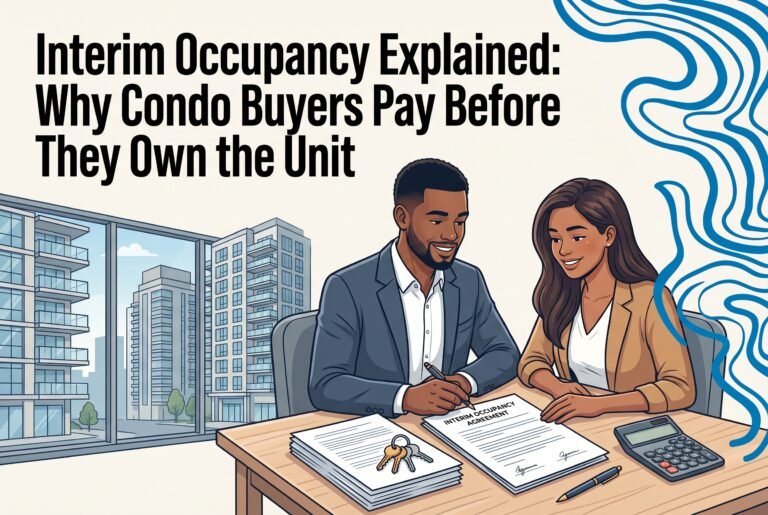
Interim Occupancy Explained: Why Condo Buyers Pay Before They Own the Unit
Updated November 19, 2026
You’ve purchased a pre-construction condominium.
After years of waiting, the builder finally tells you:
Your unit is ready for occupancy.
You get the keys.
You move in.
You start paying monthly charges.
But there is one surprising detail:
You don’t legally own the condo yet.
Welcome to interim occupancy.
This stage is one of the most confusing parts of buying a pre-construction condominium in Ontario.
Buyers often ask:
Why am I paying the builder if I don’t own the unit?
Why hasn’t my mortgage started?
Is the occupancy fee rent?
When do I actually receive title?
Can I rent the unit during occupancy?
How long does interim occupancy last?
Here’s what Ontario condo buyers need to understand.
What Is Interim Occupancy?
Interim occupancy is the period between:
The date your condominium unit is ready for you to occupy
and
The date the condominium corporation is registered and you complete final closing.
During this period, the builder allows you to occupy the unit.
But legal title has not yet transferred to you.
That’s why interim occupancy is sometimes described as:
Living in your condo before you officially own it.
Why Does Interim Occupancy Happen?
A condominium development contains:
Individual residential units
Common elements
Shared systems
Legal condominium documentation
Before purchasers can receive title to their individual units, the condominium corporation needs to be registered.
Construction may reach a stage where lower-floor units are ready for occupancy while:
Upper floors are still being finished
Common areas are incomplete
Final municipal requirements remain
Condominium registration hasn’t occurred
Instead of making completed-unit purchasers wait until the entire project is ready, the builder can begin interim occupancy.
Who Owns the Unit During Interim Occupancy?
The builder still owns the unit.
You have:
The right to occupy it.
You do not yet have registered legal title.
That happens at final closing.
This distinction explains why:
Your normal mortgage generally hasn’t funded
You pay an occupancy fee
Certain ownership rights may be restricted
Final closing occurs later
Is Interim Occupancy the Same as Renting?
No.
You aren’t an ordinary tenant renting a condo from the builder.
You are a purchaser under a binding Agreement of Purchase and Sale who has reached the occupancy stage before title transfer.
However, you do make monthly payments during this period.
Those payments are called:
Occupancy fees.
What Is an Occupancy Fee?
The occupancy fee generally represents specified carrying costs during the period before final closing.
It can include components related to:
Interest on the unpaid balance of the purchase price
Estimated municipal property taxes
Estimated common expenses
Think of it as the cost of occupying the property before ownership transfers.
Are Occupancy Fees Going Toward My Mortgage?
Generally:
No.
This surprises many buyers.
During interim occupancy, your traditional mortgage normally has not yet funded because legal title hasn’t transferred.
That means occupancy fees generally do not build mortgage equity the way principal payments do after final closing.
This is why buyers sometimes call occupancy fees:
“Phantom rent.”
But technically, the fee is calculated according to the condominium framework rather than being ordinary market rent.
Example of Interim Occupancy
Suppose your condo purchase price is:
$700,000.
You have already paid:
$105,000
in deposits.
Remaining unpaid balance:
$595,000.
During occupancy, the builder calculates the applicable components for:
Interest on the unpaid balance
Estimated property taxes
Common expenses
Your resulting monthly occupancy cost might therefore be substantial.
The exact amount varies by property and transaction.
Do not estimate it based solely on what another buyer in another project paid.
Why Doesn’t My Mortgage Start Immediately?
A conventional mortgage is secured against legal title to the property.
During interim occupancy:
You don’t have title yet.
When the condominium corporation registers and final closing occurs:
Legal title transfers
Your mortgage can fund
Remaining purchase funds are paid
Final adjustments occur
That is when your normal ownership financing begins.
What Is Final Closing?
Final closing happens after condominium registration.
At that stage:
Your lawyer receives the necessary closing documents
Your lender advances mortgage funds where applicable
Remaining down payment is provided
Land transfer tax is paid
Builder adjustments are finalized
Title transfers into your name
Now:
You officially own the condominium.
Your occupancy fee ends and regular ownership expenses begin.
How Long Does Interim Occupancy Last?
There is no universal length.
It could last:
A few weeks
Several months
Longer in some projects
The timing depends on factors such as:
Size of the development
Floor of your unit
Construction progress
Municipal approvals
Condominium registration
Buyers purchasing lower floors of a large tower may sometimes experience longer occupancy periods because those units can become habitable earlier in the construction sequence.
Does Your Floor Matter?
Potentially.
Imagine a 50-storey tower.
A purchaser on:
Floor 7
may be ready for occupancy substantially earlier than someone on:
Floor 47.
The project still needs to reach the stage where condominium registration can occur.
This is one reason lower-floor purchasers can sometimes experience longer interim occupancy.
It isn’t a guaranteed rule, but it is something condo buyers should understand.
Can You Avoid Interim Occupancy?
Not necessarily.
If your builder APS provides for interim occupancy, it may be part of the purchasing process.
Some projects have very short occupancy periods.
Others can have longer ones.
Before buying, ask:
Is interim occupancy expected?
What is the tentative occupancy date?
What is the Outside Occupancy Date?
What does the APS say about occupancy?
Does the builder have historical experience with similar projects?
Nobody can guarantee the exact duration years ahead.
What Is a Tentative Occupancy Date?
A Tentative Occupancy Date is the builder’s current expected date for occupancy.
It can potentially be extended under the applicable Tarion rules.
Condominium buyers should pay close attention to their:
Statement of Critical Dates.
It identifies important dates and notice requirements relating to occupancy.
What Is a Firm Occupancy Date?
A Firm Occupancy Date provides greater certainty.
Once that date is established, further builder delay may trigger delayed-occupancy compensation unless an applicable exception applies.
The builder still has obligations to provide proper notice.
What Is the Outside Occupancy Date?
The Outside Occupancy Date is the latest date agreed upon under the applicable framework for the builder to provide occupancy.
If the unit is not ready by the Outside Occupancy Date, the purchaser may generally enter a:
30-day termination period.
This is an important buyer protection.
If that situation arises, obtain legal advice promptly.
Can You Receive Compensation for Delayed Occupancy?
Potentially.
If the builder improperly delays occupancy beyond the applicable firm date, a purchaser may become entitled to delayed-occupancy compensation.
Current maximum compensation for a qualifying delay can reach:
$7,500.
Keep documentation if a delay causes expenses.
Why Should Buyers Budget for Occupancy Fees Before Purchasing?
Because occupancy can create an additional period of monthly expense before final closing.
Suppose you budgeted for:
Mortgage + condo fees + property taxes.
But you didn’t account for:
Six months of interim occupancy.
Your cash-flow plan could suddenly become uncomfortable.
Before buying a pre-construction condo, understand that interim occupancy may be part of the financial commitment.
Occupancy Fees vs Mortgage Payments
The two should not be confused.
Occupancy Fee
Paid before title transfers.
Generally consists of the applicable statutory components.
Mortgage Payment
Begins after final closing when your lender advances the mortgage.
Includes:
Principal
Interest
The mortgage payment builds equity through principal repayment.
Occupancy fees generally don’t work that way.
Can the Builder Charge Whatever It Wants?
No.
The calculation of interim occupancy fees is governed by Ontario condominium law.
The fee is based on permitted components rather than simply whatever rent the builder thinks the unit could command.
Your lawyer should review your occupancy statement and APS if you have concerns.
Can You Make Extra Payments to Reduce the Occupancy Fee?
Depending on the builder, agreement and applicable rules, there may be circumstances where additional funds can affect the unpaid balance component.
However, this should never be assumed.
Ask your lawyer and builder what the contract permits.
Do not send additional funds without understanding how they will be treated.
Do You Pay Property Tax During Occupancy?
One component of the occupancy fee can represent the builder’s reasonable estimate of municipal taxes attributable to the unit.
You aren’t necessarily receiving a normal property-tax bill directly in your name because you don’t yet hold legal title.
After final closing, property-tax treatment shifts to normal ownership arrangements.
Do You Pay Condo Fees During Occupancy?
The occupancy fee can include an estimated contribution toward common expenses.
This reflects the fact that even before registration, occupied residents are using building services such as:
Elevators
Cleaning
Security
Utilities for common areas
Building management
Amenities where available
At final closing and registration, regular condominium common expenses apply.
Can Estimated Condo Fees Change?
Yes.
The maintenance fee shown in early builder marketing is typically based on estimates.
Once the condominium begins operating, actual expenses can differ.
Factors may include:
Utilities
Insurance
Staffing
Maintenance
Amenities
Contracts
Reserve contributions
Don’t select a condo solely because the estimated maintenance fee looks unusually low.
Can You Rent Your Condo During Interim Occupancy?
This depends on:
Your Agreement of Purchase and Sale and builder rules.
Some builders may permit leasing during occupancy with approval.
Others may restrict it.
You should never assume:
“I bought the condo, so I can rent it immediately.”
Remember:
You don’t yet own it during interim occupancy.
Investors should review this issue before purchasing.
What Is an Occupancy Lease?
Where a builder permits an investor to lease a unit during interim occupancy, additional builder documentation or approval may be required.
The rules depend on the project.
There may also be:
Administration fees
Approval requirements
Insurance requirements
Tenant documentation
Investors need to understand these procedures before promising possession to a tenant.
Can You Sell During Interim Occupancy?
This can become complicated.
Because you don’t yet have title, an ordinary resale may not be possible in the same way as after final closing.
Depending on the builder contract, you may still be dealing with:
Assignment rights.
Builder approval and restrictions can apply.
If you need to exit during this stage, obtain legal advice.
HST and Interim Occupancy
HST is another important consideration.
The HST treatment of your new condominium depends on factors including:
How the builder structured the purchase price
Whether you qualify for an owner-occupied rebate
Whether the property is a rental
Which current federal and Ontario programs apply
How the builder credits or assigns rebates
Interim occupancy itself should not be used to guess your rebate eligibility.
Confirm the HST treatment with your lawyer and tax professional where appropriate.
Investors Need to Plan Carefully
Suppose you purchased the condo to rent.
You may need to consider:
Whether leasing is permitted during occupancy
New Residential Rental Property Rebate rules
Cash required at final closing
Occupancy fees
Mortgage qualification
Expected rent
Condo fees
Property taxes
An investment that looks cash-flow positive after final closing may produce a different cash flow during interim occupancy.
Model both stages.
Do You Pay Land Transfer Tax During Interim Occupancy?
Land transfer tax is generally connected with the transfer of legal ownership.
Since title hasn’t transferred during interim occupancy, the major land-transfer-tax payment generally arises at final closing.
This is another reason buyers need substantial funds available at the second stage of the process.
What Happens at Final Closing?
When the condominium registers:
1. Your lawyer prepares final closing.
2. Your lender funds the mortgage.
3. Remaining down payment is delivered.
4. Land transfer tax is paid.
5. Builder adjustments are finalized.
6. Title transfers.
7. Occupancy fee ends.
8. You become the legal owner.
This is the moment the purchase becomes a traditional ownership arrangement.
Don’t Confuse Occupancy With Ownership
This is the most important lesson.
When your builder says:
“Your unit is ready.”
that doesn’t necessarily mean:
“Your purchase is closing.”
For a pre-construction condominium there can be:
Stage 1 — Interim Occupancy
then
Stage 2 — Final Closing.
Understanding this before purchasing prevents a lot of confusion later.
7 Mistakes to Avoid During Interim Occupancy
Mistake 1: Assuming occupancy fee builds equity
It generally doesn’t work like a mortgage principal payment.
Mistake 2: Forgetting to budget for occupancy
The period may last months.
Mistake 3: Assuming you already own the unit
Title transfers later.
Mistake 4: Renting without builder permission
Check your APS.
Mistake 5: Ignoring builder notices
Registration and closing can occur quickly once scheduled.
Mistake 6: Taking on new debt
You still need to qualify for your mortgage at final closing.
Mistake 7: Spending your closing funds
Land transfer tax, down payment and closing costs are still coming.
How to Prepare Financially
Before occupancy:
Keep your remaining down payment available.
Maintain your closing-cost reserve.
Confirm your mortgage qualification.
Estimate occupancy fees.
Review HST treatment.
Arrange appropriate insurance.
Avoid new unnecessary debt.
The fact that you’ve received your keys does not mean the financing phase is finished.
Frequently Asked Questions
What is interim occupancy?
It is the period when a pre-construction condo purchaser can occupy the completed unit before the condominium is registered and legal title transfers.
Do I own the condo during interim occupancy?
No. The builder generally remains the legal owner until final closing.
Why do I pay an occupancy fee?
The fee generally covers permitted components relating to the unpaid purchase balance, estimated municipal taxes and common expenses during the occupancy period.
Does my occupancy fee go toward my mortgage?
Generally no. Your mortgage normally begins at final closing after title can transfer.
How long can interim occupancy last?
It varies. It can last from weeks to several months or potentially longer depending on construction and registration.
Can I rent the condo during occupancy?
Only if permitted by the builder agreement and applicable builder procedures.
Can I sell during occupancy?
Because title has not yet transferred, the transaction may still involve assignment rights rather than an ordinary resale. Builder consent and other restrictions can apply.
When do I pay land transfer tax?
Generally at final closing when legal title transfers.
When does my mortgage start?
Usually at final closing, not interim occupancy.
Can I receive compensation if occupancy is improperly delayed?
Potentially. Ontario’s new-home warranty framework provides delayed-occupancy protection subject to applicable rules.
The Bottom Line
Interim occupancy isn’t:
Final closing.
It is a temporary stage between construction completion of your unit and legal registration of the condominium.
During this period:
You can live there
but:
You don’t yet own it.
You generally pay:
Occupancy Fee
instead of:
Mortgage Payment.
Then when the condominium registers:
Mortgage funds + Title transfers + Final closing occurs.
Understanding this before purchasing can help you prepare for the extra cash-flow period and avoid one of the most common surprises in pre-construction condo ownership.
Considering a Pre-Construction Condo or Townhome?
At New Home Source, we help buyers compare different forms of new construction—not just advertised prices.
We can help you explore:
Pre-construction condos
Condo townhomes
Freehold townhomes
Builder inventory
Quick-closing homes
Deposit structures
Closing timelines
Current builder incentives
HST rebate opportunities
Tell us your:
Budget + Preferred Location + Home Type + Closing Timeline
and we can help you compare options that fit your plans.
Contact New Home Source to explore current new-home opportunities across Ontario.
Disclaimer: This article is provided for general informational and real-estate marketing purposes only and does not constitute legal, tax, mortgage or financial advice. Interim occupancy procedures, fees, leasing rights and closing requirements depend on the condominium, builder agreement and applicable legislation. Buyers should have their Agreement of Purchase and Sale reviewed by a qualified Ontario real-estate lawyer.
You Might Also Like
Building Wealth from the Ground Up: Pre-Construction Investment for Every Home Type Investing in pre-construction properties is becoming an increasingly...
Investing in pre-construction condos in the Greater Toronto Area (GTA) can be a fantastic opportunity for both first-time buyers and...
How to Buy a Pre-Construction Home in Ontario: Step-by-Step Guide (2026) Updated September 18, 2026 Buying a pre-construction home in...