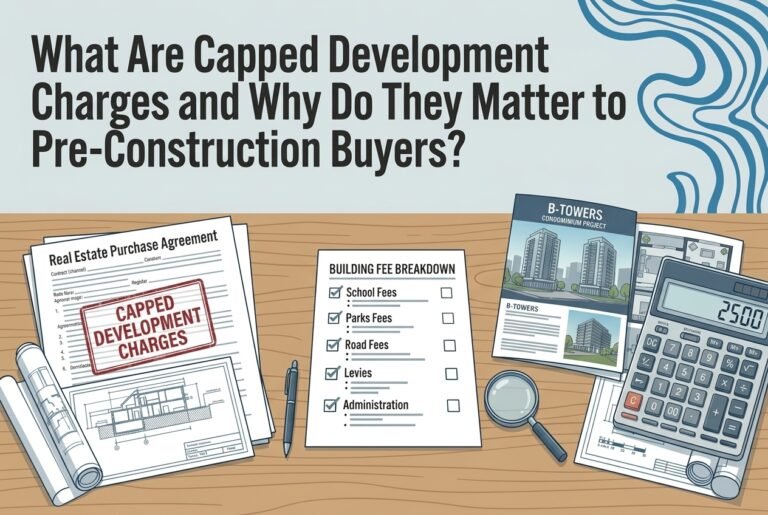
What Are Capped Development Charges and Why Do They Matter to Pre-Construction Buyers?
Updated November 26, 2026
If you’ve been looking at pre-construction projects in Ontario, you may have seen an incentive that says:
“Development Charges Capped”
or:
“Levies Capped at $10,000”
At first glance, that may sound much less exciting than:
$25,000 décor credit
or:
Finished basement included.
But capped development charges can potentially be one of the most financially important incentives in a builder agreement.
Why?
Because they can reduce uncertainty about what you may owe at closing.
Here’s what Ontario pre-construction buyers need to understand.
What Are Development Charges?
Municipalities can impose development charges on new development to help pay for infrastructure required as communities grow.
That infrastructure can include eligible services associated with growth, such as:
Roads
Water systems
Wastewater infrastructure
Transit-related infrastructure
Fire protection
Recreation
Other eligible municipal services
Developers pay development-related charges as part of bringing new housing to market.
Depending on the builder agreement, some costs or increases may ultimately affect what purchasers owe through closing adjustments.
Why Do Development Charges Exist?
Imagine a municipality approves thousands of new homes.
Those residents may require:
Roads
Water
Sewers
Transit
Fire services
Recreation facilities
Other infrastructure
Development charges are one mechanism municipalities use to help fund growth-related capital costs.
The basic principle is:
Growth creates infrastructure costs.
Are Development Charges the Same Everywhere?
No.
Development charges vary significantly by:
Municipality
Housing type
Development
Applicable by-law
Timing
A detached home in one municipality can face a very different development-charge environment from a townhouse in another.
Rates can also change over time.
Why Do Development Charges Matter to Pre-Construction Buyers?
Because years can pass between:
Signing the APS
and
Final closing.
Suppose you buy in:
2026
but close in:
2029.
Municipal development charges can change during that period.
Depending on your APS, the builder may have rights to recover specified amounts or increases through your Statement of Adjustments.
That’s why buyers need to know:
Who bears the risk if costs increase?
What Does “Capped” Mean?
A cap places a contractual limit on what the purchaser may be required to pay for specified charges covered by that cap.
For example:
Development Charges Capped at $10,000
may mean the purchaser’s liability for the specific charges covered by that clause cannot exceed $10,000, subject to the wording of the contract.
The exact APS language controls.
Capped Does Not Mean Free
This distinction is important.
If your builder says:
“Development charges capped at $10,000”
that doesn’t necessarily mean:
“Development charges waived.”
It generally means your exposure is limited according to the applicable contractual provision.
You may still need to pay:
Up to $10,000.
What Does “Development Charges Included” Mean?
This can potentially be different.
A promotion may state:
Development Charges Included
or:
No Development Charge Adjustment.
That could be more valuable than simply having a cap.
But again:
Read the contract.
Marketing language should match the actual APS or amendment.
Why Can a Cap Be Valuable?
Because it gives you:
Cost certainty.
Suppose two projects have similar homes.
Project A
Purchase price:
$750,000
Development charges:
Uncapped
Project B
Purchase price:
$765,000
Specified development charges:
Capped at $10,000
Project A appears:
$15,000 cheaper.
But if uncapped adjustments later become substantial, Project B could end up offering the safer and potentially cheaper transaction.
What Does Uncapped Mean?
An uncapped adjustment generally means the purchaser’s liability under that particular contractual provision isn’t limited to a predetermined dollar amount.
That doesn’t mean the builder can simply invent arbitrary charges.
The APS and applicable law still govern the transaction.
But the buyer has less certainty about the final amount.
Which Charges Might Be Separate?
One of the biggest mistakes buyers make is seeing:
“Development Charges Capped”
and assuming:
“All closing costs are capped.”
Not necessarily.
The agreement may separately address:
Education development charges
Utility connections
Hydro meter
Water meter
Gas connection
Parkland-related costs
Municipal levies
Condominium adjustments
Other specified charges
One cap may not cover everything.
Example: Why the Fine Print Matters
A builder promotion says:
“Levies Capped at $10,000.”
You assume:
Maximum builder closing adjustment = $10,000.
But the APS separately permits:
Utility charges
Meter charges
Administrative fees
Other adjustments
Your total builder adjustments could therefore exceed $10,000.
The correct question is:
“Exactly which charges are included in the cap?”
Ask Your Lawyer to Identify Every Cap
When your lawyer reviews your APS, ask for a simple breakdown:
Capped:
Development charges
Education levies
Utility charges
Uncapped:
Property tax adjustment
Other specified contractual items
You want to understand your:
Maximum foreseeable contractual exposure.
Development Charges Are Changing in 2026
Ontario and the federal government have introduced a Development Charge Reduction Program aimed at municipalities willing to significantly reduce eligible development charges for a three-year period.
Participating municipalities must meet program requirements and reduce charges by substantial percentages.
This is intended to lower the cost of building new housing.
However:
That does not mean every buyer’s closing adjustment automatically falls by the same amount.
Municipality participation, timing, builder agreements and project economics all matter.
Never assume a government development-charge reduction becomes an automatic purchaser credit.
Can Government Reductions Lower New-Home Prices?
Potentially.
Reducing development costs can improve project economics.
That may help:
Housing construction
Project viability
Pricing
Incentive flexibility
But builders still face many other costs, including:
Land
Labour
Materials
Financing
Infrastructure
Taxes
And market pricing depends on supply and demand.
A lower builder cost does not necessarily translate dollar-for-dollar into a lower home price.
Why Builders Use Caps as Incentives
A cap can be attractive because it gives buyers something extremely valuable:
Predictability.
Imagine signing for a home three years before closing.
You’re already uncertain about:
Mortgage rates
Property taxes
Moving expenses
Knowing that a major contractual adjustment has a limit can make planning easier.
Is a Development-Charge Cap Better Than a Décor Credit?
Sometimes.
Suppose you’re choosing between:
Option A
$20,000 décor credit
or
Option B
Development-charge protection
Which is better?
If you genuinely wanted $20,000 of upgrades, the décor credit can be valuable.
But a development-charge cap may protect you from a significant future cash requirement.
They solve different problems.
How Should You Value a Cap?
Unlike a cash discount, a cap has:
Risk-protection value.
Suppose the cap is:
$10,000.
If the eventual covered adjustment would otherwise have been:
$8,000
the cap didn’t save you anything.
But if it would have been:
$25,000
the cap potentially saved:
$15,000.
You don’t know the exact value when you purchase.
That’s why it acts like a form of cost protection.
Should You Pay More for a Home With Capped Charges?
Potentially.
Consider:
Home A
$750,000
Uncapped adjustments
Home B
$760,000
Strong caps
The $10,000 additional price may be worthwhile.
But don’t decide based on this factor alone.
Compare:
Builder
Location
Lot
Deposit
Incentives
Closing timeline
Other adjustments
What Is a Statement of Adjustments?
Shortly before final closing, your lawyer receives the builder’s:
Statement of Adjustments.
It sets out amounts that adjust the balance due on closing.
Potential items can include:
Property taxes
Deposits
Builder credits
Contractual levies
Utility-related charges
Other adjustments
Your lawyer should review the statement and explain significant amounts.
Don’t Wait Until Closing to Learn About Adjustments
This is one of the biggest mistakes.
Imagine finding out:
Five days before closing
that you need substantially more cash than expected.
The time to investigate adjustment clauses is:
During lawyer review of the APS.
Not at the end of construction.
10 Questions to Ask About Development Charges
Before your agreement becomes firm, ask:
Are development charges capped?
What is the cap?
Does the cap include HST where applicable?
Are education development charges included?
Are utility charges included?
Are meter charges separate?
Are municipal levies separate?
Which charges remain uncapped?
Is the cap written in the APS or amendment?
What does my lawyer estimate my closing exposure could be?
What If the Salesperson Says “Don’t Worry, They’re Capped”?
That’s helpful.
But:
Get it in writing.
Real-estate transactions are governed by contracts.
If a financial protection matters to your purchase decision, it should be properly documented.
Can You Negotiate Development Charges?
Sometimes the builder’s program is fixed.
In other cases, especially with:
Inventory homes
Quick-closing properties
Promotional releases
the builder may offer stronger closing-cost protection as an incentive.
It is worth asking.
Inventory Homes Can Have an Advantage
With completed or near-completed inventory, the builder may have greater certainty about applicable project costs.
This can sometimes allow:
Better caps
Closing credits
Waived charges
depending on the property.
Again, builder policies vary.
How Do Capped Charges Affect Project Comparison?
Suppose:
Project A
Price: $799,000
Décor credit: $20,000
Development charges: Uncapped
Project B
Price: $809,000
Décor credit: $10,000
Development charges: Capped
Don’t simply calculate:
Project A has:
$10,000 more décor.
You need to evaluate Project B’s risk protection too.
Frequently Asked Questions
What are development charges?
They are municipal charges imposed on development to help fund growth-related infrastructure and services.
Do buyers directly pay municipal development charges?
The developer is generally responsible for development charges in the development process, but builder purchase agreements may permit certain costs or increases to be passed to purchasers through contractual closing adjustments.
What does capped development charges mean?
It means the purchaser’s liability for the specified covered charges is contractually limited to a defined amount.
Does capped mean free?
No. A cap generally limits the charge; it does not necessarily eliminate it.
Are all builder closing costs included in the cap?
Not necessarily. Other utility, municipal or contractual adjustments may be separate.
Can development charges increase before closing?
Municipal development-charge rates and applicable project costs can change over time.
Is Ontario reducing development charges in 2026?
Ontario and Canada launched a program in 2026 designed to support participating municipalities that significantly reduce development charges for qualifying housing development. That does not automatically mean every buyer receives a direct closing credit.
Should my lawyer review the cap?
Absolutely. The APS wording determines what is actually protected.
The Bottom Line
When comparing builder incentives, don’t overlook:
Capped Development Charges.
They may not look as exciting as:
$25,000 in upgrades
or:
Free appliances.
But they can provide something just as important:
Closing-Cost Certainty.
Before buying, determine:
What Is Capped
How Much
What Isn’t Capped
What Other Adjustments Can Still Apply.
A slightly more expensive home with strong contractual caps can sometimes be financially safer than a cheaper home with substantial uncertainty.
The best time to understand that difference is:
Before you sign.
Comparing Builder Closing-Cost Incentives?
At New Home Source, we help buyers look beyond the advertised starting price.
We can help you compare:
Current builder pricing
Development-charge caps
Deposit structures
Builder incentives
Inventory homes
Closing timelines
HST rebate opportunities
Competing projects
Tell us your:
Budget + Preferred Location + Home Type
and we can help you compare current new-home opportunities based on the complete purchase structure.
Contact New Home Source to explore current pre-construction and inventory-home opportunities across Ontario.
Disclaimer: This article is provided for general informational and real-estate marketing purposes only and does not constitute legal, tax or financial advice. Development charges and builder adjustments depend on applicable municipal rules and the specific Agreement of Purchase and Sale. Buyers should have their builder agreement reviewed by a qualified Ontario real-estate lawyer before relying on any cap or closing-cost estimate.
You Might Also Like
Top Pre-Construction Markets in Ontario: A Smart Investment Guide Investing in pre-construction projects offers significant benefits for homebuyers and investors,...

When it comes to selling your home, staging is more than just a superficial exercise—it’s a crucial part of the...
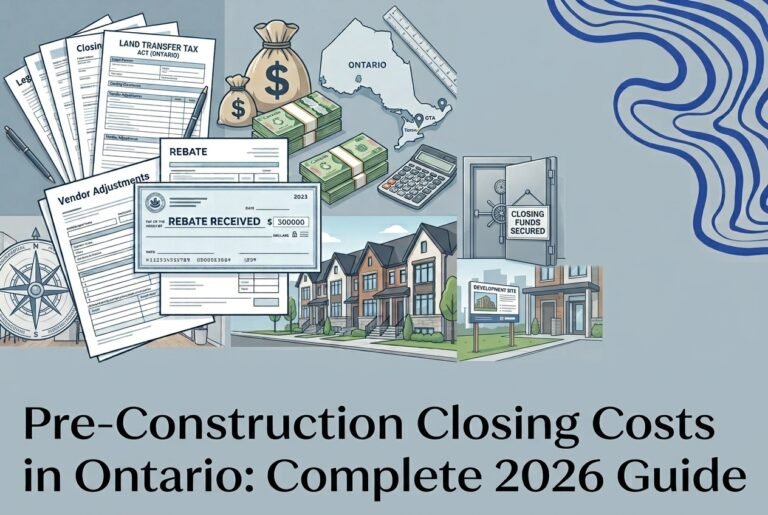
Pre-Construction Closing Costs in Ontario: Complete 2026 Guide Updated September 5, 2026 You found the right pre-construction home, paid your...