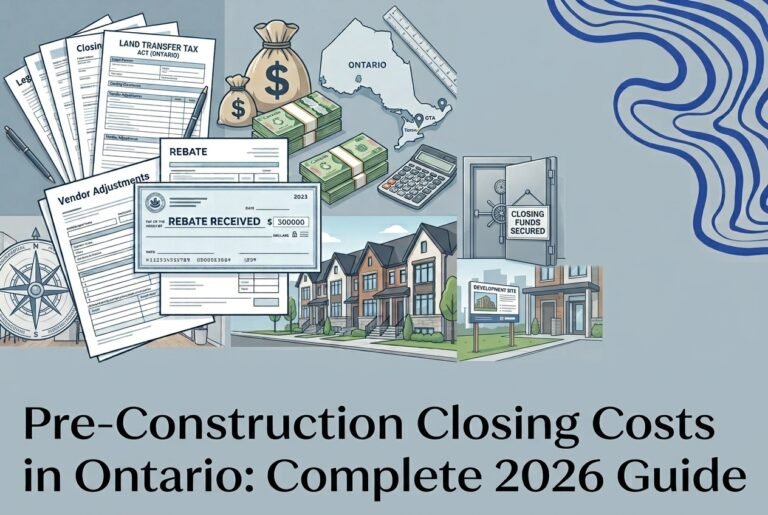
Pre-Construction Closing Costs in Ontario: Complete 2026 Guide
Updated September 5, 2026
You found the right pre-construction home, paid your deposits and secured your mortgage.
Then closing approaches—and suddenly there are thousands of dollars of expenses that were not part of the advertised builder price.
This is why understanding pre-construction closing costs in Ontario is just as important as understanding your purchase price and deposit structure.
Depending on the property, municipality and Agreement of Purchase and Sale, closing costs can include:
Ontario Land Transfer Tax
Toronto Municipal Land Transfer Tax
Legal fees and disbursements
Title insurance
Builder adjustments
Development and education levies
Utility and meter charges
Property-tax adjustments
Condominium occupancy costs
HST-related amounts
Mortgage and appraisal costs
Other charges permitted under your Agreement of Purchase and Sale
Tarion recommends that pre-construction buyers budget carefully for closing expenses and notes that one-time closing costs can range approximately 1.5% to 4% of the purchase price, depending on the transaction.
That means a buyer purchasing an $800,000 home should not assume that having exactly enough for the down payment is enough to close.
Let’s break down what Ontario buyers need to know in 2026.
What Are Closing Costs on a Pre-Construction Home?
Closing costs are amounts you pay in addition to the purchase price and deposit when ownership of your home is transferred to you.
Some expenses are government taxes.
Others are legal or financing costs.
And some are builder adjustments created by the terms of your Agreement of Purchase and Sale.
This last category is especially important with pre-construction.
A resale Agreement of Purchase and Sale may be relatively straightforward.
A builder agreement can contain dozens of pages of schedules describing additional adjustments, levies, fees and purchaser obligations.
That’s why your purchase agreement should be reviewed by a real-estate lawyer familiar with new-construction transactions before the applicable review period expires.
1. Ontario Land Transfer Tax
One of the largest closing expenses for most buyers is the Ontario Land Transfer Tax (LTT).
Ontario calculates LTT using graduated tax rates.
For residential property containing one or two single-family residences, the current provincial rates are:
0.5% on the first $55,000
1.0% from $55,000 to $250,000
1.5% from $250,000 to $400,000
2.0% above $400,000
2.5% on the portion above $2 million
Ontario Land Transfer Tax Examples
For illustration:
$700,000 purchase
Approximate Ontario LTT:
$10,475
$800,000 purchase
Approximate Ontario LTT:
$12,475
$1,000,000 purchase
Approximate Ontario LTT:
$16,475
These examples assume an ordinary residential purchase and do not account for first-time-buyer refunds or special circumstances.
2. First-Time Home Buyers Can Receive an Ontario LTT Refund
Eligible first-time home buyers may receive an Ontario Land Transfer Tax refund of up to:
$4,000
For qualifying transfers registered on or after January 1, 2017, Ontario’s maximum first-time homebuyer LTT refund remains $4,000.
That means an eligible first-time buyer purchasing an $800,000 home with approximately $12,475 in provincial LTT could potentially reduce that amount by $4,000.
Approximate provincial LTT after the maximum refund:
$8,475
Eligibility rules apply, including requirements involving age, prior homeownership, residency and citizenship/permanent-resident status.
The refund should not be assumed until your lawyer confirms your eligibility.
3. Buying in Toronto? You May Pay Land Transfer Tax Twice
If your property is located within the City of Toronto, buyers generally pay:
Ontario Land Transfer Tax
plus
Toronto Municipal Land Transfer Tax (MLTT)
For homes up to $2 million, Toronto’s basic rate structure closely follows the provincial structure:
0.5% on the first $55,000
1.0% from $55,000 to $250,000
1.5% from $250,000 to $400,000
2.0% from $400,000 to $2 million
2.5% from $2 million to $3 million
Toronto introduced significantly higher graduated rates for high-value residential properties effective April 1, 2026.
For qualifying residential properties:
More than $3M to $4M: 4.40%
More than $4M to $5M: 5.45%
More than $5M to $10M: 6.50%
More than $10M to $20M: 7.55%
More than $20M: 8.60%
Those higher rates apply only to the applicable portion of value within each bracket, not to the entire purchase price.
Toronto Land Transfer Tax Example
Consider an $800,000 property in Toronto.
Approximate Ontario LTT:
$12,475
Approximate Toronto MLTT:
$12,475
Combined:
Approximately $24,950
That is before considering any first-time-homebuyer refunds.
This is one of the most important differences when comparing a property in Toronto with a similarly priced home in Vaughan, Mississauga, Oakville, Caledon, Hamilton, Niagara or elsewhere in Ontario.
Toronto First-Time Buyer Rebate
Toronto also offers an eligible first-time purchaser a municipal land-transfer-tax rebate of up to:
$4,475
Combined with Ontario’s maximum $4,000 refund, an eligible first-time buyer purchasing in Toronto could potentially receive up to:
$8,475
in combined provincial and municipal LTT refunds.
Eligibility rules must still be satisfied.
4. Builder Adjustments Can Be One of the Biggest Surprises
This is where pre-construction differs significantly from resale.
Builder Agreements of Purchase and Sale often allow the builder to recover certain costs from purchasers on closing through a Statement of Adjustments.
Potential adjustments can include items such as:
Development charges
Education development charges
Municipal levies
Parkland-related charges
Utility installation charges
Hydro meter charges
Water meter charges
Gas connection charges
Grading or subdivision-related costs
Condominium-related adjustments
Property taxes
Common expenses
Administrative charges specifically permitted by the APS
Not every builder charges all of these items.
And not every charge will be uncapped.
The Agreement of Purchase and Sale determines what the builder can charge.
5. Capped Development Charges Can Be Extremely Valuable
You’ve probably seen builder promotions saying something like:
“Development Charges Capped”
or
“Levies Capped at $10,000.”
This can be more valuable than it initially sounds.
Municipal development charges help fund infrastructure needed for growth, such as roads, water and wastewater infrastructure and other municipal services.
With pre-construction, years can pass between signing your purchase agreement and final closing.
If your agreement allows certain increases to be passed to you, the amount due at closing could be greater than you expected.
A cap limits the amount the builder can charge you under that particular adjustment provision.
For example:
If the APS allows development-related adjustments but caps the purchaser’s exposure at:
$10,000
then the buyer has more certainty than someone whose agreement leaves applicable increases uncapped.
Never assume “capped” means “free.”
It means the charge is limited according to the wording of your agreement.
This is why your lawyer should identify:
Which charges are capped
The dollar amount of each cap
Which charges remain uncapped
Whether taxes are added to the cap
Whether other adjustments can still be charged separately
6. Legal Fees and Disbursements
You’ll need a real-estate lawyer to complete your purchase.
Legal closing expenses can include:
Lawyer’s professional fee
Land-registration expenses
Title searches
Mortgage registration
Bank or lender-related documentation
Title insurance
Courier or wire-transfer costs
Tax certificates or searches
Other legal disbursements
There is no government-mandated flat legal fee for an Ontario real-estate closing.
Different firms charge differently, and a pre-construction purchase can involve additional work compared with a straightforward resale transaction.
Instead of relying on a generic online estimate, ask the lawyer handling your transaction for a written quote showing:
Legal fee + disbursements + HST + title insurance + any additional new-construction charges.
Tarion specifically identifies legal fees, title insurance, appraisal costs and related expenses among the costs buyers should anticipate around closing.
7. Title Insurance
Most Ontario residential transactions include title insurance.
Title insurance can protect against certain title-related problems such as:
Title defects
Some forms of fraud or forgery
Certain survey or boundary issues
Existing liens that should have been discharged
Certain municipal compliance issues
Coverage varies by policy.
The cost depends on factors such as property value and the insurer.
Your lawyer will normally explain the applicable title-insurance premium as part of the closing process.
8. Property Tax Adjustments
Property taxes are usually adjusted between the buyer and seller—or builder—on closing.
Suppose the builder has already paid property taxes covering a period extending beyond your closing date.
You may need to reimburse the builder for your share after you take ownership.
Conversely, other adjustments can work in the purchaser’s favour.
Your lawyer calculates these amounts through the Statement of Adjustments.
With a newly built property, tax assessment can sometimes lag behind completion, so buyers should also understand that future property-tax bills may change once the completed home is fully assessed.
9. Tarion: Understand What You’re Actually Paying For
New homes in Ontario are covered by the province’s new-home warranty framework.
The warranty is provided by the builder and backed by Tarion.
Tarion maintains an enrolment-fee schedule based on the new home’s sale price.
However, this needs to be explained carefully:
Tarion states that the enrolment fee is payable by the vendor.
Therefore, buyers should not assume that a Tarion enrolment fee appearing in an online closing-cost calculator is automatically a direct government charge payable by the purchaser.
Instead, review your builder’s APS and Statement of Adjustments to determine whether and how warranty-related costs are treated in your particular transaction.
Tarion’s current fee schedule also defines sale price broadly for enrolment purposes, including upgrades, extras, parking spaces and storage lockers, excluding applicable taxes.
10. New 2026 Tarion Registration Requirement for Freehold Buyers
There’s also an important procedural change for 2026.
Starting April 1, 2026, purchasers of new freehold homes are required to provide notice of their purchase to Tarion within:
45 days of entering into the Agreement of Purchase and Sale.
Tarion says providing this notice is free.
This isn’t technically a closing cost, but it’s an important new-home-purchase requirement buyers should know about.
11. HST Can Dramatically Affect the Closing Calculation
Ontario HST is:
13%
comprising:
5% federal portion
8% Ontario portion
Newly constructed homes are generally subject to HST.
But how HST appears in your transaction depends on:
The advertised builder price
The wording of your APS
Whether HST is included in the stated price
Which rebate you qualify for
Whether the builder credits the rebate
Whether you must apply after closing
Whether the home is your principal residence or rental property
This is an area where buyers should be especially careful in 2026 because new federal and Ontario rebate programs have substantially changed the potential amounts.
12. Ontario’s Enhanced HST Rebate Can Reduce Costs Significantly
Ontario’s temporary Enhanced New Housing Rebate (ENHR) can allow an eligible purchaser to recover up to:
$80,000
of the provincial portion of HST.
For a typical home purchased from a builder, the qualifying Agreement of Purchase and Sale generally needs to be entered into between:
April 1, 2026 and March 31, 2027.
Qualifying purchasers may also be eligible for the Ontario New Home Affordability Payment (ONHAP), which can provide relief equivalent to as much as:
$50,000
of the 5% federal portion, subject to the applicable rules and interaction with other rebates.
That means eligible purchasers may potentially receive combined HST relief of as much as:
$130,000
But this is not an automatic $130,000 closing credit for every new-home buyer.
Eligibility must be confirmed.
13. First-Time Buyers Have Additional HST Opportunities
The federal First-Time Home Buyers’ GST/HST Rebate can provide eligible first-time purchasers with:
100% of the 5% federal portion on qualifying new homes valued up to $1 million, up to a maximum rebate of:
$50,000
The rebate is gradually reduced for qualifying homes valued between:
$1 million and $1.5 million
and disappears at $1.5 million.
Ontario also has corresponding enhanced provincial relief for eligible first-time purchasers.
Because several programs now overlap, the safest approach is to have your lawyer and, when appropriate, tax professional determine which rebate applies to your transaction.
14. What If You’re Buying the Property as an Investment?
Investor HST treatment can be different.
The ordinary owner-occupied new-housing rebate generally requires the property to be acquired for use as the primary place of residence of the purchaser or qualifying relation.
CRA’s GST190 builder-purchase form specifically states that the home must be intended as the primary residence of the purchaser or relation and not as a rental property.
Long-term rental properties may instead qualify under the New Residential Rental Property Rebate rules, depending on the circumstances.
Investors should therefore not assume that an owner-occupant rebate shown in builder marketing will automatically apply to them.
HST can create a significant cash requirement at closing when a builder cannot credit the rebate in the same way as an owner-occupied purchase.
15. Interim Occupancy Costs for Condominiums
Condominium buyers may experience interim occupancy.
This happens when your unit is ready for occupancy but the condominium corporation has not yet been registered.
You can move in—but you don’t yet own the unit.
During this period, buyers typically pay the builder an occupancy fee.
The fee can generally include components relating to:
Interest on the unpaid balance of the purchase price
Estimated municipal taxes
Common expenses
You generally do not begin your traditional mortgage until final closing because title has not yet transferred.
Interim occupancy can last weeks or months depending on the project.
This means condo buyers need to budget differently from freehold buyers.
16. Condominium Common-Expense Adjustments
At final closing, condominium purchasers may also see adjustments related to:
Common expenses
Initial contributions
Property taxes
Utility charges
Other permitted condominium-related adjustments
Your APS and disclosure statement should be reviewed carefully.
The monthly maintenance fee advertised when you originally purchased may also differ from the amount ultimately established after the condominium begins operating.
17. Utility Connections, Meters and Other Builder Charges
Some builder agreements permit charges relating to utility installation or setup.
Depending on the agreement, this could involve items connected with:
Hydro
Water
Gas
Meters
Telecommunications infrastructure
Hot-water equipment
Other servicing costs
Never assume these expenses are standardized across builders.
They aren’t.
One builder may absorb an expense.
Another may cap it.
Another agreement may permit a different adjustment.
Again, the APS controls the transaction.
18. Mortgage-Related Closing Costs
Your lender may also require expenses such as:
Property appraisal
Mortgage registration
Lender legal administration
Mortgage default insurance where applicable
Other lender conditions
Mortgage default insurance isn’t necessarily paid as a large cash expense at closing because premiums are often added to the mortgage principal, but applicable provincial tax on the premium can create a closing cash requirement.
Your mortgage professional and lawyer should give you the exact amounts before closing.
19. Non-Resident Buyers Need to Be Particularly Careful
Ontario’s Non-Resident Speculation Tax (NRST) is currently:
25%
and applies provincewide to certain residential purchases involving foreign nationals, foreign corporations and taxable trustees.
Toronto also imposes a separate Municipal Non-Resident Speculation Tax (MNRST) of:
10%
on certain residential purchases by foreign buyers.
It applies in addition to Toronto’s regular Municipal Land Transfer Tax.
These taxes can dramatically change the funds required to close.
Foreign purchasers should obtain legal and tax advice before entering into an Agreement of Purchase and Sale.
How Much Should You Budget for Pre-Construction Closing Costs?
There isn’t one percentage that works for every buyer.
Tarion suggests buyers should expect total closing expenses approximately in the range of:
1.5% to 4% of the purchase price
depending on the transaction.
For planning purposes, that could represent:
Purchase Price | 1.5% | 4% |
$600,000 | $9,000 | $24,000 |
$700,000 | $10,500 | $28,000 |
$800,000 | $12,000 | $32,000 |
$900,000 | $13,500 | $36,000 |
$1,000,000 | $15,000 | $40,000 |
These are budgeting illustrations, not quotations.
A Toronto purchase, an investor purchase, a condominium with interim occupancy, an agreement containing uncapped adjustments or a transaction involving non-resident taxes can produce very different results.
Example: Buying an $800,000 Pre-Construction Home Outside Toronto
Suppose you purchase a new freehold home in an Ontario municipality outside Toronto for:
$800,000
Your potential closing expenses could include:
Ontario Land Transfer Tax
Approximately:
$12,475
If you’re an eligible first-time homebuyer, the maximum Ontario refund could reduce this by:
$4,000
resulting in approximately:
$8,475
Legal and title-related expenses
Variable depending on your lawyer and transaction.
Builder adjustments
Depends entirely on the APS.
Mortgage/appraisal costs
Depends on your lender.
Property tax adjustments
Depends on the closing date and amounts already paid.
HST
Depends on how the purchase price and available rebates are structured.
This example shows why simply telling buyers to “budget 2%” isn’t always sufficient.
Example: Buying an $800,000 Pre-Construction Condo in Toronto
Now compare the same purchase price inside Toronto.
Approximate provincial LTT:
$12,475
Approximate Toronto MLTT:
$12,475
Total before rebates:
$24,950
An eligible first-time buyer could potentially receive up to:
$4,000 Ontario refund
plus
$4,475 Toronto rebate
potentially reducing combined LTT by:
$8,475
The buyer would still need to consider:
Legal costs
Builder adjustments
Interim occupancy
Common-expense adjustments
Mortgage costs
HST treatment
Other APS charges
Location alone can therefore materially change closing costs.
The Most Important Document: Your Agreement of Purchase and Sale
If you remember only one thing from this guide, remember this:
Your builder’s advertised price does not tell you your complete cost.
The APS does.
During the lawyer-review period, ask your lawyer specifically:
Which development charges are capped?
Which levies are uncapped?
Are utility or meter charges capped?
What can the builder add on closing?
How is HST treated?
Which rebate is assumed in the purchase price?
What happens if you don’t qualify for that rebate?
Are there assignment fees?
Are there occupancy-related costs?
Are there unusual administrative charges?
Can the builder increase any particular closing adjustment?
What approximate funds should you budget for final closing?
Don’t limit the lawyer review to:
“Is the contract okay?”
Ask for the financial exposure to be explained.
How to Avoid Closing-Cost Surprises
Before buying a pre-construction home:
Get the APS reviewed by a real-estate lawyer
Preferably someone experienced with builder contracts.
Request the incentive package in writing
If development charges are capped, ensure the cap appears in the agreement or amendment.
Understand the advertised price
Ask whether HST and assumed rebates are already included.
Don’t spend your entire savings on the deposit
Keep additional liquidity for closing.
Arrange financing early
But remember that financing conditions can change before a future closing.
Review your Statement of Adjustments before closing
Your lawyer should explain significant charges.
Confirm HST eligibility
Especially under the new 2026 federal and Ontario programs.
Compare total cost—not just the purchase price
A $799,000 home with uncapped adjustments may not necessarily be cheaper than an $819,000 home with strong incentives and capped closing costs.
Frequently Asked Questions
How much are closing costs on a pre-construction home in Ontario?
There is no single amount. Tarion suggests buyers can expect closing-related costs broadly in the range of approximately 1.5% to 4% of purchase price, but individual transactions can be higher or lower.
Does my deposit cover closing costs?
No. Your deposit forms part of the purchase price. You still need separate funds to pay applicable land transfer taxes, legal expenses, adjustments and other closing costs.
Do first-time buyers pay land transfer tax in Ontario?
Yes, but eligible first-time buyers may receive a refund of up to $4,000 of Ontario LTT.
Do Toronto buyers pay two land transfer taxes?
Generally, yes. Toronto buyers are subject to Ontario Land Transfer Tax as well as Toronto Municipal Land Transfer Tax.
How much can a Toronto first-time buyer receive back?
An eligible first-time buyer may qualify for up to $4,000 from Ontario and up to $4,475 from Toronto, for potential combined LTT relief of up to $8,475.
Do I have to pay HST on a pre-construction home?
New housing is generally subject to HST, but builder pricing and applicable rebates can significantly affect how the HST appears in your transaction. Eligible buyers may qualify for federal and/or Ontario housing rebates.
Can I get up to $130,000 in HST relief?
Potentially, under Ontario’s new 2026 enhanced programs and/or applicable federal first-time-buyer programs, depending on the transaction. It is not automatic and eligibility should be confirmed before relying on the amount.
What does “development charges capped” mean?
It means the builder has contractually limited specified development-related charges to a particular amount. The exact protection depends on the wording of the APS.
Are closing costs negotiable with builders?
Sometimes a builder promotion may cap, waive or credit certain closing adjustments. Government taxes such as land transfer tax themselves are not negotiated with the builder, although statutory rebates may apply.
Bottom Line: Budget Beyond the Builder Price
One of the biggest mistakes a pre-construction buyer can make is focusing on only two numbers:
Purchase price + deposit.
Your actual financial plan should consider:
Purchase Price
Deposits
Land Transfer Tax
Legal Expenses
Builder Adjustments
Mortgage Costs
Occupancy Costs Where Applicable
HST Treatment
= Real Cost of Buying
Today’s Ontario pre-construction market can offer attractive pricing, builder incentives and substantial HST relief.
But an incentive isn’t valuable if unexpected closing costs erase the savings.
The best time to understand your closing costs is before you sign the deal—not a week before you receive your keys.
Looking for a New Home in Ontario?
At New Home Source, we help buyers compare more than just advertised builder prices.
We can help you explore current pre-construction, new-construction and inventory-home opportunities across Ontario, including available pricing, deposit structures, builder incentives, closing timelines and capped closing-cost programs where offered.
Whether you’re searching for a townhome, semi-detached or detached home, understanding the complete purchase structure can help you make a more informed decision.
Planning to buy a new home in Ontario? Contact New Home Source to explore current opportunities and builder incentives available today.
Disclaimer: This article is provided for general informational and real-estate marketing purposes only and does not constitute legal, tax, accounting, mortgage or financial advice. Closing costs vary significantly based on the municipality, property, purchaser, builder agreement and financing arrangements. Government taxes, rebate programs and builder policies may change. Buyers should have their Agreement of Purchase and Sale reviewed by a qualified Ontario real-estate lawyer and obtain appropriate tax and financing advice before relying on any estimated amount.
You Might Also Like
Is 2026 a Good Time to Buy Pre-Construction in Ontario? Updated August 27, 2026 If you’ve been thinking about buying...
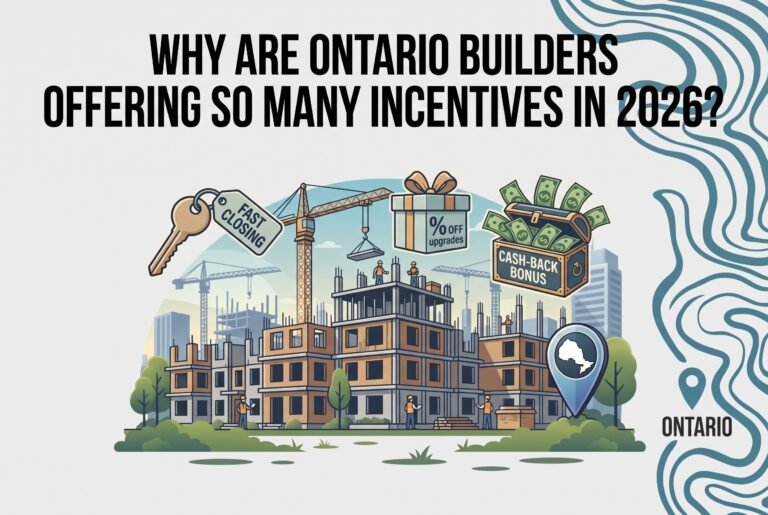
Why Are Ontario Builders Offering So Many Incentives in 2026? Updated October 30, 2026 If you’ve been shopping for a...

The Real Cost of a $700K, $800K or $1 Million New Home in Ontario Updated September 31, 2026 When buyers...