
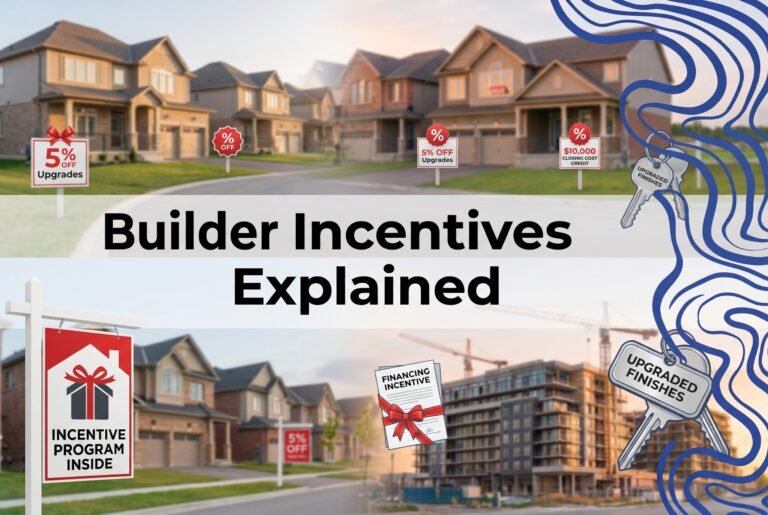
Builder Incentives Explained: Which Pre-Construction Incentives Actually Save You Money?
Updated September 25, 2026
If you’ve been looking at pre-construction homes in Ontario lately, you’ve probably seen advertisements promising:
$50,000 in incentives.
$100,000 in upgrades.
Extended deposits.
Free assignment.
Capped development charges.
Mortgage rates below market.
Finished basement included.
At first glance, these promotions can make one project look dramatically better than another.
But there is an important question every buyer should ask:
How much is the incentive actually worth to me?
A builder may advertise an incentive package worth $75,000 or even $100,000, but that does not necessarily mean the buyer is saving that amount in cash.
Some incentives directly reduce your cost.
Some improve your cash flow.
Some reduce future financial risk.
And others may sound impressive while providing relatively little practical value to your particular purchase.
In today’s competitive Ontario new-home market, understanding the difference is extremely important.
This guide explains the most common pre-construction builder incentives in Ontario, which ones can provide genuine financial value, and how buyers should compare them in 2026.
Why Are Builders Offering More Incentives in 2026?
Ontario’s new-home market has changed significantly from the peak years.
CMHC expects new housing starts in Toronto to remain low in 2026, with condominium construction particularly weak. Toronto housing sales are expected to improve, but remain below historical averages.
That creates a more competitive environment for builders.
Instead of buyers competing for every release, builders in some projects may need to compete for qualified purchasers.
Rather than simply cutting the advertised price, builders can use incentives to make the purchase more attractive.
These can include:
Price discounts
Extended deposits
Upgrade credits
Mortgage incentives
Finished basements
Free appliances
Capped development charges
Free assignments
Lot-premium discounts
Closing-cost credits
Flexible closing dates
The result can be excellent opportunities for buyers.
But only if you understand what you’re actually receiving.
Not All Builder Incentives Are Equal
Suppose two builders advertise:
Builder A
$50,000 incentive package
Builder B
$25,000 price reduction
Which is better?
You might assume Builder A.
But what if Builder A’s “$50,000 package” consists of:
$20,000 décor credit
$10,000 appliance value
$10,000 assignment incentive
$10,000 miscellaneous upgrades
while Builder B simply reduces the purchase price by:
$25,000
Builder B’s offer could potentially be more valuable depending on your needs.
Why?
Because a lower purchase price may reduce:
Mortgage principal
Down-payment requirement
Interest paid over time
Potential land transfer tax
Financing exposure
Meanwhile, you might not use every upgrade Builder A is offering.
The advertised value and your real economic value can be very different.
1. Direct Purchase Price Reduction
One of the easiest incentives to understand is a straightforward price reduction.
For example:
Original price:
$899,990
Builder promotion:
$50,000 discount
New price:
$849,990
This is generally one of the strongest incentives because the benefit is clear.
You are paying less for the property.
A lower purchase price can potentially reduce:
Mortgage amount
Down payment
Monthly payment
Land transfer tax
Interest over the mortgage term
However, always compare the discounted price against current resale homes and competing new-build projects.
A “$50,000 discount” doesn’t necessarily mean the property is inexpensive if the original price was above market.
2. Extended Deposit Structures
In today’s market, this can be one of the most useful incentives.
Suppose both builders require a total:
10% deposit
Builder A
Requires the full 10% within 90 days.
Builder B
Allows the 10% to be paid over 18 months.
The dollar amount is the same.
But Builder B’s structure could be significantly easier for the buyer.
For an $800,000 home:
10% deposit:
$80,000
Having 18 months rather than 90 days to accumulate that money can make a significant difference.
An extended deposit can allow you to:
Continue saving
Keep more emergency cash available
Avoid liquidating investments immediately
Coordinate the sale of another property
Better manage cash flow
This is not a direct discount.
But for many buyers, it is a very real financial benefit.
3. Reduced Deposits
Some builders may offer:
5% deposit
8% deposit
10% deposit
instead of the 15% or 20% schedules traditionally associated with some pre-construction projects.
For example:
$800,000 home
20% builder deposit
$160,000
versus
10% builder deposit
$80,000
That means:
$80,000 less cash tied up during construction.
However, remember:
Builder deposit does not equal final mortgage down payment.
You may still need additional equity at closing depending on your financing.
A lower deposit improves cash flow, but it does not necessarily reduce the final cost of the property.
4. Mortgage Rate Buydowns and Promotional Mortgage Programs
Mortgage incentives have become increasingly visible in new-home marketing.
A builder might advertise:
2.99% mortgage rate
or
3.49% mortgage rate
for a specified period.
This can be extremely valuable—but the details matter.
Questions to ask include:
How long is the promotional rate guaranteed?
Is it fixed or variable?
Which lender provides it?
Is the buyer required to qualify normally?
Is the rate valid until closing?
Is the builder paying a lump-sum subsidy?
What happens when the promotional period ends?
Can the incentive be exchanged for a cash discount?
For example, imagine the normal mortgage rate available to you is 4.5%, but the builder subsidizes your mortgage to 2.99% for two years.
That could produce significant monthly savings.
But it is not the same thing as having a 2.99% mortgage for the entire amortization period.
Always calculate:
Total dollar savings over the actual incentive period.
Do not evaluate a mortgage promotion based only on the advertised rate.
5. Décor and Upgrade Credits
Builders frequently offer:
$20,000 décor credit
or
$50,000 in upgrades
These incentives can be valuable if you intended to purchase those upgrades anyway.
Common upgrade categories include:
Flooring
Kitchen cabinets
Countertops
Staircases
Electrical upgrades
Bathrooms
Plumbing fixtures
Interior doors
Fireplace packages
But there are two important issues.
First: builder upgrade pricing may be higher than retail renovation pricing.
A $20,000 décor credit doesn’t necessarily represent $20,000 of market-value improvements.
Second: unused credit may have no cash value.
If you only want $8,000 of upgrades, a $20,000 credit may not provide the same benefit as a $20,000 price reduction.
Prioritize upgrades that are:
Difficult to change after closing
Structurally important
Expensive or disruptive to retrofit
Examples might include:
Ceiling-height changes
Staircase configurations
Structural walls
Additional bathrooms
Rough-ins
Electrical changes
Basement entrances
Cosmetic improvements can often be completed after closing.
6. Finished Basement Included
For detached and semi-detached buyers, a builder-finished basement can represent substantial value.
Depending on the project, the incentive could include:
Recreation room
Bedroom
Bathroom
Separate entrance
Larger windows
In-law suite configuration
A finished basement can potentially save buyers the time and inconvenience of completing major construction after possession.
But ask exactly what “finished basement” means.
Does it include:
Flooring?
Finished ceilings?
Bathroom?
Bedroom?
Separate entrance?
Kitchen rough-in?
Electrical?
HVAC extensions?
A builder saying:
“Finished basement included”
does not necessarily mean:
“Legal second dwelling included.”
A secondary suite must comply with applicable municipal zoning, Building Code, fire and other legal requirements.
Never advertise or assume that an ordinary finished basement is automatically a legal rental suite.
7. Appliance Packages
Many builders include appliance packages such as:
Refrigerator
Stove
Dishwasher
Washer
Dryer
Luxury projects may include premium appliance brands.
This can certainly save money.
But again, evaluate the real value.
If a builder advertises:
“$15,000 appliance package”
research whether those appliances actually have approximately that retail value.
Also check:
Exact models
Whether substitutions are permitted
Installation
Warranty
Whether the package is mandatory
Whether you can choose a different incentive instead
Appliances are useful, but they generally shouldn’t outweigh a major difference in home price or location.
8. Capped Development Charges
This is one of the most underrated builder incentives.
Builder agreements may allow certain municipal development charges, education development charges or other levies to be adjusted and passed to purchasers at closing.
These amounts can potentially increase during the years between purchase and completion.
An incentive stating:
“Development Charges Capped”
can therefore reduce uncertainty.
Suppose your APS specifies a purchaser cap of:
$10,000
That gives you greater certainty than an agreement containing broad uncapped adjustment provisions.
The value is not necessarily the cap itself.
The real value is:
Reducing your exposure to unexpected closing costs.
Have your lawyer verify exactly which charges are capped.
Ask:
What is capped?
At what amount?
Which charges remain uncapped?
Does HST apply to the cap?
Are utility charges separate?
Are education levies included?
A “capped development charges” promotion can be extremely valuable—but only if the contract wording actually protects you.
9. Free Assignment
An assignment allows a purchaser, subject to the APS and builder approval, to transfer their contractual interest to another purchaser before final closing.
Some builders charge assignment fees.
Others advertise:
“Free Assignment”
This can be valuable because life changes.
Between signing and closing, a buyer might:
Relocate
Change jobs
Get married
Separate
Have children
Experience financial changes
Decide the home no longer fits their needs
Having an assignment option provides flexibility.
But “free assignment” does not necessarily mean you can freely sell whenever you want.
Check:
Builder consent requirement
Administration fees
Legal fees
Marketing restrictions
Timing restrictions
Whether assignments are allowed before a certain sales threshold
Whether multiple assignments are prohibited
Tax and HST consequences may also apply.
Free assignment is best viewed as:
Flexibility insurance.
It can be extremely useful even if you never use it.
10. Lot Premium Discounts
Freehold buyers may pay premiums for lots such as:
Corner lots
Wider lots
Deeper lots
Ravine lots
Walkout lots
Pie-shaped lots
Green-space lots
A builder might offer:
$20,000 lot premium reduction
or
Premium lot included
This can provide direct value if you genuinely prefer that lot.
But don’t pay more for a feature simply because the builder has labelled it “premium.”
Evaluate:
Backyard usability
Road exposure
Sidewalk location
Utility boxes
Grading
Privacy
Future development
Sun exposure
Traffic
A premium lot should provide something valuable to you.
11. Closing-Cost Credits
Some builders may offer:
$5,000 toward closing costs
or
$10,000 closing credit.
This can be very useful because closing costs require cash.
Unlike a décor package, a closing credit addresses an expense you would likely face anyway.
Check whether the credit can be applied to:
Builder adjustments
Legal fees
Development charges
Purchase price balance
and whether any unused amount expires.
12. Free Parking or Locker
This is especially relevant to condominiums.
A parking space can represent a substantial additional cost depending on the project and location.
If the builder normally charges:
$60,000 for parking
and includes it at no additional cost, that can provide meaningful value.
But consider whether you actually need it.
For some downtown buyers without a vehicle, receiving a parking incentive may still provide resale value.
For others, a cash discount could be more useful.
The same principle applies to lockers.
13. Free Air Conditioning
For low-rise homes, some builders include central air conditioning as an incentive.
This is useful because otherwise the buyer may need to install it after closing.
But compare the value realistically.
A free air-conditioning system is a positive feature.
It should not be treated as equivalent to a major price reduction.
14. Free or Discounted Upgrades to Exterior Elevations
Builders sometimes offer premium elevations or exterior packages at reduced cost.
Examples can include:
Brick upgrades
Stone detailing
Larger windows
Premium façade designs
These can improve curb appeal and potentially resale desirability.
However, the financial benefit is subjective.
Buy the elevation because you value it—not because the builder has attached a large promotional number to it.
15. Flexible Closing Dates
A builder may allow a purchaser to choose among:
Quick closing
6-month closing
12-month closing
Later construction completion
This can be extremely useful.
A buyer who needs to sell an existing property may value additional time.
Another buyer may want immediate possession.
Flexibility can reduce:
Temporary accommodation
Bridge financing
Double carrying costs
Moving complications
Again, it isn’t a headline cash discount, but it can have real financial value.
16. HST Rebate Savings Are Not the Same as a Builder Incentive
This distinction is extremely important in 2026.
Ontario’s temporary Enhanced New Housing Rebate applies to qualifying new homes purchased from builders under agreements entered into from:
April 1, 2026 through March 31, 2027
and can provide eligible purchasers with up to:
$80,000
of enhanced provincial HST relief.
Ontario has also created additional affordability relief connected with the federal portion, while qualifying first-time buyers may have access to the federal First-Time Home Buyers’ GST/HST Rebate.
Potential combined relief can reach substantial amounts depending on eligibility.
However:
A government HST rebate is not a builder discount.
If a builder advertises:
“Save up to $130,000!”
you need to determine how much of that amount is:
Government HST relief
Builder discount
Upgrade value
Other incentives
The builder should not receive credit for a government program as though the entire amount is a builder-funded incentive.
Compare these separately.
How to Calculate the Real Value of a Builder Incentive Package
Suppose a builder advertises:
$100,000 IN INCENTIVES
The package consists of:
Price reduction:
$20,000
Décor credit:
$25,000
Finished basement:
Advertised value $30,000
Appliances:
Advertised value $10,000
Free assignment:
Advertised value $5,000
Development-charge protection:
Advertised value $10,000
Total advertised:
$100,000
But your personal calculation might look different.
You were already planning:
$15,000 of upgrades
Basement completion later for approximately $25,000
$7,000 appliance budget
You may therefore personally value the package closer to:
Price reduction:
$20,000
Useful upgrades:
$15,000
Basement:
$25,000
Appliances:
$7,000
Assignment flexibility:
Potential value
Development-charge cap:
Risk reduction
The “$100,000 package” may still be excellent.
But its real value to you isn’t necessarily exactly $100,000.
Which Builder Incentives Are Usually Most Valuable?
Every buyer is different, but generally I would rank incentives approximately this way:
Tier 1 — Strongest Financial Value
Direct price reduction
Real reduction in purchase cost.
Mortgage subsidy or meaningful rate buydown
Potentially substantial cash-flow savings if properly structured.
Capped or waived closing adjustments
Reduces future cost and uncertainty.
Significant HST relief
Not technically a builder incentive, but extremely important to total affordability.
Tier 2 — Strong Practical Value
Extended deposits
Excellent for cash flow.
Reduced deposits
Preserves liquidity.
Finished basement
Potentially high practical value for families.
Lot-premium reduction
Strong when buying a genuinely desirable lot.
Closing-cost credit
Directly reduces cash needed at closing.
Tier 3 — Valuable Depending on Buyer
Décor credits
Good if you were planning upgrades anyway.
Appliances
Useful but relatively easy to purchase separately.
Free assignment
Excellent flexibility, although you may never use it.
Free parking or locker
Can be extremely useful depending on location and lifestyle.
Tier 4 — Nice Extras
Air conditioning
Premium exterior elevation
Smart-home package
Window coverings
Minor décor upgrades
These are positive features, but they generally should not drive your buying decision.
Cash Incentive vs Upgrade Incentive: Which Is Better?
Suppose you’re offered:
Option A
$25,000 purchase-price reduction
or
Option B
$35,000 décor credit.
Which should you choose?
If you genuinely planned $35,000 of builder upgrades, Option B may be excellent.
But if you only wanted $10,000 of upgrades, the $25,000 price reduction could provide significantly more value.
Ask whether the builder allows:
Incentive substitution.
Sometimes a builder will allow certain incentives to be exchanged or restructured.
Sometimes they will not.
It never hurts to ask.
Should You Negotiate With a Builder?
Potentially.
Builder negotiation works differently from resale negotiation.
A builder may be reluctant to reduce the recorded sale price because lower sale prices can affect:
Future project pricing
Comparable sales
Existing buyers
Appraisals
Project financing
Instead, a builder may be more willing to provide:
Upgrades
Deposit flexibility
Lot premiums
Closing credits
Appliances
Assignment rights
Development-charge caps
That is why negotiating pre-construction can often be about:
Improving the package rather than simply lowering the price.
Inventory Homes May Offer Stronger Incentives
Completed or nearly completed inventory homes can sometimes offer particularly attractive incentives.
Why?
Because the builder has already invested significant capital into:
Land
Construction
Financing
Materials
Labour
An unsold completed home represents carrying costs.
This can motivate a builder to offer stronger terms for a qualified buyer who can close relatively quickly.
Potential inventory incentives can include:
Larger price discounts
Quick-closing credits
Free appliances
Upgrade packages
Finished basements
Lot-premium reductions
Flexible closing
Not every inventory home is discounted.
But they are always worth comparing with traditional pre-construction releases.
Don’t Let an Incentive Hide an Overpriced Home
This is probably the most important point in this entire guide.
Imagine:
Comparable resale homes:
$850,000
Builder home:
$950,000
Builder advertises:
$75,000 in incentives
Even if you genuinely value every incentive at $75,000:
Effective comparison:
$875,000
The resale home may still be cheaper.
That does not automatically mean resale is better.
The new home may include:
Warranty protection
Better energy efficiency
New mechanical systems
Modern design
Lower maintenance
Longer closing
HST relief
But you need to compare the complete value proposition.
Never allow a large incentive headline to stop you from comparing actual market value.
Compare Incentives Using This Formula
When evaluating a project, calculate:
Purchase Price
minus
Real Value of Builder-Funded Incentives
minus
Government Rebates You Personally Qualify For
plus
Expected Closing Costs
plus
Upgrades You Still Need
=
Your Effective Purchase Cost
Then compare that number against:
Nearby resale homes
Competing builder projects
Inventory homes
Alternative communities
This is a much better method than simply comparing advertised starting prices.
Questions to Ask About Every Builder Incentive
Before buying, ask:
Is the incentive written into the APS?
Is it builder-funded or government-funded?
Does it have an expiry date?
Can it be exchanged for another incentive?
Does unused credit have cash value?
Are upgrades priced at builder retail values?
Which development charges are actually capped?
Does HST apply to the incentive or cap?
Does “free assignment” still require builder approval?
How long does a promotional mortgage rate last?
Can a rate incentive be combined with other promotions?
Is the incentive available on every lot/model?
Does accepting the incentive remove another benefit?
Is it reflected in the final APS or amendment?
If it isn’t documented, don’t rely on it.
5 Warning Signs With Builder Incentives
1. Huge incentive with no breakdown
Ask exactly how the total was calculated.
2. Government rebate presented as builder savings
Separate government HST programs from builder-funded incentives.
3. “Free assignment” with restrictive conditions
Read the actual assignment clause.
4. “Capped closing costs” without knowing what is capped
There may still be uncapped charges.
5. Pressure to sign immediately because incentives are “ending tonight”
Promotions can legitimately expire, but never skip financial and legal due diligence because of artificial urgency.
Example: Comparing Two $800,000 Homes
Project A
Purchase price:
$800,000
Incentives:
$20,000 décor credit
Free appliances
10% deposit over 12 months
Project B
Purchase price:
$820,000
Incentives:
$20,000 price reduction
Development charges capped
Finished basement
10% deposit over 18 months
Headline price makes Project A appear cheaper.
But after the price reduction:
Project B effectively starts at:
$800,000
Then adds:
Finished basement
Development-charge protection
Better deposit terms
Project B might actually provide stronger overall value.
This is why buyers should compare the package—not just the sticker price.
Frequently Asked Questions
Why are Ontario builders offering so many incentives in 2026?
Ontario’s new-home market is significantly more competitive than during the peak years. CMHC expects Toronto new construction to remain weak in 2026, particularly in condominiums, while housing sales remain below historical averages. Builders may therefore use incentives to attract qualified buyers without necessarily reducing headline prices.
What is the best builder incentive?
A direct price reduction is among the easiest incentives to value. Capped closing costs, mortgage subsidies, extended deposits and finished basements can also provide substantial value depending on the buyer.
Is a $50,000 décor credit really worth $50,000?
Not necessarily to you. It represents builder-design-centre purchasing power. Its personal value depends on which upgrades you actually want and how builder pricing compares with completing those upgrades later.
Are government HST rebates builder incentives?
No. HST rebates are government programs. Ontario’s Enhanced New Housing Rebate, for example, is a government rebate available to eligible purchasers under specified conditions.
What does capped development charges mean?
It means specified charges covered by the contractual cap cannot exceed the amount stated in the agreement. Your lawyer should verify which charges are included and which remain uncapped.
Is free assignment valuable?
Potentially. It gives a purchaser additional flexibility if circumstances change before closing. However, builder approval, legal costs and restrictions may still apply.
Should I choose a lower price or more upgrades?
Usually compare the real dollar value. If you don’t need the upgrades, a smaller direct price discount may be worth more to you than a larger décor package.
Can Realtors negotiate incentives with builders?
Depending on the builder and project, there may be opportunities to request pricing adjustments, upgrades, deposit flexibility or other concessions. Builder policies vary, and some programs are fixed.
The Bottom Line
The best pre-construction incentive isn’t necessarily the one with the biggest number beside it.
A “$100,000 incentive package” can be less valuable than:
$40,000 of benefits you actually need.
When evaluating a builder promotion, separate incentives into three categories:
1. Real cost savings
Price reductions, closing credits and waived charges.
2. Cash-flow benefits
Lower deposits, extended deposits and mortgage subsidies.
3. Added-value benefits
Finished basements, upgrades, appliances, assignments and premium lots.
Then compare the effective cost of the home against resale properties and competing new-build projects.
In today’s Ontario market, buyers often have more ability to compare projects and incentive packages than they did during the peak years.
Use that leverage carefully.
Don’t ask only, “What is the builder giving me?”
Ask:
“What am I actually paying for this home after everything is included?”
That is the number that matters.
Looking for the Best Builder Incentives in Ontario?
Builder promotions can change quickly, and the strongest advertised incentive isn’t always the best overall deal.
At New Home Source, we help buyers compare current pre-construction and inventory-home opportunities based on:
Actual builder pricing
Current incentives
Deposit structures
HST rebate opportunities
Capped development charges
Available inventory
Lot premiums
Closing timelines
Competing projects and resale options
Whether you’re considering a townhome, semi-detached or detached home, we can help you look beyond the headline promotion and compare the complete purchase structure.
Contact New Home Source to explore current builder incentives and new-home opportunities available across Ontario.
Disclaimer: This article is provided for general informational and real-estate marketing purposes only and does not constitute legal, tax, mortgage, financial or investment advice. Builder pricing, incentives, deposit programs and availability can change without notice. HST rebate eligibility depends on the purchaser and transaction. Buyers should have all incentives documented in their Agreement of Purchase and Sale or applicable amendment and obtain independent legal, mortgage and tax advice where appropriate.
You Might Also Like
In the heart of Canada’s largest city, downtown Toronto continues to be a focal point for those seeking the vibrancy...
Assignment Sales in Ontario: What Pre-Construction Buyers Need to Know Updated November 8 2026 When you buy a pre-construction home...
Interim Occupancy Explained: Why Condo Buyers Pay Before They Own the Unit Updated November 19, 2026 You’ve purchased a pre-construction...