
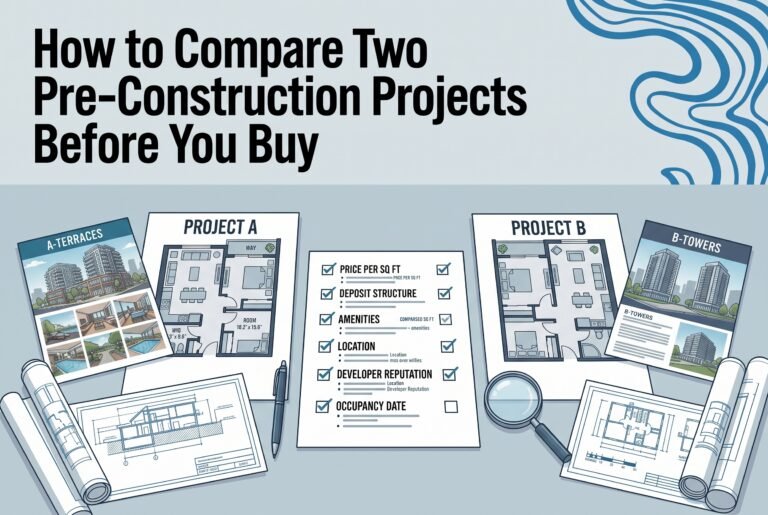
How to Compare Two Pre-Construction Projects Before You Buy
Updated November 23, 2026
You’ve narrowed your search down to two pre-construction projects.
Both look impressive.
Both have attractive floor plans.
Both are offering incentives.
And both sales representatives are telling you:
“This is a great opportunity.”
So how do you actually decide which one is better?
One of the biggest mistakes pre-construction buyers make is comparing projects based only on:
Starting Price.
A $749,000 home isn’t automatically a better deal than a $779,000 home.
The more expensive project could include:
Better incentives
Lower closing costs
Better deposit terms
Larger lot
Finished basement
Better location
Stronger builder
More flexible closing
Better long-term value
The right way to compare pre-construction projects is to evaluate the complete purchase, not one number on a price list.
Here’s a practical framework Ontario buyers can use.
Start With the Actual Home You Would Buy
Don’t compare:
Project A “from $699,990”
against:
Project B “from $729,990.”
Those starting prices may represent completely different homes.
Instead, compare the actual models that meet your requirements.
For example:
Project A
3-bedroom townhome
1,750 sq. ft.
Single garage
20-foot lot
$749,990
Project B
3-bedroom townhome
1,850 sq. ft.
Single garage
22-foot lot
$779,990
Now you have a meaningful comparison.
1. Compare the Real Purchase Price
Start with:
Base Price
Then add:
Lot premium
Elevation premium
Structural upgrades
Parking
Locker
Finished basement
Other mandatory costs included in purchase price
For example:
Project A
Base price: $749,000
Lot premium: $20,000
Desired structural upgrade: $10,000
Actual price:
$779,000
Project B
Base price: $775,000
Lot premium: Included
Structural feature: Included
Actual price:
$775,000
Suddenly Project B is cheaper.
2. Compare Price Per Square Foot Carefully
Price per square foot can be useful, particularly for condos and similar housing types.
But don’t use it blindly.
Suppose:
Project A
1,600 sq. ft.
$720,000
Approximately:
$450/sq. ft.
Project B
1,800 sq. ft.
$790,000
Approximately:
$439/sq. ft.
Project B is more expensive overall but cheaper per square foot.
However, square footage doesn’t tell you everything.
Also compare:
Layout
Hallway space
Bedroom sizes
Basement
Garage
Outdoor area
Ceiling heights
Lot size
A well-designed 1,700-square-foot home can function better than a poorly designed 1,900-square-foot home.
3. Compare the Deposit Structure
Two homes can have the same purchase price but very different cash requirements.
Suppose both cost:
$800,000.
Project A
10% deposit within 90 days:
$80,000
Project B
10% deposit over 18 months:
$80,000
Total deposit is identical.
But Project B gives you significantly more time to save.
That has real value.
Compare:
Initial deposit
Total deposit
Payment dates
Length of deposit schedule
Whether extensions are available
Don’t compare percentage alone.
Compare:
Cash-flow timing.
4. Compare Builder Incentives
This is where many buyers get distracted.
Project A advertises:
$75,000 in incentives.
Project B advertises:
$40,000 in incentives.
You might immediately assume Project A is better.
But what do those incentives include?
Project A
$30,000 décor credit
$15,000 appliance package
Free assignment
Extended deposit
Project B
$25,000 price reduction
Capped development charges
Finished basement
Project B’s smaller headline package may actually save you more money.
Convert every incentive into:
Real value to you.
5. Separate Government Rebates From Builder Incentives
This is particularly important in 2026.
If both projects qualify for the same government HST program, that rebate doesn’t necessarily make one builder better than the other.
For example:
Builder A says:
“Up to $130,000 in savings!”
Builder B says:
“Up to $50,000 builder incentives.”
Builder A’s advertised savings may include government HST relief.
Builder B’s may be actual builder-funded benefits.
Separate:
Government relief
from
Builder-funded incentives.
Then compare fairly.
6. Compare Development Charges and Closing Costs
This is one of the most overlooked comparisons.
Project A:
$760,000
but development charges are broadly uncapped.
Project B:
$775,000
but specified development charges are capped at:
$10,000.
The $15,000 price difference may be worth paying for greater closing-cost certainty.
Ask your lawyer to identify:
Development-charge caps
Education levy caps
Utility caps
Municipal adjustments
Uncapped charges
A lower base price can become a more expensive transaction at closing.
7. Compare the Builder
Never compare houses without comparing who is building them.
Research:
Licensing
Years in business
Completed communities
Construction history
Customer service
Warranty history
Reputation
A slightly cheaper home from an inexperienced or poorly regarded builder isn’t automatically a better purchase.
You are trusting the builder to deliver something you may not receive for years.
Builder quality matters.
8. Compare the Location
Location remains one of the most important real-estate fundamentals.
Compare access to:
Employment
Highways
Transit
GO stations
Schools
Shopping
Hospitals
Parks
Recreation
Future infrastructure
Ask:
Which location will still make sense ten years from now?
Don’t buy a home simply because the builder is offering a large incentive.
9. Compare the Exact Lot
For low-rise homes, the lot can be just as important as the floor plan.
Compare:
Lot width
Lot depth
Backyard
Corner position
Ravine
Walkout potential
Street traffic
Sidewalk
Utility boxes
Fire hydrants
Stormwater areas
Future development
A cheaper lot may come with compromises.
A premium lot may justify a higher price.
10. Compare Parking
This matters more than many buyers realize.
Ask:
Garage size
Driveway length
Tandem parking
Two-car garage
Parking restrictions
Visitor parking
For townhomes, one project might provide:
2-car parking
while another offers:
4-car parking.
For a growing family, that can materially affect long-term usability and resale demand.
11. Compare the Floor Plan
Don’t buy square footage.
Buy:
Usable space.
Look at:
Bedroom dimensions
Closet space
Kitchen layout
Island
Pantry
Laundry location
Main-floor office
Powder room
Basement
Ceiling heights
Windows
Natural light
Pay particular attention to wasted space.
Long hallways and oversized foyers add square footage without necessarily adding useful living space.
12. Compare Basement Options
For low-rise homes, ask:
Is there a basement?
Is it finished?
Is there a separate entrance?
Are larger windows available?
Is there a bathroom rough-in?
Can an in-law suite be created?
What ceiling height is provided?
A finished basement can significantly change a home’s effective usable space.
But remember:
Finished basement does not automatically mean legal apartment.
13. Compare Included Features
Builders have different standard specifications.
One may include:
Hardwood
Quartz counters
Air conditioning
Appliances
Oak stairs
Smooth ceilings
Another may charge extra.
A lower base price can become much more expensive after upgrades.
Compare the:
Standard Features & Finishes.
14. Compare Ceiling Heights
Ceiling height can affect how spacious a home feels.
For example:
Project A
9-foot main floor
8-foot second floor
Project B
9-foot main floor
9-foot second floor
That difference may matter.
Likewise, basement ceiling height can affect future usability.
15. Compare Closing Dates
Suppose:
Project A
Closing:
2027
Project B
Closing:
2029
Which is better?
Depends on you.
A longer closing gives you:
More saving time
More deposit time
More planning time
A shorter closing gives you:
Greater certainty
Less long-term market exposure
Earlier possession
Closing timeline should match your life plan.
16. Compare Construction Stage
A project at:
Early launch
has different risks from a home that is:
Already under construction.
And both are different from:
Completed builder inventory.
Generally, the further along construction is, the more certainty you have around what you’re buying.
But earlier purchases may provide more selection.
17. Compare Assignment Rights
Ask:
Is assignment allowed?
Builder consent required?
Fee?
Free assignment incentive?
Marketing restrictions?
Timing restrictions?
You may never use assignment.
But over a three-year closing period, flexibility has value.
18. Compare HST Treatment
Do not simply ask:
“Is HST included?”
Ask:
Which rebate is assumed?
Do I qualify?
Is the rebate already reflected in price?
What happens if I don’t qualify?
Does the builder credit it?
Two projects can market HST differently.
Make sure you’re comparing equivalent prices.
19. Compare Resale Homes Too
Before choosing either project, compare:
Resale.
Suppose:
Project A
$800,000
Project B
$825,000
Comparable resale
$725,000
Now the question changes.
Do the new-home benefits justify the premium?
Alternatively, if resale is:
$810,000
then the builder projects may look much stronger.
Always include the existing market in your comparison.
20. Compare Builder Inventory
Ask both builders:
“Do you have any inventory or quick-closing homes?”
Sometimes the best opportunity isn’t the current release.
A completed home may offer:
Better incentives
Faster closing
Included upgrades
Price flexibility
Never assume the newest release is the best deal.
Create a Project Scorecard
A simple scoring system can help.
Score each project from:
1 to 10
for:
Price
Deposit
Builder
Location
Lot
Floor plan
Included finishes
Incentives
Closing costs
Closing timeline
Resale comparison
Flexibility
Then calculate the overall result.
It doesn’t make the decision for you.
But it prevents one flashy incentive from dominating your thinking.
Example: Project A vs Project B
Project A
Price: $749,000
Deposit: 10% over 6 months
Closing: 2028
Décor: $25,000
Development charges: Uncapped
Builder: Established
Lot: Standard
Project B
Price: $769,000
Deposit: 10% over 18 months
Closing: 2027
Décor: $10,000
Development charges: Capped
Builder: Established
Basement: Finished
At first:
Project A looks cheaper.
But Project B provides:
Better deposit timing
Closing-cost protection
Finished basement
Earlier possession
The extra:
$20,000
might be excellent value.
Or it might not.
The correct answer depends on what those benefits are worth to you.
15 Questions to Ask Before Choosing
What is the actual purchase price of my preferred model?
What lot premium applies?
What is the full deposit schedule?
Which incentives are genuinely builder funded?
Which government rebates may apply?
Which closing costs are capped?
Which remain uncapped?
What finishes are included?
How experienced is the builder?
What is the project’s construction status?
What is the realistic closing timeline?
Is assignment permitted?
How does the price compare with resale?
Is builder inventory available?
Which home would I prefer if both cost exactly the same?
That final question can reveal a lot.
Frequently Asked Questions
Should I choose the cheaper pre-construction project?
Not automatically. Compare the effective purchase cost, deposit, incentives, closing adjustments, builder, location and property itself.
Is the project with the biggest incentive better?
Not necessarily. A smaller direct price reduction or closing-cost cap may be more valuable than a larger décor package.
Should I compare price per square foot?
Yes, where appropriate, but don’t ignore layout, lot, parking and included features.
Does builder reputation matter?
Absolutely. You are relying on that builder to deliver the home and address warranty obligations.
Is a longer closing better?
It can give you more time to save but also creates more financing, appraisal and market uncertainty.
Should I compare resale?
Always. New construction should compete for your money against the best resale alternatives.
Is completed inventory worth checking?
Yes. Inventory homes can sometimes provide excellent combinations of incentives, upgrades and faster closing.
The Bottom Line
Don’t choose a pre-construction project based on:
Price alone.
Compare:
Actual Price
Deposit
Closing Costs
−
Real Builder Incentives
−
Government Relief You Qualify For
Required Upgrades
=
Effective Purchase Cost.
Then evaluate:
Builder + Location + Lot + Layout + Timeline + Flexibility.
The best project isn’t necessarily the cheapest.
It’s the project offering the strongest combination of:
Value + Usability + Financial Comfort + Long-Term Fit.
Comparing Two New-Home Projects?
At New Home Source, we help buyers compare competing projects before making a commitment.
Tell us the:
Two Projects + Your Budget + Preferred Model + Closing Timeline
and we can help you examine:
Pricing
Deposits
Builder incentives
Lot availability
Closing costs
HST opportunities
Inventory
Resale alternatives
Contact New Home Source before choosing your next new home and compare the complete deal—not just the advertised price.
Disclaimer: This article is provided for general informational and real-estate marketing purposes only and does not constitute legal, financial, mortgage, tax or investment advice. Builder prices, incentives, availability and closing costs can change. Buyers should have their Agreement of Purchase and Sale reviewed by a qualified Ontario real-estate lawyer and obtain appropriate financing and tax advice.
You Might Also Like
Freehold Townhouse vs Condo Townhouse in Ontario: Which Is Better? Updated November 30, 2026 Townhouses have become one of the...
Investing in pre-construction condos in the Greater Toronto Area (GTA) can be a fantastic opportunity for both first-time buyers and...

Buying your first home is a monumental milestone, and in a market as diverse and dynamic as the Greater Toronto...