
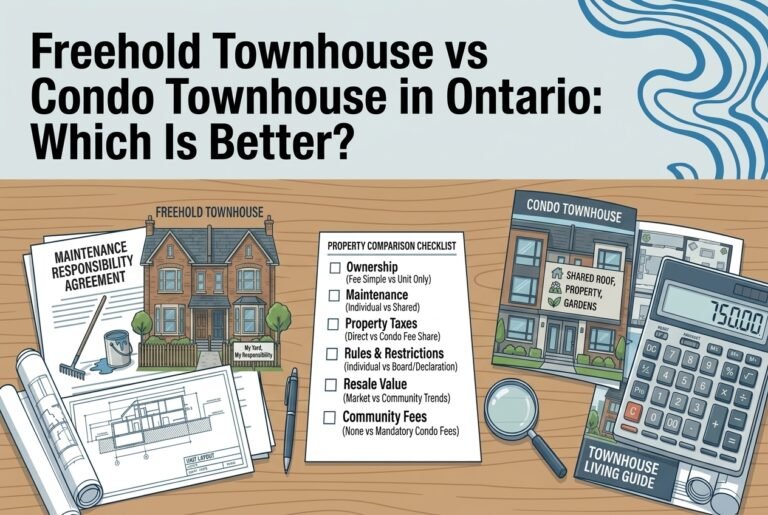
Freehold Townhouse vs Condo Townhouse in Ontario: Which Is Better?
Updated November 30, 2026
Townhouses have become one of the most important housing choices for Ontario buyers.
They can provide more space than a typical condominium apartment while remaining more affordable than many detached homes.
But when buyers start looking at townhomes, another question quickly appears:
Freehold townhouse or condo townhouse?
At first glance, they may look almost identical.
Both can offer:
Multiple bedrooms
Garage
Driveway
Backyard or terrace
Multi-level living
Family-oriented layouts
But the ownership structure can be very different.
That affects:
Monthly fees
Maintenance responsibilities
Insurance
Renovations
Common areas
Rules
Resale
Overall affordability
Neither option is automatically better.
Here’s how Ontario buyers should compare them in 2026.
What Is a Freehold Townhouse?
A traditional freehold townhouse generally means you own:
The home and the land associated with it.
There usually isn’t a condominium corporation managing the property.
You are typically responsible for maintaining your own:
Roof
Exterior
Windows
Driveway
Landscaping
Snow removal
Backyard
Mechanical systems
There may be exceptions, including certain common-element structures, so always confirm the exact ownership type.
What Is a Condo Townhouse?
With a condominium townhouse, you own your individual unit or interest as defined by the condominium documents and share ownership or responsibility for common elements through the condominium corporation.
You normally pay:
Monthly condominium fees.
Depending on the development, those fees may contribute toward:
Exterior maintenance
Landscaping
Snow removal
Private roads
Garbage services
Building insurance
Common utilities
Amenities
Reserve fund
Exactly what is included varies significantly from one condominium to another.
What Is a POTL or Common-Element Townhouse?
Ontario also has ownership structures that sit somewhere between traditional freehold and conventional condominium townhouses.
You may see terms such as:
POTL — Parcel of Tied Land
or
Common Elements Condominium.
In these arrangements, you may own your house and land as freehold but also have a legal interest in shared common elements.
Examples might include:
Private roads
Visitor parking
Landscaping
Shared amenities
Garbage areas
You may therefore pay a monthly common-element fee even though the house itself is freehold.
This is why buyers shouldn’t assume:
“It has a fee, so it must be a condo townhouse.”
or:
“It’s freehold, so there can never be a monthly fee.”
Always confirm the legal ownership structure.
Freehold vs Condo Townhouse at a Glance
Feature | Freehold Townhouse | Condo Townhouse |
Monthly condo fee | Usually none | Usually yes |
Exterior maintenance | Owner | Often corporation, depending on documents |
Snow/landscaping | Owner | Often included |
Rules/restrictions | Fewer private condo rules | Condominium rules apply |
Reserve fund | No condo reserve fund | Yes |
Roof/exterior repairs | Owner responsibility | Often corporation responsibility |
Insurance | Full homeowner coverage | Owner policy + corporation coverage |
Renovation freedom | Generally more | May require approval |
Purchase price | Often higher | Can be lower |
Ongoing costs | Less predictable repairs | More predictable monthly fee but can rise |
Amenities | Less common | Sometimes included |
1. Purchase Price
Condo townhouses can sometimes have a lower purchase price than comparable freehold towns.
For example:
Condo Townhouse
Price:
$650,000
Maintenance:
$450/month
Freehold Townhouse
Price:
$725,000
Maintenance fee:
$0
At first glance, the condo townhouse is:
$75,000 cheaper.
That can make it easier to enter the market.
But you also need to consider the long-term monthly fee.
2. Monthly Condo Fees
This is the most obvious difference.
Suppose the condo townhouse charges:
$450 per month.
That equals:
$5,400 per year.
Over ten years, ignoring increases:
$54,000.
But you shouldn’t conclude:
“That’s $54,000 wasted.”
The fee may be paying for services you would otherwise need to fund yourself.
For example:
Roof reserve
Exterior maintenance
Snow removal
Landscaping
Insurance
Private roads
The right question is:
What does the maintenance fee actually include?
3. Freehold Doesn’t Mean Maintenance Is Free
A freehold townhome may have no monthly condo fee.
That’s attractive.
But you are responsible for future repairs.
Eventually you may need to pay for:
Roof
Windows
Driveway
Exterior repairs
Landscaping
Fencing
Snow equipment
Other maintenance
Instead of paying:
$400 each month
you may occasionally face:
$8,000
or
$15,000
repair bills.
A disciplined freehold owner should create their own maintenance reserve.
4. Condo Fees Can Provide Predictability
For some buyers, monthly maintenance fees make budgeting easier.
Rather than worrying about a major common-element expense directly, the condominium corporation collects fees from owners and builds a:
Reserve fund.
That reserve is intended to help fund major future repair and replacement of common elements.
This doesn’t eliminate financial risk.
But it creates a structured process.
5. Condo Fees Can Increase
Another important consideration:
Maintenance fees aren’t permanently fixed.
They can rise because of:
Inflation
Insurance
Utilities
Labour costs
Repairs
Reserve-fund needs
Contract costs
A condo with unusually low fees isn’t automatically better.
In fact, fees that are too low can sometimes mean insufficient money is being collected for future expenses.
6. What Is a Special Assessment?
If a condominium corporation faces a significant expense that cannot be adequately covered through available funds, owners may potentially face a:
Special assessment.
This is an additional amount owners are required to contribute.
For example, major repairs could involve:
Roof
Parking structure
Private roads
Exterior
Mechanical systems
This is why resale condo-townhouse buyers should carefully review the:
Status Certificate.
7. Freehold Owners Have More Control
One of the biggest attractions of freehold ownership is autonomy.
Subject to:
Municipal bylaws
Building Code
Easements
Subdivision agreements
Other legal restrictions
you generally have more freedom over your property.
You may have greater flexibility involving:
Landscaping
Exterior improvements
Backyard
Renovations
Doors
Windows
Fences
Condo owners operate within an additional layer of condominium rules.
8. Condo Townhouses Can Have More Restrictions
A condominium corporation may have rules relating to:
Exterior changes
Parking
Landscaping
Pets
Use of common areas
Satellite dishes
EV charging installations
Exterior decorations
Renovations affecting common elements
These rules aren’t necessarily bad.
They can help maintain consistency throughout the community.
But buyers who highly value independence may prefer freehold ownership.
9. Exterior Maintenance Can Be Easier in a Condo Townhouse
Some buyers don’t want to spend weekends dealing with:
Snow
Landscaping
Exterior repairs
Roof maintenance
Depending on what the corporation covers, condo-townhouse living can reduce those responsibilities.
This may appeal to:
Busy professionals
Seniors
Travellers
First-time buyers
People who prefer lower-maintenance living
Again, read the condominium documents.
Not every condo townhouse includes the same services.
10. Freehold May Appeal More to Families Wanting Control
Families may prefer traditional freehold ownership because it can provide:
Greater control of backyard
Fewer condominium restrictions
Ability to personalize
No monthly condominium fee
More autonomy over maintenance
But families who want convenience may prefer a well-managed condo townhouse.
Lifestyle matters as much as mathematics.
11. What About Insurance?
Insurance works differently.
Freehold
You generally arrange homeowner insurance covering the house and your property.
Condo Townhouse
The condominium corporation typically carries insurance for areas covered under its responsibilities, while you need your own condominium-unit insurance for matters such as:
Personal contents
Improvements
Liability
Deductible exposure
Other unit-owner risks
Never assume the corporation’s insurance means you don’t need your own policy.
12. Mortgage Qualification Can Be Different
Mortgage lenders consider your total housing expenses.
For a condo townhouse, this can include the applicable portion of:
Monthly condo fees.
That means a lower-priced condo townhouse isn’t always automatically easier to qualify for than a slightly more expensive freehold.
Your mortgage professional should calculate both scenarios.
Example: Monthly Cost Comparison
Consider:
Condo Townhouse
Price:
$650,000
Maintenance:
$450/month
versus:
Freehold Townhouse
Price:
$700,000
Maintenance:
No monthly condo fee
The condo has a smaller mortgage.
But the lender also considers condominium fees.
The freehold has a larger mortgage.
The correct comparison is:
Total Monthly Housing Cost.
Not simply purchase price.
13. Land Transfer Tax Applies to Both
Whether you buy freehold or condominium ownership, Ontario Land Transfer Tax generally needs to be considered.
Toronto purchases can also involve Toronto Municipal Land Transfer Tax.
Eligible first-time buyers may qualify for applicable refunds.
The ownership format does not eliminate those closing costs.
14. HST Can Apply to New Versions of Both
If you purchase a newly built:
Freehold townhome
Condo townhome
from a builder, HST generally needs to be considered.
Current federal and Ontario new-housing rebate programs may provide significant relief to qualifying purchasers.
The important issue is:
New vs resale
rather than simply:
Freehold vs condo.
15. Tarion Can Protect Qualifying New Versions of Both
Qualifying newly built freehold and condominium townhomes can receive statutory Ontario new-home warranty protection.
However, common-element responsibilities differ.
For condominium properties, some defects may affect:
Individual unit
while others involve:
Common elements.
Understanding who is responsible is essential.
16. Resale Condo Buyers Should Review the Status Certificate
If you’re buying an existing condominium townhouse, the:
Status Certificate
is one of the most important due-diligence documents.
It can provide information involving:
Monthly common expenses
Arrears
Reserve fund
Insurance
Legal matters
Condominium rules
Financial position
Your lawyer should review it.
Never choose a condo townhouse based only on:
Low maintenance fee.
Understand the corporation behind the fee.
17. New Condo Townhouse Fees Are Estimates
For a pre-construction condominium townhouse, the builder provides estimated common expenses.
But the condominium hasn’t been operating for years yet.
Actual future costs can be different.
When comparing a new condo townhouse with a freehold town:
Don’t assume today’s estimated fee will remain unchanged.
18. Freehold Resale Can Sometimes Be More Desirable
In many suburban markets, traditional freehold townhouses have strong buyer appeal because they offer:
Lower monthly fixed fees
Private yards
Parking
Greater control
This can support resale demand.
But location, price, layout and condition matter more than one ownership label.
A well-located condo townhouse can outperform a poorly located freehold.
19. Condo Townhouses Can Offer Better Entry-Level Affordability
For buyers priced out of traditional freeholds, condo towns can provide:
More bedrooms than a condo apartment
Ground-level access
Outdoor space
Parking
Family-oriented layout
at a lower purchase price.
That can make them an important stepping stone into homeownership.
20. What About Stacked Townhouses?
A stacked townhouse is typically another form of condominium ownership.
Instead of each townhome extending from ground to roof, units are stacked vertically.
For example:
Lower unit
Upper unit
These can be more affordable than traditional two-storey freehold townhouses.
But they may involve:
More stairs
Less backyard
Condo fees
Shared structure
Neighbours above or below
They should be evaluated separately from traditional towns.
Which Is Better for First-Time Buyers?
There is no universal answer.
Condo townhouse may be better if:
Lower price is critical
You value maintenance convenience
You don’t mind condo rules
The corporation is financially healthy
Freehold may be better if:
You can afford the higher purchase price
You want more control
You prefer no monthly condo fee
You’re comfortable managing maintenance
The best choice is the one you can comfortably own—not simply the one with the lowest advertised price.
Which Is Better for Families?
Families often value:
Bedrooms
Backyard
Parking
Schools
Storage
Basement
Outdoor space
Traditional freehold towns frequently perform well on these criteria.
But condo townhouse communities can also be excellent for families, especially where:
Parks are nearby
Exterior maintenance is included
Purchase price is lower
Community amenities are available
Compare the individual property.
Which Is Better for Investors?
Investors should consider:
Purchase price
Market rent
Condo fees
Property tax
Insurance
Maintenance
Tenant demand
Appreciation potential
Resale liquidity
A lower-priced condo town can produce attractive rental economics.
But rising condominium fees can affect cash flow.
A freehold may have no monthly condo fee but still requires the owner to fund repairs.
Run the numbers.
10 Questions to Ask Before Choosing
What exactly do I own?
Is there a condo corporation?
Is it POTL/common element?
What does the monthly fee include?
What am I personally responsible for maintaining?
Can condo fees increase?
What rules affect my use of the property?
What does the same budget buy in freehold?
How does the lender treat the condo fee?
Which home better fits my lifestyle five years from now?
Example: Which One Is Better?
Suppose:
Condo Townhome
Price:
$625,000
Fee:
$400/month
Includes:
Snow
Landscaping
Exterior maintenance
versus:
Freehold Townhome
Price:
$690,000
Fee:
$0
but owner handles:
Snow
Landscaping
Roof
Exterior
Future repairs
If cash available for down payment is limited, the condo town could be the better route into homeownership.
If long-term control and avoiding condominium fees are higher priorities, the freehold may justify the additional price.
There isn’t a universal winner.
Frequently Asked Questions
What is the main difference between a freehold and condo townhouse?
A freehold owner generally owns the home and associated land directly and handles maintenance personally. A condo townhouse owner operates within a condominium corporation and pays common expenses for specified shared responsibilities.
Do freehold townhouses have maintenance fees?
Traditional freeholds generally do not have condominium maintenance fees. However, POTL or common-element arrangements can involve monthly fees even where the home itself is freehold.
Are condo fees wasted money?
Not necessarily. They pay for services, insurance, maintenance and reserve funding according to the condominium’s budget.
Can condo fees increase?
Yes. Common expenses can change based on operating costs and reserve requirements.
Are freehold townhouses more expensive?
Often, but not always. Pricing depends heavily on location, age, size, parking, condition and market demand.
Is a condo townhouse easier to maintain?
Potentially, depending on what the corporation covers. Review the documents to determine your responsibilities.
Which is better for resale?
Both can have strong resale demand. Location, price, condition, layout and affordability generally matter more than ownership type alone.
Can new condo and freehold townhomes qualify for HST rebates?
Potentially, yes, if the purchaser and transaction meet the applicable new-housing rebate requirements.
The Bottom Line
The choice isn’t simply:
Condo Fee vs No Condo Fee.
The real comparison is:
Purchase Price
Monthly Costs
Maintenance Responsibility
Rules
Lifestyle
Long-Term Flexibility.
Choose a freehold townhouse if you value:
Greater control
No traditional condo fee
Personal responsibility for maintenance
More independence
Choose a condo townhouse if you value:
Lower purchase price in many cases
Shared maintenance
More predictable service structure
Less exterior responsibility
And remember:
“Freehold” doesn’t always mean zero fees.
Always determine whether the property includes a POTL or common-element condominium structure.
The best townhouse is the one whose total cost and ownership structure match the way you actually want to live.
Looking for a Townhome in Ontario?
At New Home Source, we can help you compare:
Freehold townhomes
Condo townhomes
Stacked townhomes
POTL communities
Builder inventory
Quick-closing homes
Pre-construction projects
Builder incentives
Deposit structures
Resale alternatives
Tell us your:
Budget + Preferred Location + Home Type + Closing Timeline
and we can help you compare which ownership option makes the most sense for you.
Contact New Home Source to explore current townhouse opportunities across Ontario.
Disclaimer: This article is provided for general informational and real-estate marketing purposes only and does not constitute legal, financial, mortgage or condominium advice. Ownership structures and maintenance responsibilities vary by property. Buyers should have the Agreement of Purchase and Sale, condominium documents and status certificate where applicable reviewed by a qualified Ontario real-estate lawyer.
You Might Also Like

Buying your first home is a monumental milestone, and in a market as diverse and dynamic as the Greater Toronto...
10 Mistakes to Avoid When Buying Pre-Construction in Ontario Updated October 17, 2026 Buying a pre-construction home can be an...
Inventory Homes vs Pre-Construction Homes: Which Should You Buy in 2026? Updated October 12, 2026 When most buyers hear “new...