
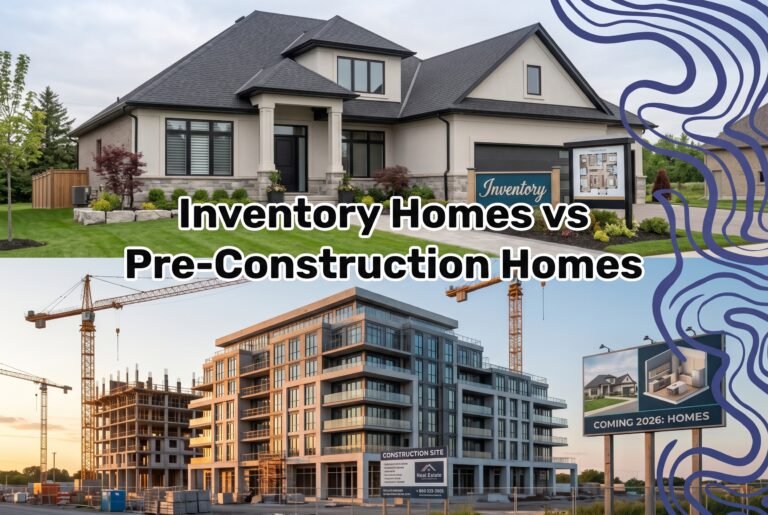
Inventory Homes vs Pre-Construction Homes: Which Should You Buy in 2026?
Updated October 12, 2026
When most buyers hear “new construction,” they imagine choosing a floor plan today and waiting two or three years for their home to be built.
But that isn’t the only way to buy a brand-new home.
In today’s Ontario market, buyers may also find inventory homes—new homes that are already under construction, nearly completed or completely finished and available for a much faster closing.
That creates an important question:
Should you buy an inventory home or traditional pre-construction?
In 2026, inventory homes deserve serious consideration.
Ontario’s slower new-home market has resulted in more unsold completed and under-construction inventory in some areas, particularly in certain condominium and townhouse segments. At the same time, some builders are delaying future construction because of weaker demand and higher costs.
For buyers, this can create opportunities.
An inventory home can potentially offer the brand-new-home experience without the multi-year wait, while traditional pre-construction can still provide greater selection, customization and additional time to save.
Neither is automatically better.
The right choice depends on your budget, timing, financing, desired home, available incentives and tolerance for uncertainty.
What Is an Inventory Home?
An inventory home is a new home being sold directly by the builder that has already progressed beyond the earliest pre-construction stage.
It may be:
Under construction
Structurally complete
Near completion
Fully finished
Ready for immediate or quick possession
A home that was previously reserved but returned to builder inventory
Builders may use different terminology, including:
Inventory home
Quick-closing home
Move-in-ready home
Immediate-possession home
Spec home
Completed inventory
Quick occupancy
Although the terminology varies, the main difference is the same:
You are buying much closer to completion.
What Is Traditional Pre-Construction?
Traditional pre-construction generally means purchasing much earlier in the development process.
You may buy:
Before construction begins
During the project’s initial launch
From a floor plan
From a model home
Before your particular lot or unit has been built
Closing could be:
One year away
Two years away
Three years away
Sometimes longer
This gives you more time—but also introduces more uncertainty.
Inventory vs Pre-Construction at a Glance
Factor | Inventory Home | Traditional Pre-Construction |
Construction stage | Advanced or complete | Early stage |
Closing | Usually sooner | Often years away |
What you see | Actual or nearly completed home | Plans/renderings |
Floor-plan choice | Limited | Usually greater |
Lot choice | Limited | Usually greater |
Décor selection | Often completed | More customization |
Deposit period | Usually shorter | Can be spread over time |
Builder incentives | Can be strong | Varies |
Construction-delay risk | Lower | Higher |
Appraisal timing risk | Lower | Higher |
Time to save | Less | More |
Warranty | New-home warranty | New-home warranty |
Immediate maintenance | Generally low | Generally low |
HST | New-home rules apply | New-home rules apply |
Let’s examine the differences.
1. Inventory Homes Can Offer Much Faster Closings
One of the biggest advantages of an inventory home is speed.
Instead of waiting until 2028 or 2029, you might be able to close in:
30 days
60 days
90 days
Several months
depending on construction status.
This is particularly useful for buyers who:
Have already sold their existing home
Are renting and want to stop paying rent
Need more space quickly
Want a new home without waiting years
Have mortgage financing available now
Traditional pre-construction is better suited to buyers who don’t need the property immediately.
2. You May Be Able to See What You’re Buying
This is a major advantage.
When purchasing early-stage pre-construction, you may be evaluating:
Floor plans
Renderings
Site plans
Model homes
Material samples
With completed inventory, you can potentially walk through the actual home.
You may be able to evaluate:
Room sizes
Natural light
Backyard
Lot position
Kitchen
Flooring
View
Street location
Neighbouring homes
That eliminates some of the imagination required with traditional pre-construction.
3. Inventory Homes Can Reduce Construction Uncertainty
Traditional pre-construction includes a longer construction period.
And the longer the period, the more opportunities there are for:
Construction delays
Changes to anticipated closing dates
Economic changes
Financing changes
Personal circumstances to change
With a completed or nearly completed inventory home, much of that uncertainty has already passed.
This doesn’t eliminate every possible issue.
But the timeline is generally more predictable.
Tarion’s new-home framework provides delayed-closing or occupancy protections for qualifying homes, but avoiding a lengthy construction period can still be valuable to buyers who prioritize certainty.
4. Inventory Homes May Have Strong Builder Incentives
This is where inventory homes can become particularly interesting.
Once a builder has completed a home, capital has already been invested in:
Land
Labour
Materials
Construction financing
Trades
Carrying costs
A completed unsold home may therefore represent capital that the builder wants to recover.
Depending on the builder and market, this can sometimes create incentives such as:
Price reductions
Closing credits
Free appliances
Upgrade packages
Finished basements
Lot-premium reductions
Mortgage incentives
Flexible closing dates
Capped closing costs
Not every builder or home will be discounted.
But inventory should always be investigated when comparing new-home opportunities.
5. But Don’t Assume Every Inventory Home Is a Bargain
This is extremely important.
An inventory home may be available quickly.
That does not automatically mean it is discounted.
Suppose:
Builder Inventory Home
Price:
$829,000
Similar Resale Home
Price:
$750,000
Even if the builder offers:
$25,000 in incentives
there is still a considerable price difference.
The new home may still provide advantages.
But you need to determine whether those advantages justify the premium.
Always compare:
Inventory vs Pre-Construction vs Resale.
Not just one new home against another.
6. Traditional Pre-Construction Usually Gives You More Selection
This is where buying early has an advantage.
During an initial release, buyers may have access to:
Multiple floor plans
Different elevations
Different lot sizes
Corner lots
Premium lots
Ravine lots
Walkout lots
Different closing dates
With inventory, you’re choosing from whatever has already been built or started.
You might love the community but dislike:
The lot
Floor plan
Exterior
Kitchen
Flooring
Inventory requires more compromise.
7. Traditional Pre-Construction Gives You More Customization
Buying early may allow you to choose:
Flooring
Cabinets
Countertops
Tiles
Bathroom finishes
Plumbing fixtures
Hardware
Structural options
Electrical options
Depending on the builder, you may also be able to add:
Finished basement
Separate entrance
Additional bathroom
Main-floor bedroom
Fireplace
Larger windows
Kitchen modifications
With an inventory home, many or all of those decisions may already have been made.
8. Sometimes the Builder’s Choices Are an Advantage
Not every buyer wants to spend hours choosing finishes.
A completed inventory home may already have professionally selected:
Flooring
Cabinets
Countertops
Tiles
Hardware
Paint
You simply decide:
Do I like it or not?
That can make the purchasing process considerably easier.
It also gives you certainty about upgrade costs.
Instead of buying a $750,000 base home and later discovering you want $40,000 in upgrades, an inventory home’s finished price may be easier to understand.
9. Traditional Pre-Construction Gives You More Time to Save
Suppose you purchase in 2026 for a 2028 closing.
You may have two years to:
Accumulate savings
Pay builder deposits
Reduce debt
Improve credit
Increase income
Prepare your existing property for sale
This can be a major benefit.
An inventory home closing in 60 days doesn’t give you that luxury.
You need to be financially ready now.
10. Inventory Homes May Require Deposits More Quickly
Imagine both homes cost:
$800,000.
Traditional Pre-Construction
Builder requires:
10% = $80,000
spread over:
18 months.
Inventory Home
Builder still requires:
$80,000
but closing is in:
60 days.
The total amount may be identical.
But the cash-flow requirement is dramatically different.
Inventory is therefore usually more suitable for buyers who already have their funds available.
11. Mortgage Certainty Can Be Better With Inventory
This is one of the strongest financial advantages.
With an inventory home closing soon, you can arrange mortgage financing based on:
Current income
Current credit
Current mortgage rules
Current interest rates
Current property value
Traditional pre-construction might not close for several years.
During that period:
Your income could change
Your employment could change
Your debt could change
Interest rates could change
Mortgage rules could change
Property values could change
An approval obtained today does not guarantee financing years later.
12. Inventory Homes Reduce Long-Term Appraisal Risk
Consider traditional pre-construction.
You buy today for:
$1,000,000.
Three years later, the lender appraises the completed home at:
$900,000.
You are still contractually obligated to close at your $1-million purchase price.
If the lender bases financing on the lower appraisal, you may need more cash.
With an inventory home, the purchase and appraisal happen closer together.
That doesn’t eliminate appraisal risk.
But it significantly shortens the period during which property values can change.
13. Traditional Pre-Construction Gives the Market More Time
The same long timeline that creates risk can also create opportunity.
Suppose you buy today but close in three years.
During that time:
The neighbourhood may develop
New infrastructure may open
Schools may be built
Commercial amenities may arrive
Market conditions may improve
But none of those outcomes should be treated as guaranteed appreciation.
Buyers should be comfortable owning the property even if prices remain relatively flat.
14. Inventory Homes Can Let You Evaluate the Community More Clearly
If construction is advanced, you may already be able to see:
Streets
Parks
Neighbouring homes
Traffic flow
Lot grading
Sidewalks
Community layout
With an early-stage project, more of the neighbourhood exists primarily on the site plan.
For some buyers, seeing the community take shape provides valuable certainty.
15. New-Home Warranty Applies to Qualifying Inventory Homes Too
Buying completed inventory doesn’t mean giving up new-home warranty protection.
Ontario’s new-home warranty framework generally applies to qualifying newly built homes, providing financial protection before possession and coverage for specified construction defects after possession. Warranty protection can extend through one-, two- and seven-year coverage periods depending on the issue.
This gives inventory homes an important advantage over many older resale properties.
16. You Still Need a Pre-Delivery Inspection
Just because the home is already complete doesn’t mean you should assume everything is perfect.
Before possession, buyers typically participate in a Pre-Delivery Inspection, or PDI.
Inspect:
Flooring
Walls
Cabinets
Countertops
Doors
Windows
Plumbing
Electrical
Appliances
Exterior items where accessible
Document incomplete, damaged or missing items.
Tarion considers the PDI form an important record of the home’s condition before possession.
17. Completed Doesn’t Mean Perfect
A brand-new home can still have:
Cosmetic deficiencies
Paint issues
Flooring damage
Cabinet adjustments
Door alignment problems
Incomplete exterior work
Seasonal items outstanding
The advantage is that Ontario’s new-home warranty framework provides a process for eligible warranty claims.
Still, inspect carefully.
18. HST Rules Apply to Both
Both inventory and traditional pre-construction are forms of new construction.
That means HST generally needs to be considered in the transaction.
In 2026, qualifying Ontario buyers may have access to significant enhanced new-home HST relief.
The important issue isn’t whether the home is labelled:
Inventory
or
Pre-construction.
It’s whether the buyer and transaction satisfy the applicable rebate requirements.
Also determine whether:
HST is included in the builder price
The builder assumes a rebate
You qualify for the assumed rebate
The builder credits it
You need to apply afterward
Never calculate your savings from the headline rebate alone.
19. The Agreement Date Still Matters
This can become particularly important for inventory homes.
A home may have been constructed before you purchased it.
But government rebate eligibility can depend on when your Agreement of Purchase and Sale was entered into, along with other construction, ownership and occupancy conditions.
Therefore:
Don’t assume a completed home is too late for an HST rebate.
And don’t assume it automatically qualifies.
Have the transaction reviewed based on its specific facts.
20. Inventory Can Be Great for Buyers Selling a Resale Home
Suppose you own a home today.
You want a new build but don’t want to:
Sell now
Rent for two years
Move twice
Wait indefinitely for construction
An inventory home can solve that problem.
You may be able to:
Sell your current home → close the inventory home → move once.
This can make the transition much simpler.
21. Traditional Pre-Construction May Be Better for Renters Who Need Time
Now consider a renter.
They want to buy but only have:
$40,000 saved.
A $700,000 home might require significantly more cash once deposits and closing costs are considered.
Traditional pre-construction with a long deposit schedule may give them time to:
Keep working
Save monthly
Use an FHSA
Prepare future down-payment funds
Inventory may require too much money too quickly.
22. Inventory Can Be Good for Families Needing More Space Now
Suppose you’ve just had another child.
Your current condominium has become too small.
Waiting three years for a detached home may not be realistic.
An inventory home can allow you to move into:
Larger townhome
Semi-detached home
Detached home
much sooner while still buying brand new.
23. Traditional Pre-Construction Can Be Better for Buyers Seeking a Specific Lot
Some buyers aren’t flexible about:
Ravine backing
Corner lot
Walkout basement
South-facing yard
Deep lot
Cul-de-sac
Wider lot
Buying during an early release gives you a better opportunity to request these features.
With inventory, your choice may be:
Take the available lot—or don’t.
24. Inventory May Include Upgrades at a Better Effective Price
Suppose a home was originally built with:
Upgraded kitchen
Hardwood flooring
Fireplace
Premium countertops
Finished basement
The builder might have originally charged substantial upgrade premiums.
If the completed home remains unsold and is later discounted, you may effectively receive those upgrades for less than their original builder price.
This is one reason inventory homes need to be evaluated based on the complete package, not simply base price.
25. But You May Be Paying for Upgrades You Don’t Want
The opposite can also happen.
Suppose the builder selected:
Expensive flooring
Premium cabinets
Fireplace
Luxury bathroom finishes
and included those costs in the asking price.
If you wouldn’t have selected those upgrades yourself, their value to you may be much lower.
Ask:
“Would I pay for these features if I were choosing the home myself?”
If not, don’t assign them full advertised value.
26. Inventory Homes Can Sometimes Have More Negotiating Potential
Builders often prefer to protect headline pricing on early-stage releases.
Lower recorded sales can affect:
Future pricing
Comparable sales
Existing purchasers
Project financing
With completed inventory, circumstances can sometimes be different.
The builder may be more willing to discuss:
Price
Closing date
Appliances
Lot premiums
Upgrades
Closing credits
Not every builder negotiates.
But inventory is generally worth investigating rather than assuming the posted price is the only possible package.
27. Traditional Pre-Construction Can Offer Better Promotional Launch Pricing
On the other hand, early purchasers can sometimes receive:
Launch pricing
Early-access incentives
Better unit selection
Promotional deposits
Realtor launch incentives
If the project later sells strongly, those early terms could prove attractive.
But there is no guarantee.
Buying earlier also exposes you to more construction and market risk.
28. What About Condo Inventory?
Inventory condominiums deserve special attention.
A completed condo can allow buyers to evaluate:
Actual unit
Actual view
Building entrance
Amenities
Finishes
Elevators
Lobby
Neighbourhood
This can eliminate one of the biggest uncertainties associated with buying a condo from renderings.
However, buyers should investigate:
Interim occupancy status
Registration status
Estimated versus established condo fees
Builder adjustments
Parking and locker
HST treatment
Assignment history where relevant
29. What About Freehold Inventory?
Freehold inventory can be especially attractive to buyers looking for:
Townhomes
Semi-detached homes
Detached homes
because you may be able to inspect:
Exact lot
Backyard
Driveway
Exterior
Street
Neighbouring homes
You can therefore compare it much more directly against resale.
30. Inventory vs Resale Is Also Worth Comparing
Don’t assume that because inventory is new, resale is no longer relevant.
Imagine:
Inventory Detached
$999,000
Similar Resale Detached
$925,000
The new home may include:
Warranty
New mechanical systems
No immediate renovation
Builder incentives
But is that worth:
$74,000?
Maybe.
Maybe not.
Now suppose the builder offers:
$30,000 discount
Finished basement
Appliances
Capped development charges
The gap becomes much smaller.
That’s why every serious buyer should compare all three:
Pre-Construction + Inventory + Resale.
Inventory Home May Be Better If…
Consider inventory if you:
Want a brand-new home
Need to move relatively soon
Have your down payment available
Want greater closing certainty
Want to see the actual home
Prefer less construction risk
Want to secure financing under current conditions
Find strong builder incentives
Don’t need extensive customization
Traditional Pre-Construction May Be Better If…
Consider early-stage pre-construction if you:
Don’t need to move soon
Want more time to save
Prefer extended deposits
Want maximum floor-plan choice
Want a specific lot
Want to select finishes
Are comfortable with construction delays
Have stable long-term finances
Can tolerate market-value fluctuations before closing
Which Is Better for First-Time Buyers?
It depends mainly on cash availability.
An inventory home can offer:
Faster homeownership
New-home warranty
Less construction uncertainty
Potential incentives
But traditional pre-construction may give a first-time buyer something extremely valuable:
Time.
Time to:
Build FHSA savings
Accumulate deposits
Improve credit
Reduce debt
Prepare for closing
For some first-time buyers, the deposit schedule matters more than the home price.
Which Is Better for Move-Up Buyers?
Inventory can be particularly attractive.
A move-up buyer may already have equity in their current home.
If they sell that property, they may have enough funds to complete a quick-closing purchase.
This can allow them to move from:
Current resale home → brand-new home
without spending years waiting for construction.
Which Is Better for Investors?
Investors should evaluate the economics rather than the construction stage.
Inventory can offer:
Faster rental income
More current appraisal certainty
Ability to evaluate actual property
Less construction risk
Traditional pre-construction offers:
Longer time before closing
Staggered deposits
Potential future market change
But buying today because you assume prices will rise before completion is speculation—not a guaranteed investment strategy.
How to Compare an Inventory Home Properly
Before buying, calculate:
Builder Asking Price
minus
Genuine Price Discount
minus
Builder Incentives You Actually Value
minus
Government Rebates You Qualify For
plus
Closing Adjustments
plus
Required Additional Work
=
Effective Purchase Cost
Then compare that against:
Similar builder inventory
Traditional pre-construction
Comparable resale homes
That’s the number that matters.
10 Questions to Ask About an Inventory Home
Before purchasing, ask:
Is the home complete or still under construction?
What is the earliest closing date?
Why is the property currently available?
What upgrades are already included?
Are there current builder incentives?
Is the price negotiable?
Are development charges capped?
How is HST treated?
What warranty coverage applies?
Can I inspect or walk through the actual home before committing?
Also ask your lawyer to review the builder APS.
Quick closing does not mean skipping due diligence.
Example: Inventory vs Traditional Pre-Construction
Suppose you are comparing two new townhomes.
Option A — Inventory Home
Price:
$759,000
Closing:
60 days
Includes:
Appliances
Finished flooring
Upgraded kitchen
Capped development charges
Deposit:
Required quickly
Option B — Pre-Construction
Price:
$739,000
Closing:
2028
Includes:
Standard finishes
Deposit:
10% spread over 18 months
Which is better?
If you have money available and need a home now, the $20,000 premium for inventory may be worthwhile.
If you need time to save and want to select your finishes, the traditional pre-construction home may be better.
The answer depends on your circumstances, not simply which price is lower.
Frequently Asked Questions
What is an inventory home?
An inventory home is a newly built home being sold directly by the builder after construction has already started or been completed.
Are inventory homes cheaper than pre-construction?
Sometimes, but not always. Builders may discount completed inventory or add incentives, but some inventory homes include premium upgrades or lots that increase the price.
Can you negotiate an inventory home?
Depending on the builder and project, there may be flexibility on price, incentives, closing date, upgrades or other terms. Builder policies vary.
Do inventory homes have Tarion warranty?
Qualifying newly built Ontario homes generally receive statutory new-home warranty protection, including applicable post-possession warranty coverage.
Can an inventory home qualify for an HST rebate?
Potentially. Eligibility depends on the purchaser, Agreement of Purchase and Sale, home value, occupancy intentions and applicable program conditions—not simply whether the home is already constructed.
Is inventory safer than pre-construction?
Inventory generally reduces construction-delay, future appraisal and long-term financing uncertainty because the home is closer to completion. It does not eliminate all purchasing risk.
Do I still need a lawyer for an inventory home?
Yes. It is still a builder Agreement of Purchase and Sale and should be reviewed carefully.
Can I inspect an inventory home before buying?
Often you may be able to view a completed or substantially completed home, depending on construction status and builder policy. This is one of inventory’s major advantages.
The Bottom Line: Inventory or Pre-Construction?
The answer depends largely on:
Time + Cash + Choice + Certainty.
Choose inventory when you value:
Faster closing
Seeing the actual home
Greater construction certainty
Current mortgage planning
Potential builder incentives
Choose traditional pre-construction when you value:
More time to save
Extended deposits
Greater lot selection
More floor-plan choices
Customization
In 2026, buyers should not automatically assume the newest project launch provides the best opportunity.
Sometimes the better deal may already be:
Built.
A completed or near-completed builder home with the right price, incentives and closing terms can provide an attractive combination of new construction + warranty + certainty + potential value.
The smartest approach is to compare all three:
Inventory Homes
vs
Traditional Pre-Construction
vs
Resale
and determine which individual property gives you the strongest overall value.
Looking for Quick-Closing or Inventory Homes in Ontario?
Some of the strongest new-home opportunities aren’t always the ones being heavily advertised.
At New Home Source, we can help buyers explore both upcoming pre-construction releases and currently available builder inventory.
Tell us your:
Budget + Preferred Location + Home Type + Desired Closing Date
and we can help you compare:
Quick-closing builder homes
Move-in-ready inventory
Traditional pre-construction projects
Current builder incentives
Deposit structures
HST rebate opportunities
Townhomes
Semi-detached homes
Detached homes
Comparable resale alternatives
Contact New Home Source to find out which new homes are available now—and which upcoming opportunities may be worth waiting for.
Disclaimer: This article is provided for general informational and real-estate marketing purposes only and does not constitute legal, tax, mortgage, financial or investment advice. Builder prices, incentives, inventory, construction schedules and government programs can change without notice. Buyers should obtain independent legal, mortgage and tax advice where appropriate and carefully review the Agreement of Purchase and Sale before purchasing a new home.
You Might Also Like
Inventory Homes vs Pre-Construction Homes: Which Should You Buy in 2026? Updated October 12, 2026 When most buyers hear “new...

Investing in pre-construction condos in the Greater Toronto Area (GTA) can be a fantastic opportunity for both first-time buyers and...
How to Compare Two Pre-Construction Projects Before You Buy Updated November 23, 2026 You’ve narrowed your search down to two...