
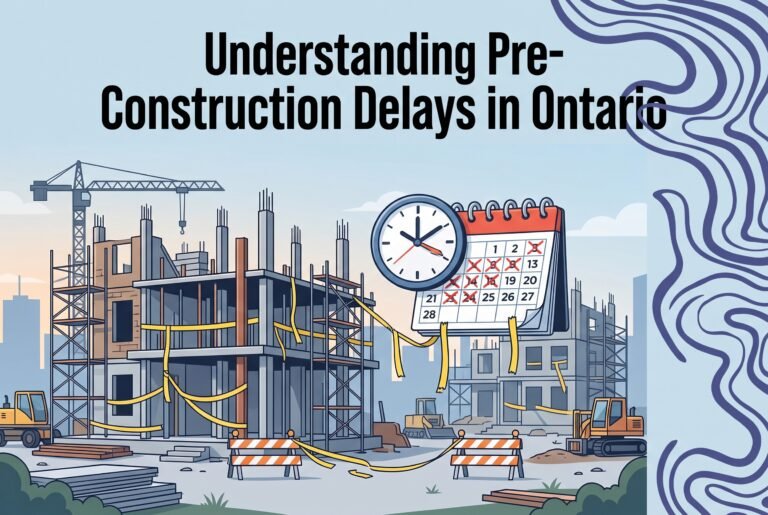
Understanding Pre-Construction Delays in Ontario: Tentative vs Firm Closing Dates
Updated November 14, 2026
When buying a pre-construction home in Ontario, one of the first dates buyers look at is the expected closing date.
You might see:
Tentative Closing: Spring 2028
or:
Occupancy Expected: Fall 2027
It is natural to begin planning around that date.
But there is something every pre-construction buyer needs to understand:
Your first closing date may not be your final closing date.
Construction can take years, and delays can happen.
Ontario’s new-home warranty framework establishes specific rules around closing and occupancy dates, required notices, extensions, compensation and, in certain circumstances, a purchaser’s right to terminate the agreement.
The key is understanding terms such as:
Tentative Closing Date
Firm Closing Date
Delayed Closing Date
Outside Closing Date
Tentative Occupancy Date
Firm Occupancy Date
Outside Occupancy Date
Here’s what Ontario pre-construction buyers should know in 2026.
Why Are Pre-Construction Closing Dates Different From Resale?
When purchasing a resale home, the buyer and seller typically agree on a specific closing date.
For example:
October 30, 2026
The property already exists, so there is usually greater certainty around possession.
Pre-construction is different.
When you sign your Agreement of Purchase and Sale, the builder may still need to:
Obtain or complete approvals
Service the land
Build roads
Install infrastructure
Complete foundations
Construct the home
Coordinate trades
Complete inspections
Obtain occupancy approvals
Your closing could be years away.
That is why Ontario’s new-home system allows certain closing dates to begin as tentative.
What Is the Tarion Addendum?
When purchasing a qualifying new home in Ontario, the builder APS includes a Tarion Addendum.
The Addendum contains important provisions governing matters such as:
Closing or occupancy dates
Permitted delays
Notices
Early termination conditions
Delayed-closing compensation
Outside dates
The first page contains the:
Statement of Critical Dates.
This is one of the most important pages in your entire builder agreement.
Don’t ignore it.
What Is a Tentative Closing Date?
A Tentative Closing Date is a date the builder currently expects your freehold home to be ready but which can be changed within the applicable Tarion framework.
For qualifying freehold purchases using tentative closing dates, the builder can generally establish a:
First Tentative Closing Date
and, if required:
Second Tentative Closing Date
before a:
Firm Closing Date
is established.
Under the current framework, the builder may extend a tentative closing date up to two times by as much as 120 days each, provided the required advance written notice is properly given.
That means:
Tentative does not mean guaranteed.
Example of a Tentative Closing
Suppose your original APS says:
First Tentative Closing Date: June 1, 2028
As construction progresses, the builder determines the home will not be completed in time.
If the applicable rules are followed, the builder may establish a second tentative date.
Later, the builder may establish a firm date.
The exact dates and notice deadlines should appear in your Statement of Critical Dates.
This is why buyers should not make irreversible plans around the first tentative date.
What Is a Firm Closing Date?
A Firm Closing Date provides significantly greater certainty.
Once the builder establishes the Firm Closing Date, extending beyond that date generally triggers delayed-closing consequences unless an applicable exception applies, such as an unavoidable delay or a mutually agreed amendment.
In simple terms:
Tentative Date = Builder still has permitted flexibility.
Firm Date = Greater buyer protection against further delay.
That distinction is critical.
What Is a Delayed Closing Date?
If the builder cannot close on the Firm Closing Date and no applicable exception prevents compensation, the builder may establish a:
Delayed Closing Date.
At this stage, the purchaser may become entitled to delayed-closing compensation under the applicable warranty rules.
This is very different from a builder properly changing an earlier tentative date.
Not every change in closing date automatically creates a right to compensation.
What Is the Outside Closing Date?
The Outside Closing Date is especially important.
For the applicable Tarion freehold framework, the Outside Closing Date is generally:
365 days after the Firm Closing Date.
It represents the latest closing date available to the builder under that framework.
If the home is not completed by the Outside Closing Date, the buyer generally enters a:
30-day Purchaser’s Termination Period.
During that period, the purchaser may have the right to terminate the agreement.
This is why buyers should know their Outside Closing Date—not just their tentative one.
What Happens During the Purchaser’s Termination Period?
If the home is not ready by the applicable Outside Closing Date, the purchaser may generally have a 30-day period during which they can terminate the purchase agreement.
This is an important buyer protection.
However, termination rights are legal matters.
If you reach an Outside Closing Date without completion, speak with your real-estate lawyer immediately.
Don’t assume:
“The agreement automatically disappears.”
Follow the proper procedure.
Can the Buyer Agree to Another Closing Date?
Potentially.
Buyer and builder may mutually agree to change certain dates.
But before agreeing to an extension, understand what you’re giving up.
For example, an agreement to amend a closing date may affect:
Delayed-closing compensation
Termination rights
Other contractual rights
Have your lawyer review any significant extension agreement before signing.
What About Condominium Occupancy Dates?
Condominium buyers use similar concepts, but the terminology focuses primarily on:
Occupancy
rather than freehold closing.
A pre-construction condominium may have:
First Tentative Occupancy Date
Subsequent Tentative Occupancy Date
Firm Occupancy Date
Delayed Occupancy Date
Outside Occupancy Date
The builder must follow the applicable notice requirements when changing these dates.
Why Is Condo “Occupancy” Different From “Closing”?
This is one of the biggest differences between condos and freehold homes.
With a freehold home, possession and ownership typically occur together on final closing.
With a condominium, you may reach:
Interim Occupancy
before the condominium corporation is registered.
During interim occupancy:
You can live in the unit
You generally do not yet hold title
Your final mortgage may not yet have funded
You may pay occupancy fees
Final closing happens later.
That is why Tarion’s condo framework uses occupancy dates.
What Is an Outside Occupancy Date?
The Outside Occupancy Date is the latest date the builder has agreed to provide occupancy of the condominium unit under the applicable Addendum.
If occupancy has not occurred by that date, the purchaser generally has a:
30-day termination period.
Again, buyers should seek legal advice if this situation occurs.
How Much Notice Must a Condo Builder Give?
Under the current framework, condominium builders generally need to provide:
90 days’ written notice
when properly extending applicable tentative occupancy dates.
If the required notice is not properly given, consequences can arise under the Tarion framework.
The important lesson for buyers is simple:
Read every builder notice.
Do not assume an email about a closing date is routine.
Can Builders Delay Forever?
No.
Builders have flexibility, but it isn’t unlimited.
The Tarion Addendum creates:
Specific dates
Notice requirements
Outside dates
Compensation rights
Termination rights
That is why your Statement of Critical Dates is so important.
What Is an Unavoidable Delay?
Certain events outside the builder’s reasonable control can affect the normal delay rules.
Examples may involve extraordinary circumstances such as:
Certain strikes
Fires
Floods
Severe weather events
Other qualifying events beyond the builder’s control
The builder must follow applicable notice requirements when relying on an unavoidable-delay provision.
Not every construction problem automatically qualifies.
Can You Receive Compensation for a Delayed Closing?
Potentially.
Where the builder fails to close or provide occupancy in accordance with the applicable rules, purchasers may qualify for delayed-closing or delayed-occupancy compensation.
Current maximum compensation can reach:
$7,500
for qualifying delays.
The exact amount depends on the circumstances and eligible expenses.
Keep records if a delay causes you financial loss.
What Expenses Should You Document?
If your firm closing or occupancy is improperly delayed, keep documentation for expenses potentially connected with the delay.
Examples may include:
Accommodation
Moving or storage
Additional living costs directly related to the delay
Other eligible expenses
Keep:
Receipts
Invoices
Builder notices
Emails
Rental documents
Don’t rely on memory months later.
A Delay Can Cost More Than Money
Compensation doesn’t eliminate every inconvenience.
Imagine you:
Sold your current home
Gave notice to your landlord
Arranged movers
Registered children for school
Booked vacation days
Then the closing moves.
This is why buyers should avoid making irreversible arrangements too early when their date remains tentative.
How Should Renters Handle a Tentative Closing?
Suppose you’re renting and your first tentative closing is:
September 15.
Do not automatically give your landlord notice months in advance simply because the original builder schedule says September.
As the date approaches:
Confirm whether it is tentative or firm
Review builder notices
Coordinate with your lawyer
Understand your tenancy notice requirements
You may need some overlap between your rental and new home to protect yourself from a last-minute problem.
What If You Need to Sell Your Current Home?
Move-up buyers face a similar challenge.
Selling too early can leave you needing temporary accommodation if construction is delayed.
Selling too late can create financing or carrying-cost pressure.
As your builder closing approaches, coordinate:
Builder status
Mortgage financing
Sale strategy
Closing dates
Bridge-financing possibilities where applicable
Your existing home sale and pre-construction closing should be planned together.
Should You Lock a Mortgage Rate Years in Advance?
Usually, standard mortgage commitments don’t remain locked for several years.
Some builders may work with lenders that offer specialized long-term rate-cap or mortgage programs.
But buyers should not assume:
“My mortgage is guaranteed until the builder finishes.”
Revisit your financing as closing approaches.
A construction delay can also affect mortgage arrangements that were based on an earlier date.
Construction Delays Can Affect Your Mortgage Qualification
A delay isn’t always financially negative.
It gives you more time to save.
But it also means closing occurs later.
During that period:
Interest rates may change
Mortgage rules may change
Your income may change
Your debt may change
Property values may change
Maintain financial discipline until the transaction actually closes.
What About Appraisal Risk?
Imagine you signed in 2026 for:
$900,000.
The project is delayed and finally closes several years later.
Your lender appraises the completed property at:
$825,000.
Depending on the lender and financing structure, you may need to provide additional equity.
Longer construction timelines increase the period during which market values can change.
This is one reason buyers should maintain a financial cushion.
Project Delay vs Project Cancellation
These are different.
Delay
The builder still intends to complete the project, but the timeline changes.
Cancellation
The transaction or project does not proceed under the applicable contractual conditions.
The rights and remedies available to the purchaser can be very different.
Do not treat the terms interchangeably.
Early Termination Conditions
Some builder agreements can contain permitted conditions relating to project viability or other matters.
These might involve issues such as:
Financing
Sales thresholds
Approvals
The Tarion Addendum places restrictions and disclosure requirements around applicable early termination conditions.
This is another reason lawyer review is essential.
Before committing, ask:
“Under what circumstances can the builder terminate this agreement?”
What Should Your Lawyer Review?
Ask your lawyer to explain:
First Tentative Closing Date
Second Tentative Closing Date
Firm Closing Date
Outside Closing Date
Notice deadlines
Termination rights
Delayed-closing compensation
Unavoidable-delay provisions
Early termination conditions
Any builder-specific extension language
For a condo, ask the equivalent questions about occupancy.
7 Things to Do When Your Builder Delays Closing
1. Read the notice carefully
Don’t rely on the subject line.
2. Compare it with your Statement of Critical Dates
Determine which date changed.
3. Check whether proper notice was given
Timing matters.
4. Contact your lawyer if you’re unsure
Especially once dates become firm.
5. Save receipts
If the delay causes costs.
6. Update mortgage planning
Tell your lender or mortgage professional.
7. Avoid emotional decisions
A delay is frustrating, but first determine exactly what contractual rights apply.
5 Mistakes Buyers Make With Closing Dates
Mistake 1: Treating the first tentative date as guaranteed
It isn’t.
Mistake 2: Giving up existing housing too early
Wait until the timeline becomes more certain.
Mistake 3: Ignoring builder notices
Closing-date emails matter.
Mistake 4: Signing extensions without understanding them
You may affect your rights.
Mistake 5: Failing to keep receipts
Documentation can matter if compensation becomes available.
Frequently Asked Questions
What does tentative closing mean?
It is a date the builder currently expects the home to be ready but which may be changed within the applicable Tarion framework.
How many times can a freehold tentative closing date be extended?
Under the standard current framework, a builder using tentative dates may generally extend the tentative closing schedule twice by up to 120 days each, provided proper notice is given.
What is a Firm Closing Date?
It is the date at which the builder’s permitted flexibility becomes more limited. Further delay can trigger compensation unless an applicable exception applies.
What is the Outside Closing Date?
For the applicable freehold Tarion framework, it is generally 365 days after the Firm Closing Date and represents the builder’s latest available closing date before the purchaser’s termination period can arise.
Can I cancel if the builder delays too long?
Potentially. If the home is not completed by the applicable Outside Closing or Outside Occupancy Date, a purchaser may generally enter a 30-day termination period. Obtain legal advice before exercising any termination right.
Can I get compensation for a builder delay?
Potentially. Qualifying delayed closing or occupancy claims can currently provide compensation of up to $7,500.
Are condo dates different?
Yes. Condominium purchases generally focus on occupancy dates because purchasers may take interim occupancy before final ownership transfers.
Should I sell my existing home based on my tentative closing date?
Be cautious. Coordinate your sale strategy with the latest builder notices, your lawyer and your financing plans.
The Bottom Line
When buying pre-construction, don’t focus only on:
“When do I get my keys?”
Understand:
What type of date is it?
There is a major difference between:
Tentative
and
Firm.
And another important difference between:
Firm
and
Outside.
Your Statement of Critical Dates exists to help you understand that timeline.
Before making major moving, rental or financial decisions:
Read your Tarion Addendum
Monitor builder notices
Keep your lawyer informed
Maintain financial flexibility
Understand your termination and compensation rights
Construction delays are one of the realities of buying a home that doesn’t yet exist.
The goal isn’t to assume delays will happen.
It’s to make sure you’re financially and legally prepared if they do.
Looking for a New Home With a Closing Timeline That Fits Your Plans?
Not every buyer wants to wait three years.
And not every buyer needs a quick-closing home.
At New Home Source, we help buyers compare:
Upcoming pre-construction projects
Inventory homes
Quick-closing homes
Closing timelines
Deposit structures
Builder incentives
HST rebate opportunities
Townhomes
Semi-detached homes
Detached homes
Tell us your:
Budget + Preferred Location + Home Type + Ideal Closing Timeline
and we can help you focus on opportunities that better match your plans.
Contact New Home Source to explore current new-home opportunities across Ontario.
Disclaimer: This article is provided for general information and real-estate marketing purposes only and does not constitute legal advice. Closing and occupancy rights depend on the Agreement of Purchase and Sale, Tarion Addendum and circumstances of each transaction. Buyers should review their specific critical dates and any delay notices with a qualified Ontario real-estate lawyer.
You Might Also Like

Bank of Canada Cuts Interest Rates for the Third Time in 2024: What It Means for GTA Real Estate Introduction...

Is 2026 a Good Time to Buy Pre-Construction in Ontario? Updated August 27, 2026 If you’ve been thinking about buying...
Interim Occupancy Explained: Why Condo Buyers Pay Before They Own the Unit Updated November 19, 2026 You’ve purchased a pre-construction...