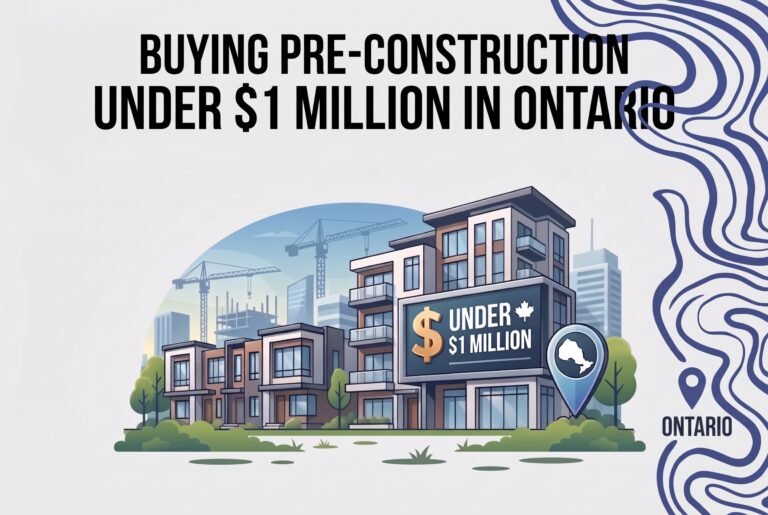
Buying Pre-Construction Under $1 Million in Ontario: Why 2026 Is Different
Updated October 23, 2026
For years, the $1 million mark has been an important psychological and financial threshold for Ontario home buyers.
In 2026, it matters even more.
A combination of new HST relief, expanded insured-mortgage rules, 30-year amortization options for qualifying new-build buyers, builder incentives and softer new-home market conditions has created a very different environment for buyers shopping below $1 million.
For qualifying buyers, a newly built home priced under $1 million can potentially provide benefits that simply weren’t available a few years ago.
But that doesn’t mean every home below $1 million is automatically a good deal.
The key is understanding why this price range matters—and how to compare the opportunities properly.
Why Is the $1 Million Price Point So Important in 2026?
Several major home-buying programs now intersect around the $1-million threshold.
For qualifying purchasers of new construction, these may include:
Federal GST/HST relief for first-time buyers
Ontario’s Enhanced New Housing Rebate
Ontario’s additional new-home affordability relief
Insured mortgage financing
30-year insured amortization for qualifying new-build purchases
Builder deposit incentives
Builder price reductions
First-time-buyer land transfer tax relief
This makes the sub-$1-million new-home market particularly important for:
First-time buyers
Young families
Move-up buyers
Buyers seeking freehold townhomes
Buyers considering semi-detached homes
Buyers moving beyond the core GTA
Buyers comparing new construction with resale
1. First-Time Buyers Can Potentially Receive Up to $50,000 in Federal GST/HST Relief
One of the biggest changes is the federal First-Time Home Buyers’ GST/HST Rebate.
For an eligible first-time buyer purchasing a qualifying new home valued at:
$1 million or less
the program can provide a rebate of up to:
$50,000
representing up to 100% of the federal 5% portion of HST.
For qualifying homes between:
$1 million and $1.5 million
the rebate gradually declines.
At $1.5 million or more, the federal first-time-buyer rebate is no longer available.
That makes the area at or below $1 million particularly important.
2. Ontario’s 2026 Enhanced HST Rebate Can Be Even Larger
Ontario also introduced the temporary Enhanced New Housing Rebate.
For qualifying purchases from a builder, the Agreement of Purchase and Sale generally needs to be entered into between:
April 1, 2026 and March 31, 2027.
For eligible homes valued up to $1 million, the Ontario enhancement can provide relief of up to:
$80,000
against the provincial 8% portion of HST.
Ontario has also introduced additional affordability relief connected to the remaining 5% portion for qualifying purchasers.
For the right buyer and transaction, the potential relief can therefore be substantial.
Can an Eligible Buyer Really Save Up to $130,000?
Potentially.
Consider a qualifying new home valued at:
$1,000,000
Ontario provincial portion:
8% = $80,000
Federal portion:
5% = $50,000
Total HST:
$130,000
Ontario and CRA examples confirm that qualifying transactions can potentially receive the benefit of both the $80,000 enhanced provincial rebate and up to $50,000 of additional relief, depending on the program and purchaser.
But this is extremely important:
Do not simply take a builder’s advertised $1-million price and subtract $130,000.
Many builder prices already assume certain HST rebates.
You need to determine:
Whether HST is included
Which rebate is already built into the advertised price
Which programs you qualify for
Whether the builder credits the rebate
Whether you need to apply separately
What happens if you ultimately do not qualify
The APS and your individual circumstances determine the real number.
3. The HST Advantage Isn’t Necessarily Limited to First-Time Buyers
This is another major difference in 2026.
The federal $50,000 program is specifically designed for qualifying first-time buyers.
But Ontario’s temporary enhanced new-housing measures are broader.
That means someone who has owned a home before may still potentially qualify for important Ontario new-home relief if the transaction meets the program conditions.
This creates opportunities for:
Move-up buyers
Downsizers
Families relocating
Previous homeowners returning to the market
So if you hear:
“The new HST rebate is only for first-time buyers,”
that is an oversimplification.
There are different programs with different eligibility rules.
4. Mortgage Rules Are Also More Favourable Below $1 Million
HST isn’t the only reason the price point matters.
Canada’s insured-mortgage rules currently allow eligible purchasers to obtain mortgage insurance on properties priced below:
$1.5 million.
For homes between $500,000 and $1.5 million, the minimum down payment is generally:
5% on the first $500,000
plus
10% on the portion above $500,000.
This means buyers no longer automatically need a 20% down payment simply because the property costs $1 million or slightly more.
How Much Down Payment Would You Need?
Let’s look at several price points.
$600,000 New Home
First $500,000 × 5%:
$25,000
Remaining $100,000 × 10%:
$10,000
Minimum:
$35,000
$700,000 New Home
First $500,000:
$25,000
Remaining $200,000 × 10%:
$20,000
Minimum:
$45,000
$800,000 New Home
First $500,000:
$25,000
Remaining $300,000:
$30,000
Minimum:
$55,000
$900,000 New Home
First $500,000:
$25,000
Remaining $400,000:
$40,000
Minimum:
$65,000
$1 Million New Home
First $500,000:
$25,000
Remaining $500,000:
$50,000
Minimum:
$75,000
These figures illustrate the minimum equity formula for qualifying insured financing.
They do not include:
Mortgage insurance
Closing costs
Builder deposits
Legal fees
Land transfer tax
Other required cash
And the buyer still needs to qualify for the mortgage.
5. Builder Deposit and Mortgage Down Payment Are Different
This distinction is particularly important with pre-construction.
Suppose you buy an:
$800,000 home.
Your theoretical minimum insured-mortgage down payment might be:
$55,000.
But the builder requires:
10% deposit = $80,000.
You must follow the builder’s contract.
The builder deposit isn’t determined by federal mortgage minimums.
Now consider another builder offering:
5% deposit = $40,000.
That sounds easier.
And initially, it is.
But you may still need additional down-payment funds at final closing.
So:
Low Deposit ≠ Low Total Down Payment
Always calculate both separately.
6. 30-Year Amortizations Can Help New-Build Buyers
Another major affordability change involves mortgage amortization.
Qualifying purchasers of newly built homes may access insured mortgages with amortization periods of up to:
30 years.
A longer amortization can lower the required monthly mortgage payment.
For example, financing the same mortgage over:
30 years
instead of:
25 years
generally results in a lower monthly payment.
But there is a trade-off:
You generally pay more total interest over the life of the mortgage.
So a 30-year amortization improves monthly cash flow.
It doesn’t make the loan cheaper overall.
7. Builder Incentives Are Making Some Sub-$1M Homes More Competitive
Today’s slower new-home market has created more competition among builders in many Ontario communities.
Depending on the project, buyers shopping below $1 million may encounter:
Direct price reductions
5%–10% deposits
Extended deposits
Mortgage-rate promotions
Finished basement packages
Appliances
Décor credits
Free assignments
Capped development charges
Lot-premium discounts
Closing credits
This can make the effective purchase price very different from the headline number.
Example: $799,990 Townhome
Imagine a builder offers a new freehold townhome for:
$799,990
with:
10% deposit over 18 months
Appliances included
Capped development charges
Air conditioning
Flexible closing
Applicable HST relief for qualifying purchasers
Now compare it with a resale townhome for:
$760,000.
At first glance:
Resale wins by approximately:
$40,000.
But now consider:
Does the resale need renovations?
How old is the furnace?
Does it have the same number of bedrooms?
Does it have parking?
Does it have a backyard?
What incentives are included with the new home?
What HST relief applies?
How much more time does the new-home buyer have to save?
The answer becomes less obvious.
8. Under $1 Million Doesn’t Automatically Mean Affordable
This is very important.
A home priced at:
$999,000
is not affordable simply because it qualifies for certain programs.
You still need to comfortably manage:
Mortgage payment
Property taxes
Insurance
Utilities
Maintenance
Condo fees where applicable
Transportation costs
Other household expenses
Never determine affordability solely from the minimum down payment.
A lender approving the mortgage doesn’t necessarily mean the monthly payment fits comfortably into your lifestyle.
9. Look Beyond the GTA Core
One reason the sub-$1-million market remains important is geography.
Depending on market conditions and housing type, buyers may find considerably different opportunities when moving beyond the most expensive GTA communities.
Areas worth comparing can include portions of:
Niagara Region
Welland
Niagara Falls
Hamilton
Brantford
Waterloo Region
Cambridge
Guelph
Caledon
Simcoe County
Durham Region
Other growing Ontario communities
Availability changes constantly.
Instead of asking:
“Where can I buy for under $1 million?”
ask:
“Where does my $1 million buy the strongest combination of home, location and future usability?”
10. Freehold Townhomes Can Be an Important Sweet Spot
For buyers seeking more space without detached-home pricing, freehold townhomes can be particularly attractive.
Potential benefits include:
No traditional condo maintenance fee
Private backyard
Multiple bedrooms
Garage
Driveway parking
Basement
Family-oriented layouts
In some Ontario markets, freehold towns remain available well below $1 million.
This can provide a middle ground between:
Condominium affordability
and
Detached-home lifestyle.
11. Semi-Detached Homes May Be Worth Comparing Too
Buyers sometimes assume a semi-detached home will be dramatically more expensive than a townhome.
That isn’t always the case.
In a slower market, builder incentives and community pricing can narrow the difference.
Suppose:
Townhome
$749,000
Semi-detached
$799,000
Difference:
$50,000
For that difference, the semi may provide:
Wider lot
More windows
Greater privacy
Larger home
Stronger resale appeal for some buyers
That doesn’t automatically mean the semi is better.
But buyers should compare the next housing category up before deciding.
12. Don’t Ignore Detached Homes Just Because Your Budget Is Under $1 Million
Depending on the Ontario market, builder inventory, release and incentive program, detached-home opportunities can sometimes appear below the $1-million threshold.
They may be found in:
Emerging communities
Outer GTA areas
Niagara
Southwestern Ontario
Smaller Ontario cities
Builder inventory
If detached living is your long-term goal, don’t automatically assume it is impossible.
Search first.
13. Inventory Homes Can Be Particularly Attractive Below $1 Million
A builder may have completed or nearly completed homes that need buyers.
These can include:
Townhomes
Semis
Detached homes
Inventory can sometimes come with:
Better pricing
Quick closing
Included upgrades
Appliances
Finished basements
Closing credits
For a buyer who already has their down payment available, an inventory home can provide:
New construction without the multi-year wait.
14. But Traditional Pre-Construction Gives You More Time to Save
Suppose you buy in 2026 and close in:
2028.
That gives you more time to:
Build savings
Contribute to an FHSA
Reduce debt
Improve credit
Accumulate closing costs
Prepare an existing home for sale
For buyers whose income is strong but current savings are limited, this can be extremely useful.
15. First-Time Buyers Should Consider the FHSA
The First Home Savings Account can be particularly useful when buying pre-construction.
Eligible first-time buyers can contribute to an FHSA and potentially receive:
A tax deduction on qualifying contributions
Tax-free growth
Tax-free qualifying withdrawals for a first home
A longer pre-construction timeline can give buyers additional time to build these savings before closing.
16. The Home Buyers’ Plan Can Also Help
Eligible purchasers may also access the federal Home Buyers’ Plan, which allows qualifying withdrawals from RRSP savings toward a home purchase.
Used together, a qualifying buyer may potentially combine:
FHSA
Home Buyers’ Plan
Personal Savings
to build the necessary down payment.
These programs have their own eligibility rules and should be considered as part of a broader financial plan.
17. First-Time Buyers May Also Receive Ontario Land Transfer Tax Relief
Ontario provides eligible first-time homebuyers with a Land Transfer Tax refund of up to:
$4,000.
This is separate from HST relief.
So a qualifying first-time buyer of a brand-new home may potentially benefit from several different programs.
These shouldn’t be lumped together as one “government rebate.”
Each program has separate rules.
18. Don’t Count Government Rebates Twice
This is a common mistake.
Suppose the builder’s price list states:
$799,990
and includes fine print indicating that applicable HST rebates have already been incorporated.
The buyer sees a government announcement about HST relief and thinks:
“Great—I can subtract another $100,000.”
Not necessarily.
Always determine whether the advertised price is:
Before the rebate
or
After the assumed rebate.
This can completely change your calculation.
19. Compare Effective Price, Not Advertised Price
Suppose:
Project A
Price:
$749,000
Minimal incentives.
Uncapped development adjustments.
Project B
Price:
$775,000
Includes:
$10,000 price reduction
Appliances
Finished basement
Capped development charges
Project B could potentially offer better overall value even though the headline price is higher.
Use this calculation:
Builder Price
− Genuine Builder Discounts
− Applicable Government Relief
Closing Adjustments
Necessary Upgrades
= Effective Acquisition Cost
That is the number you should compare.
20. Don’t Forget Closing Costs
Buying below $1 million doesn’t eliminate closing costs.
You may still need funds for:
Ontario Land Transfer Tax
Toronto Municipal Land Transfer Tax where applicable
Legal fees
Title insurance
Builder adjustments
Development charges
Utility charges
Property-tax adjustments
Mortgage-related costs
Occupancy fees for certain condominiums
Your deposit is not your closing-cost reserve.
Keep those funds separate.
Example: $700,000 New Home
Let’s put several pieces together.
Purchase price:
$700,000
Minimum insured down payment for an eligible borrower:
$45,000
Suppose builder requires:
10% = $70,000
paid over 18 months.
Ontario Land Transfer Tax:
Approximately:
$10,475
Eligible first-time-buyer maximum LTT refund:
$4,000.
Then the buyer must consider:
Legal fees
Builder adjustments
Mortgage insurance
Closing costs
Moving expenses
HST treatment
This is why:
“I can afford the deposit”
is not the same as:
“I can comfortably afford the home.”
Example: $800,000 New Home
Purchase price:
$800,000
Minimum insured down payment:
$55,000
Example builder deposit at 10%:
$80,000
Ontario Land Transfer Tax:
Approximately:
$12,475
Potential first-time-buyer provincial refund:
Up to $4,000
Potential HST relief:
Depends on buyer eligibility and transaction structure.
The buyer should therefore budget beyond the initial $80,000 deposit.
Example: $999,000 New Home
Now consider a home at:
$999,000.
The minimum insured-mortgage formula would require approximately:
First $500,000:
$25,000
Remaining $499,000 × 10%:
$49,900
Total:
$74,900
before closing costs and mortgage-insurance considerations.
For qualifying buyers, this price also sits within the range where the federal first-time-buyer rebate can provide up to 100% of the federal portion and Ontario’s enhanced provincial relief can potentially apply at its maximum level.
This is why pricing immediately below $1 million deserves particular attention in 2026.
Does This Mean You Should Always Stay Below $1 Million?
No.
Don’t reject a significantly better home solely because it costs:
$1,020,000
instead of:
$999,000.
The federal first-time-buyer rebate doesn’t instantly disappear at $1 million.
It gradually phases out between:
$1 million and $1.5 million.
Ontario’s enhanced rebate also has its own price structure.
The $1-million threshold is important.
It shouldn’t override everything else.
Location Still Matters More Than a Rebate
A rebate can improve a purchase.
It cannot fix a poor location.
When comparing homes under $1 million, consider:
Employment access
Transportation
Schools
Shopping
Future infrastructure
Community growth
Lot
Layout
Supply of competing homes
Saving $30,000 upfront isn’t necessarily beneficial if you buy a property that doesn’t fit your long-term needs.
Builder Reputation Still Matters
Price should never replace due diligence.
Before buying:
Research the builder
Review previous projects
Check licensing
Understand construction progress
Review your APS
Investigate project status
An unusually cheap home can be an excellent opportunity.
Or it can simply be cheap.
Know the difference.
Who Should Consider a Sub-$1M New Home in 2026?
This segment may be particularly attractive for:
First-time buyers
Because of federal and provincial programs.
Young families
Especially those comparing condos with freehold townhomes.
Buyers who need time to save
Extended builder deposits can help.
Buyers priced out of central GTA markets
Other Ontario communities can offer more space.
Move-up buyers
Ontario’s enhanced relief isn’t necessarily restricted only to first-time purchasers.
Buyers wanting brand-new construction
Warranty and reduced immediate maintenance can add value.
Who Should Still Be Cautious?
A sub-$1-million home may not be right if:
Monthly payments stretch your budget
You have little emergency savings
You’re relying on future appreciation
Your income is unstable
You may need to move before closing
You’re buying only for the rebate
Resale offers significantly better value
The government program should improve a strong purchase.
It should not justify a weak one.
A Smarter Strategy for Buying Under $1 Million
Instead of searching only:
“Homes Under $1M”
use these filters:
1. Maximum comfortable monthly payment
2. Total cash available
3. Preferred home type
4. Maximum commute
5. Minimum bedrooms
6. Parking requirement
7. Closing timeline
8. HST eligibility
9. Builder incentives
10. Comparable resale value
That creates a much more useful search.
Frequently Asked Questions
Why is buying below $1 million different in 2026?
Because several current affordability measures are particularly strong at or below this price point, including maximum federal first-time-buyer GST/HST relief and maximum Ontario enhanced provincial relief for qualifying transactions.
Can a first-time buyer get $50,000 back?
An eligible first-time buyer purchasing a qualifying new home valued at or below $1 million may receive up to $50,000 under the federal First-Time Home Buyers’ GST/HST Rebate.
Can Ontario buyers also receive $80,000?
Qualifying purchasers under Ontario’s Enhanced New Housing Rebate can potentially receive up to $80,000 of provincial HST relief.
Is the rebate automatically $130,000?
No. The amount depends on the purchaser, transaction, home value and applicable programs. Builder pricing may also already incorporate assumed rebates.
Do you need 20% down on a $1-million home?
Not necessarily. Eligible insured financing is available below the $1.5-million threshold, subject to borrower and property requirements.
What is the minimum down payment on a $1-million home?
Under the current insured-mortgage formula, it is generally $75,000 for an eligible borrower.
Can new-home buyers use a 30-year mortgage?
Qualifying purchasers of newly built homes may access insured mortgages with amortization periods of up to 30 years.
Do repeat buyers qualify for the enhanced Ontario rebate?
Potentially, yes. Ontario’s temporary Enhanced New Housing Rebate follows its applicable new-housing eligibility framework and is not structured solely as a first-time-buyer program. Individual eligibility should be confirmed.
Are resale homes eligible for these new-home HST rebates?
Ordinary resale purchases are generally treated differently because the programs discussed here relate to qualifying new or substantially renovated housing.
The Bottom Line: Why Under $1 Million Matters in 2026
For Ontario new-home buyers, 2026 is not a normal year.
Qualifying buyers shopping at or below $1 million can potentially benefit from a combination of:
Up to $50,000 in federal first-time-buyer GST/HST relief
Up to $80,000 in enhanced Ontario HST relief
Expanded insured-mortgage financing
30-year insured amortization for qualifying new builds
Extended builder deposits
Builder incentives
First-time-buyer land transfer tax relief
A more competitive new-home market
But affordability isn’t created by one rebate.
The right calculation is:
Price
Closing Costs
− Genuine Builder Incentives
− Government Relief You Actually Qualify For
Financing Cost
= Your Real Purchase
Then ask:
Can I comfortably afford this home long term?
If the answer is yes, 2026 may offer particularly interesting opportunities for buyers looking below the $1-million mark.
Looking for New Homes Under $1 Million in Ontario?
At New Home Source, we help buyers compare new-home opportunities based on more than the advertised starting price.
Tell us your:
Budget + Preferred Location + Home Type + Closing Timeline
and we can help you explore:
Freehold townhomes
Condo townhomes
Semi-detached homes
Detached homes where available
Builder inventory
Quick-closing homes
Extended deposit programs
Current builder incentives
Potential HST rebate opportunities
Whether your budget is $500,000, $700,000, $800,000, $900,000 or up to $1 million, the goal is to identify the strongest combination of price, location, incentives and long-term value.
Contact New Home Source to explore current new-home opportunities under $1 million across Ontario.
Disclaimer: This article is provided for general informational and real-estate marketing purposes only and does not constitute legal, tax, mortgage, financial or investment advice. Government programs, builder pricing, incentives and mortgage requirements can change. HST rebate eligibility is transaction-specific. Buyers should obtain independent legal, mortgage and tax advice before relying on any rebate or entering into an Agreement of Purchase and Sale.
You Might Also Like
Interim Occupancy Explained: Why Condo Buyers Pay Before They Own the Unit Updated November 19, 2026 You’ve purchased a pre-construction...
10 Mistakes to Avoid When Buying Pre-Construction in Ontario Updated October 17, 2026 Buying a pre-construction home can be an...
Understanding Pre-Construction Delays in Ontario: Tentative vs Firm Closing Dates Updated November 14, 2026 When buying a pre-construction home in...