
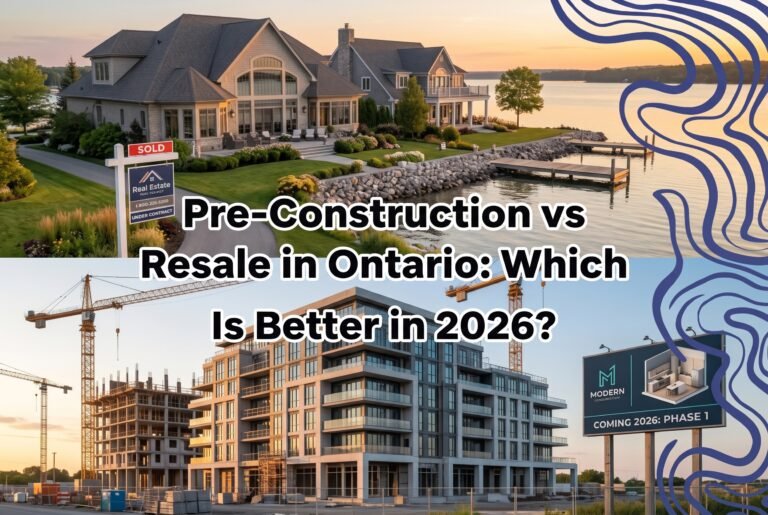
Pre-Construction vs Resale in Ontario: Which Is Better in 2026?
Updated October 4, 2026
If you’re planning to buy a home in Ontario, one of the biggest decisions isn’t simply where to buy.
It’s:
Should you buy pre-construction or resale?
In 2026, that question is more important than ever.
Ontario buyers currently have meaningful choices in both markets. Resale prices have adjusted from previous highs in many areas, while builders are responding to a slower new-home market with incentives, extended deposits, inventory homes and more competitive offers.
At the same time, qualifying buyers of brand-new homes may benefit from significant new HST relief that doesn’t apply in the same way to an ordinary resale purchase.
So which one is better?
Neither—automatically.
Pre-construction can be the stronger choice for one buyer, while resale may be clearly better for another.
The right answer depends on price, financing, deposits, closing timeline, condition, location, incentives, risk and your long-term plans.
This guide compares both options so you can make a more informed decision in today’s Ontario market.
What Is a Pre-Construction Home?
A pre-construction home is purchased directly from a builder before construction is complete.
Depending on the project, you may be buying:
From a floor plan before construction begins
While the home is under construction
Near completion
From completed builder inventory
Pre-construction can include:
Condominiums
Stacked townhomes
Condo townhouses
Freehold townhomes
Semi-detached homes
Detached homes
You enter into an Agreement of Purchase and Sale with the builder, pay deposits according to the builder’s schedule and complete the purchase when the home is ready.
What Is a Resale Home?
A resale home has already been owned—or at least previously completed—and is being sold by its current owner.
You normally:
View the actual property
Submit an offer
Negotiate price and conditions
Arrange financing
Conduct due diligence
Complete the purchase
Receive possession
The timeline is generally much shorter than traditional pre-construction.
The 2026 Market Makes This Comparison Particularly Important
Ontario’s housing market remains softer than during the peak years.
CMHC’s latest 2026 outlook expects historically weak sales conditions to continue in Ontario in the near term, while housing starts are also expected to decline as builders respond to softer demand, unsold inventory and high construction costs.
That creates opportunities on both sides of the market.
Resale buyers can potentially benefit from:
More listings in some areas
Negotiating opportunities
Price adjustments
Conditions in offers
Faster closings
New-home buyers may find:
Builder incentives
Promotional pricing
Extended deposits
Inventory homes
Mortgage incentives
Capped closing costs
HST relief
The strongest opportunity may therefore depend on the individual property—not whether the word “new” or “resale” appears on the listing.
Pre-Construction vs Resale: Quick Comparison
Factor | Pre-Construction | Resale |
Home condition | Brand new | Varies |
Closing timeline | Months to years | Usually much sooner |
Deposit | Often paid in stages | Usually paid shortly after offer acceptance |
Mortgage | Final financing closer to completion | Arranged around current purchase |
HST | Generally applicable, rebates may help | Usually no HST on ordinary resale price |
Warranty | Tarion coverage on qualifying new homes | No comparable new-home warranty |
Inspection | PDI plus warranty process | Home inspection may be condition of offer |
Customization | Often available | Renovation usually required |
Immediate repairs | Usually fewer | Depends on age/condition |
Builder incentives | Often available | Not applicable |
Price negotiation | Depends on builder/project | Negotiated with seller |
Closing certainty | Can change | Usually more predictable |
What you see | Often plans/renderings | Actual property |
Neighbourhood | May still be developing | Usually established |
Landscaping | May be incomplete | Often mature |
Market-value certainty | Greater future risk | Easier to assess today |
Let’s examine the differences more closely.
1. Purchase Price: Which Is Cheaper?
This is the first comparison most buyers make.
But there is no universal answer in 2026.
In some communities, builders are offering new homes at prices that compete closely with resale.
In other areas, resale properties may be considerably cheaper.
Suppose you’re comparing two townhomes.
Pre-Construction
Price:
$799,000
Includes:
New finishes
Appliances
Builder incentives
New-home warranty
Extended deposits
Resale
Price:
$749,000
Requires:
New flooring
Kitchen updates
Painting
Furnace replacement in several years
Which one costs less?
The resale property is $50,000 cheaper upfront.
But if you expect to spend $30,000–$40,000 updating it, the difference becomes much smaller.
Now reverse the situation.
If a resale home is:
$700,000
and the builder wants:
$825,000
the new home may be difficult to justify regardless of the incentives.
Compare actual homes—not categories.
2. Deposits Work Very Differently
This is one of the biggest differences.
Resale
A resale buyer normally pays a deposit shortly after the offer is accepted.
The deposit amount is negotiated as part of the offer.
The remainder of the down payment is provided at closing.
Pre-Construction
Builders typically establish their own deposit schedule.
You might see:
5%
8%
10%
15%
20%
paid over several months or years.
For example:
$10,000 on signing
then
Balance to 5% in 30 days
then
2.5% later
then
2.5% later
For buyers who need time to save, an extended pre-construction deposit structure can be a major advantage.
3. Pre-Construction Can Give You More Time to Save
Suppose you buy a new home scheduled for completion in 2028.
You may have nearly two years to:
Increase savings
Pay deposits
Reduce debt
Improve credit
Increase income
Prepare your current property for sale
With resale, you may have only 30–90 days before closing.
For buyers with strong income but limited current cash reserves, the longer timeline can make pre-construction attractive.
But there is a trade-off.
Your finances also have more time to change.
4. Resale Gives You More Certainty
With resale:
You can see what you’re buying.
You can inspect:
The actual rooms
Backyard
Street
Neighbours
Natural light
Parking
Basement
View
Noise
Condition
With traditional pre-construction, you may be making a decision from:
Renderings
Floor plans
Site plans
Model homes
Décor samples
The finished product should substantially follow the contractual specifications, but renderings are marketing representations rather than a substitute for seeing the completed property.
For buyers who value certainty, resale has a major advantage.
5. Pre-Construction Gives You a Brand-New Home
For many buyers, this is one of the biggest benefits.
With a new home, you may receive:
New roof
New furnace
New air conditioner where included
New plumbing
New electrical systems
New kitchen
New bathrooms
New windows
Modern insulation
Current design
New appliances where included
That usually means fewer immediate renovation and replacement expenses.
With an older resale home, some of these components may be approaching the end of their useful life.
6. Resale Can Offer Better Established Locations
One of resale’s biggest strengths is the neighbourhood.
Older communities often already have:
Schools
Parks
Mature trees
Transit
Shopping
Community centres
Established streets
Known traffic patterns
With a new community, some of those amenities may still be planned or under development.
A new neighbourhood can eventually become excellent.
But you’re sometimes buying the future vision of the community.
With resale, you can evaluate the community as it exists today.
7. New Homes Come With Tarion Warranty Protection
Qualifying new homes in Ontario come with statutory new-home warranty protection provided by the builder and backed by Tarion.
Coverage includes financial protection before possession and warranty coverage for specified construction defects after possession.
That can provide buyers with protection that doesn’t exist in the same way on an ordinary resale home.
With resale, after closing, most future repairs become the homeowner’s responsibility unless another contractual or manufacturer warranty happens to apply.
8. Resale Buyers Can Use a Home Inspection
A resale buyer may make their offer conditional on a satisfactory home inspection, depending on market conditions and the negotiation.
An inspector can examine areas such as:
Roof
Structure
Electrical
Plumbing
HVAC
Basement
Exterior
Moisture
An inspection can’t identify every hidden problem, but it can provide valuable information before the buyer becomes fully committed.
Pre-construction buyers instead rely more heavily on:
Builder specifications
Construction standards
Pre-Delivery Inspection
Tarion warranty process
9. Pre-Construction Buyers May Be Able to Customize
Depending on when you buy, you may have opportunities to select:
Flooring
Cabinets
Countertops
Tiles
Hardware
Plumbing fixtures
Electrical options
Structural modifications
Some low-rise projects may offer:
Main-floor bedrooms
Finished basements
Separate entrances
Additional bathrooms
Kitchen modifications
Resale buyers can renovate as well.
But you’re paying for the existing home first and then paying again to change it.
10. Don’t Overpay for Builder Upgrades
Customization is attractive—but it can become expensive quickly.
Builder décor-centre pricing may exceed the cost of completing certain cosmetic upgrades after closing.
Prioritize features that are:
Structural
Difficult to change later
Disruptive to retrofit
For example:
Adding electrical outlets during construction can make sense.
Paying a large builder premium for something easily replaced after possession may not.
11. HST Is a Major Difference in 2026
Ordinary resale residential purchases are generally not subject to HST on the purchase price.
Newly constructed homes generally are.
However, rebates can significantly change the calculation for qualifying new-home buyers.
Ontario’s temporary Enhanced New Housing Rebate currently applies to qualifying builder purchases under agreements entered into between:
April 1, 2026 and March 31, 2027.
Eligible purchasers can potentially recover up to:
$80,000
of the provincial portion of HST.
Qualifying first-time buyers may also receive up to:
$50,000
under the federal First-Time Home Buyers’ GST/HST Rebate on eligible new homes valued up to $1 million, with relief phased down between $1 million and $1.5 million.
This is a meaningful advantage that should be considered when comparing a new home with resale.
But government rebates should be calculated correctly and separately from builder incentives.
12. Never Compare Pre-Construction and Resale Using Sticker Price Alone
Suppose:
Resale Home
Price:
$800,000
New Home
Price:
$850,000
The resale home initially appears $50,000 cheaper.
But the builder includes:
$20,000 genuine price incentive
Appliances
Finished basement
Capped development charges
Applicable HST benefits for which the buyer qualifies
The comparison may become much closer.
Now imagine the builder price already incorporates applicable rebates and the “incentive” is mostly décor credit.
Then the resale property could still provide much better value.
You need to calculate:
Effective acquisition cost.
13. Builder Incentives Are a Major Pre-Construction Advantage in 2026
Because of today’s softer new-home market, some builders are offering incentives that weren’t commonly available during the peak.
Potential incentives include:
Direct price reductions
Extended deposits
Lower deposits
Décor credits
Appliances
Finished basements
Lot-premium discounts
Mortgage-rate subsidies
Capped development charges
Free assignments
Closing credits
These can meaningfully improve a deal.
But evaluate the real value, not the advertised value.
14. Resale Sellers Can Negotiate Too
Builders aren’t the only motivated sellers.
In a softer resale market, a homeowner may negotiate:
Purchase price
Closing date
Included appliances
Furniture
Repairs
Conditions
Depending on the property and market, a resale buyer might secure a significant discount from asking price.
This is another reason to compare both markets.
15. Closing Costs Can Be Different
Both resale and pre-construction buyers generally need to budget for:
Land transfer tax
Legal fees
Title insurance
Mortgage-related expenses
Property-tax adjustments
Pre-construction can include additional builder adjustments such as:
Development charges
Education levies
Utility charges
Meter charges
Condominium adjustments
Other APS-permitted expenses
That can make the new-home closing more complicated.
A builder offering capped development charges can therefore provide meaningful protection.
16. Resale Closing Costs Are Often Easier to Predict
Because the property already exists, many resale transaction costs can be estimated reasonably early.
Builder transactions may close years after signing.
Some costs can change before completion.
This is why lawyer review is particularly important with pre-construction.
Ask your lawyer:
Which charges are capped?
Which are uncapped?
How is HST handled?
What can the builder adjust?
What additional amounts should you budget?
17. Closing Timeline: Immediate vs Future
This can make the decision easy for some buyers.
Resale
You may be able to close in:
30, 60 or 90 days, depending on what is negotiated.
Pre-Construction
Closing could be:
Several months away
One year away
Two years away
Three years or more away
Some buyers want time.
Others want certainty.
18. Construction Delays Are a Pre-Construction Risk
The estimated closing date in a builder agreement may change.
Construction can be affected by:
Approvals
Infrastructure
Labour
Materials
Financing
Weather
Other development conditions
Tarion provides a framework for closing or occupancy dates and certain delayed-closing protections, but that doesn’t mean every original estimated date is guaranteed.
If you need to move by a specific date, resale or completed inventory may be more suitable.
19. Resale Usually Has Less Appraisal Timing Risk
Consider a pre-construction purchase today that closes in 2029.
The lender may appraise the property shortly before closing.
If the home’s value is below the contract price at that time, the lender may provide less financing than you expected.
You could need more cash.
With resale, the purchase and appraisal generally occur within the same current market environment.
That reduces the length of time during which market values can change before closing.
20. Financing Is More Predictable With Resale
With resale, mortgage qualification happens relatively close to the purchase.
With pre-construction, a buyer might sign in 2026 and close in 2028 or 2029.
During that period:
Employment can change
Income can change
Debt can increase
Credit can change
Mortgage rules can change
Property values can change
A mortgage pre-approval today doesn’t guarantee financing years later.
This is an important pre-construction risk.
21. But New-Build Buyers Have Attractive Mortgage Options
Current federal mortgage rules allow eligible insured financing on homes valued below $1.5 million.
Qualifying buyers of new-build homes may also access insured mortgages with amortizations of up to 30 years.
CMHC reports that newer insured-mortgage eligibility rules have increased insured mortgage activity among first-time and new-home buyers.
The longer amortization can reduce monthly payments, although it generally increases total interest paid over time.
22. Maintenance Costs: New vs Older Home
A newly built home generally shouldn’t require immediate replacement of major components.
An older resale property might eventually need:
Roof
Furnace
Air conditioner
Windows
Plumbing work
Electrical work
Driveway
Kitchen
Bathrooms
This does not make every resale home expensive.
A well-maintained older home can be an excellent purchase.
But buyers should include expected maintenance and renovation costs in their comparison.
23. Resale Has Mature Landscaping
This sounds minor until you move into a new subdivision.
A new home may initially have:
Young trees
Limited shade
Construction nearby
Unfinished neighbouring lots
Temporary roads
Ongoing dust and noise
An established resale neighbourhood may already have:
Mature trees
Finished parks
Established yards
Fences
Decks
Landscaping
Those features have real lifestyle value.
24. Pre-Construction Can Offer More Energy-Efficient Construction
Newer Ontario homes are constructed to current building requirements.
Depending on the builder and home, you may benefit from:
Modern insulation
New windows
Efficient HVAC
Smart-home systems
Efficient appliances
An older resale home may have higher utility consumption unless it has been updated.
However, don’t assume every new home will automatically have dramatically lower carrying costs.
Ask for the specifications.
25. Condo Buyers Need to Consider Interim Occupancy
Pre-construction condominiums have an additional consideration that resale condos generally don’t:
Interim occupancy.
Your unit may be ready before the condominium corporation is registered.
During this period:
You may move in
You do not yet have title
Your traditional mortgage usually hasn’t funded
You pay occupancy fees to the builder
Final closing happens later.
This needs to be included in your financial planning.
26. Resale Condo Fees Are Easier to Evaluate
When buying an existing condominium, you can examine:
Current maintenance fees
Status certificate
Reserve fund
Building budget
Existing amenities
Past increases
With pre-construction, the initial maintenance fee is estimated.
Actual future operating costs can differ after the corporation becomes established.
27. Which Is Better for First-Time Buyers?
There is no universal answer.
Pre-construction may appeal because of:
Extended deposits
More time to save
Brand-new condition
Warranty
HST relief
30-year insured amortization eligibility for qualifying new builds
Resale may appeal because of:
Faster possession
More certainty
Ability to inspect the actual home
Established communities
Easier appraisal comparison
No builder construction delay
First-time buyers should compare both.
28. Which Is Better for Families?
Families may appreciate new construction when it offers:
Larger modern layouts
Upstairs laundry
Main-floor offices
In-law options
Finished basements
Backyards
New schools and parks planned nearby
But established resale neighbourhoods may offer immediate access to:
Existing schools
Transit
Mature parks
Community centres
Known neighbourhood character
Lifestyle should be part of the financial decision.
29. Which Is Better for Investors?
Investors need to be particularly disciplined in 2026.
Pre-construction may offer:
Long closing
Staggered deposits
New product
Assignment options where permitted
But it also introduces:
Market-value risk
Appraisal risk
Assignment restrictions
HST considerations
Project delays
Resale investment property provides more immediate information about:
Rent
Expenses
Condo fees
Taxes
Current market value
An investor shouldn’t choose pre-construction simply because they expect appreciation before closing.
The investment should work under realistic assumptions.
30. What About Builder Inventory Homes?
There is actually a third option between traditional pre-construction and resale:
Builder inventory.
These are new homes that may already be:
Under construction
Nearly complete
Fully completed
Available for quick closing
Inventory homes can combine advantages of both markets.
You may receive:
Brand-new construction
Tarion protection
Faster closing
Ability to see the actual home
Builder incentives
while avoiding a multi-year construction wait.
In today’s market, inventory homes are particularly worth comparing.
Pre-Construction May Be Better If…
Consider pre-construction if you:
Prefer a brand-new home
Can wait for completion
Want time to save
Value builder warranty
Want design selections
Find attractive builder incentives
Qualify for meaningful new-home HST relief
Have stable finances
Can tolerate market fluctuations
Plan to hold the property long term
Resale May Be Better If…
Consider resale if you:
Need to move soon
Want to inspect the exact property
Want certainty around closing
Prefer an established neighbourhood
Want mature landscaping
Find better resale value
Don’t want construction delays
Want more certainty around mortgage appraisal
Prefer to negotiate directly against today’s market
Example: Pre-Construction vs Resale Townhome
Suppose you’re buying in an Ontario suburb.
Resale Townhome
Price:
$750,000
Features:
8 years old
Finished basement
Existing landscaping
Immediate possession
Some cosmetic updating needed
New Townhome
Price:
$790,000
Includes:
New construction
Appliances
Builder warranty
Extended deposit
Capped development charges
Potential HST benefits for qualifying buyer
Difference:
$40,000
Is the new home worth $40,000 more?
Potentially.
But now suppose the resale home is:
$690,000.
The comparison changes dramatically.
There is no formula that says:
New = better
or
Resale = better.
Compare the actual numbers.
Use This Formula to Compare Them
For pre-construction:
Builder Purchase Price
− Genuine Builder Discounts
− Government Rebates You Qualify For
Builder Closing Adjustments
Necessary Upgrades
Land Transfer Tax
Legal/Closing Costs
= Effective New-Home Cost
For resale:
Purchase Price
Immediate Renovations
Expected Major Repairs
Land Transfer Tax
Legal/Closing Costs
= Effective Resale Cost
Then compare monthly ownership costs.
That gives you a much more meaningful answer than comparing two listing prices.
10 Questions to Ask Before Choosing
Before deciding between pre-construction and resale, ask yourself:
Which property offers better value today?
How soon do I need to move?
How much deposit can I comfortably commit?
Do I qualify for new-home HST relief?
How much will the new home cost at closing?
Does the resale home need renovations?
How stable is my future mortgage qualification?
How important is warranty coverage?
How much uncertainty am I comfortable accepting?
Which home would I still be happy owning if prices didn’t rise for several years?
The last question is particularly valuable.
Frequently Asked Questions
Is pre-construction cheaper than resale in Ontario in 2026?
Sometimes, but not always. Current builder incentives and HST relief can make some new homes highly competitive, while softer resale prices can make existing homes attractive as well. Compare the effective total cost of individual properties.
Is resale safer than pre-construction?
Resale generally provides more certainty regarding the exact property, current market value and closing date. Pre-construction offers warranty and new-home advantages but introduces construction, financing and appraisal risks.
Do you pay HST on resale homes?
Ordinary resale residential homes are generally not subject to HST on the purchase price. Newly constructed homes generally are, although qualifying buyers may benefit from applicable housing rebates.
Do new homes have a warranty?
Qualifying newly built Ontario homes come with statutory warranty protection provided by the builder and backed by Tarion.
Can you negotiate with a builder?
Sometimes. Builders may negotiate through pricing, upgrades, deposit flexibility, lot premiums, closing credits or other incentives. Policies vary by builder and project.
Can you negotiate more on resale?
Resale pricing is negotiated directly between buyer and seller. The amount of flexibility depends on competition, property condition, seller motivation and local market conditions.
Is a builder inventory home considered pre-construction?
It is new construction sold by the builder, but it may already be under construction or complete. Inventory homes can provide an attractive alternative to both early-stage pre-construction and resale.
Which is better for a first-time buyer?
It depends on finances and priorities. New homes may offer extended deposits, HST relief and warranty protection, while resale offers more certainty and potentially faster possession.
The Bottom Line: Pre-Construction or Resale in 2026?
The answer isn’t:
Pre-construction.
And it isn’t:
Resale.
The answer is:
Whichever property gives you the best combination of value, affordability, lifestyle and manageable risk.
In 2026, buyers have an unusual opportunity to shop both markets.
Pre-construction buyers may benefit from:
Builder incentives
Extended deposits
Brand-new homes
Tarion warranty
HST relief
More financing flexibility for qualifying new builds
Resale buyers may benefit from:
Softer pricing
Negotiating opportunities
Immediate possession
Established communities
Greater closing certainty
Ability to inspect the actual property
The mistake is deciding:
“I only want pre-construction.”
or:
“I only want resale.”
before comparing what’s actually available.
A stronger approach is:
Set your budget → identify your preferred area → compare the best new and resale opportunities → calculate the true cost → choose the property that makes the most sense.
Not Sure Whether Pre-Construction or Resale Is Better for You?
At New Home Source, we work with buyers across both pre-construction and resale real estate.
That means we can help you compare your options rather than automatically pushing you toward one type of property.
Tell us your:
Budget + Preferred Location + Home Type + Closing Timeline
and we can help you compare:
Current pre-construction projects
Builder inventory homes
Quick-closing new homes
Current builder incentives
Resale properties
Deposit requirements
Potential HST rebate opportunities
Townhomes
Semi-detached homes
Detached homes
Contact New Home Source to compare current pre-construction and resale opportunities and find the option that makes the most sense for you.
Disclaimer: This article is provided for general informational and real-estate marketing purposes only and does not constitute legal, tax, mortgage, financial or investment advice. Real-estate conditions, builder incentives, government programs and financing requirements can change. Buyers should obtain independent legal, mortgage, home-inspection and tax advice where appropriate before entering into an Agreement of Purchase and Sale.
You Might Also Like
Pre-Construction vs Resale in Ontario: Which Is Better in 2026? Updated October 4, 2026 If you’re planning to buy a...
How to Compare Two Pre-Construction Projects Before You Buy Updated November 23, 2026 You’ve narrowed your search down to two...
Interim Occupancy Explained: Why Condo Buyers Pay Before They Own the Unit Updated November 19, 2026 You’ve purchased a pre-construction...